The air in Washington smells of old rain, hot asphalt, and the invisible hum of a thousand silent alarms.
It is a city built on paper. Every block holds a monument, a statute, an archive meant to keep the chaos of human nature neatly bound between leather covers. But sometimes the chaos refuses to stay put. Sometimes it rolls down Constitution Avenue in the bed of a tired pickup truck, bolted to a wooden frame that belongs to another century entirely.
Imagine standing on the sidewalk near the Capitol dome on a Tuesday morning. The light is pale. Commuters shuffle past with cardboard cups of coffee, eyes glued to glowing rectangles. Sirens wail in the distance—white noise to anyone who lives inside the beltway.
Then comes the truck.
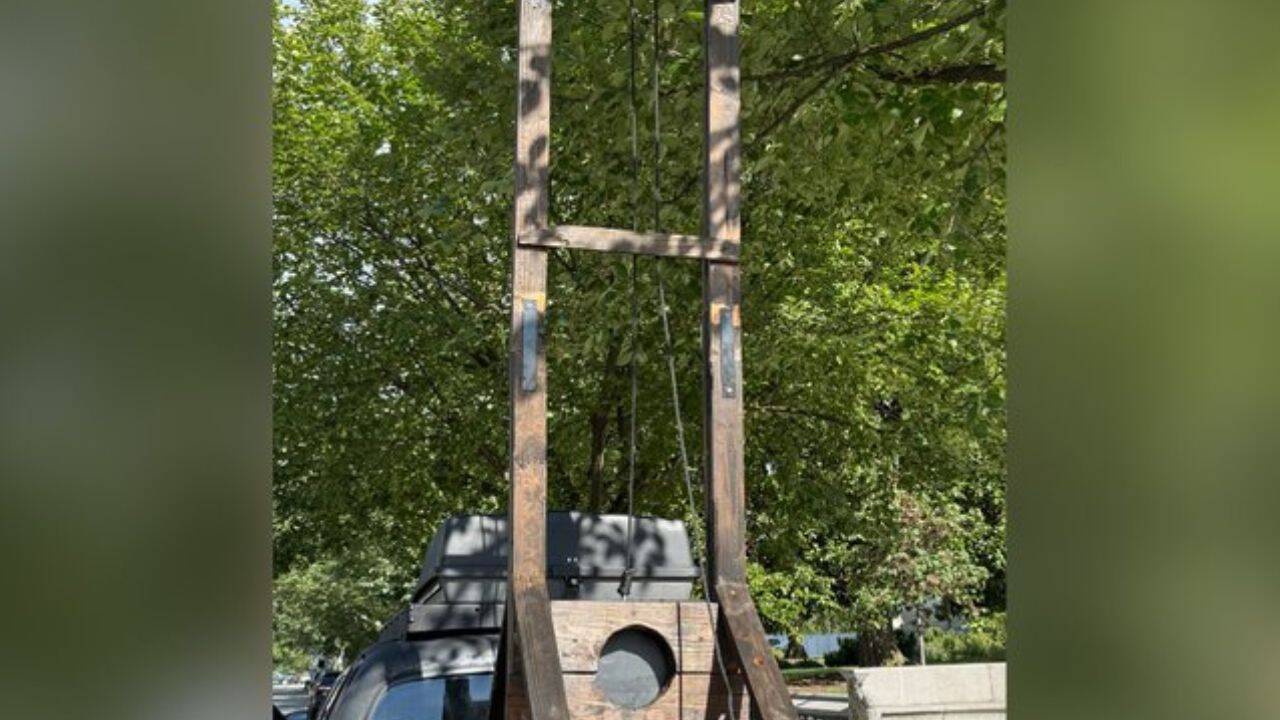
It is not an armored car. It is not a sleek prototype of the future. It is a domestic vehicle, carrying a heavy piece of historical theater. A blade. Suspended upright, gleaming with an oily, indifferent shine.
History has a strange way of recycling its props.
Michael DiFiore knew what he was carrying. Or perhaps, in the way that people consumed by personal grievances often lose the plot of reality, he thought he was carrying an argument. The United States Capitol rises against the gray sky like a marble promise. Inside, men and women debate taxes, wars, and the shape of tomorrow. Outside, a man from Poughkeepsie brought a machine designed to sever the human neck cleanly, swiftly, and with absolute finality.
Why?
The question hangs in the heavy D.C. air like woodsmoke. Was it a protest? A symbol meant to startle the slumbering guardians of the republic? A desperate, theatrical cry into an unlistening void?
When the Capitol Police stepped forward, weapons drawn, shouting commands that cut through the morning traffic, the confrontation lacked the grandeur of an epic clash. It was messy. It was small. A man in a baseball cap stepping out of a cab. Steel meeting cold autumn air.
We live in an age where symbolism has become untethered from consequence. People treat digital platforms like colosseums, hurling digital stones and cheering for virtual destruction. But physical space has a stubborn gravity. When you haul a 300-pound wooden execution device within shouting distance of the legislative heart of the free world, the metaphor breaks. The shadow becomes heavy.
Consider the mechanics of the object itself. The French Enlightenment produced it as an instrument of egalitarian execution—a grim, mechanical equalizer designed to replace the messy sword of the aristocrat with the efficient drop of the state. It was supposed to be humane. Think about that grotesque irony. Humanity wrapped in oak and iron, sliding down a greased groove.
To drag that artifact into the shadow of a building dedicated to constitutional law is to misunderstand the entire architecture of American governance. Law is not forged by the drop of a blade. It is hammered out in endless, tedious, soul-crushing committee meetings. It is shaped by amendments, footnotes, filibusters, and the slow, grinding machinery of compromise.
The guillotine represents a full stop. Democracy is an eternal comma.
When the police pulled DiFiore from the vehicle and secured the instrument, the drama evaporated as quickly as it had gathered. No blood was spilled. No dramatic speeches echoed across the National Mall. Just the mundane clicking of handcuffs, the shuffling of boots on gravel, and the towing of a pickup truck bearing a very strange load to an impound lot.
Yet the image lingers.
It lingers because it taps into a subterranean current of modern anxiety. Beneath the polished veneer of institutions, there is a growing, itchy dread that the social contract is fraying at the edges. People feel unheard. People feel invisible. And invisibility makes men do loud, terrible things to ensure they are looked at, even if only through the lens of a mugshot or a breaking news alert.
The truck is gone. The blade is in an evidence locker, tagged and cataloged by technicians who have seen stranger things than a miniature scaffold in a Ford F-150. The Capitol dome still gleams in the afternoon sun, indifferent to the theater played out at its doorstep.
We walk past the same corners tomorrow. We buy our coffee. We check our phones. But somewhere beneath the noise, the iron waits, reminding us how thin the line is between the rule of law and the dark theatre of the drop.