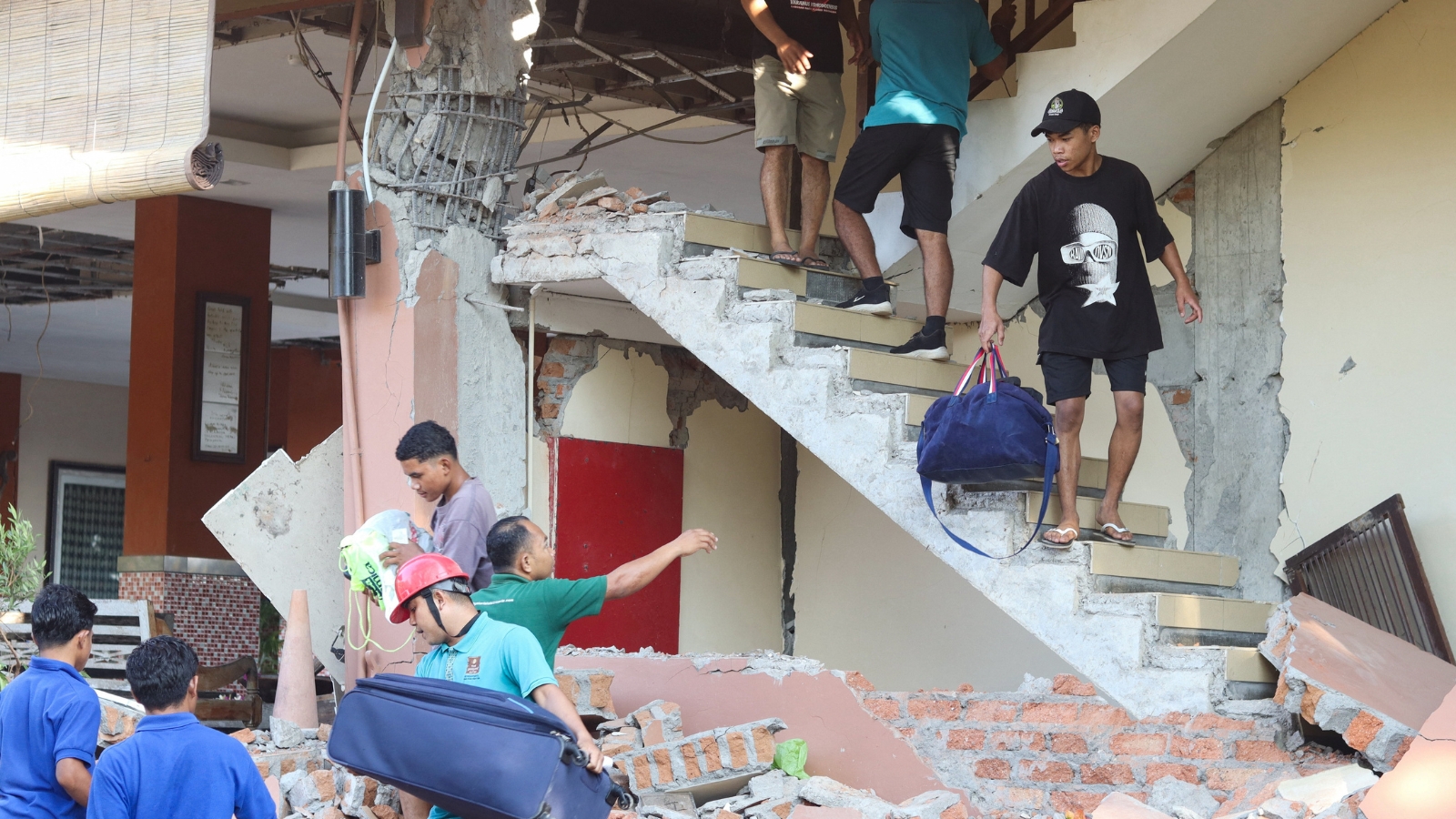
Clusters of high-magnitude seismic events across Indonesia, Colombia, and Venezuela regularly provoke media panic regarding whether the Pacific Ring of Fire is awakening. This binary narrative misinterprets basic geodynamics. The Earth does not operate as a synchronized circuit breaker that flips on and off. Instead, the circum-Pacific seismic belt is a fragmented mosaic of distinct tectonic boundaries operating under independent strain accumulation rates. Evaluating global seismicity requires replacing sensationalist timelines with strict stress-transfer mechanics, fault typology, and failure criteria.
The Structural Anatomy Of Tectonic Fragmentation
The primary analytical error in public commentary is treating the Ring of Fire as a single structural entity. It is not a continuous fault line. It is a 40,000-kilometer horseshoe-shaped perimeter composed of multiple independent plate interfaces.
These boundaries fall into three distinct mechanical categories:
- Subduction zones, where dense oceanic lithosphere descends beneath lighter continental or oceanic plates, locking at the interface until accumulated elastic strain exceeds frictional resistance.
- Transform boundaries, where plates slide horizontally past one another, generating high shear stress without vertical displacement.
- Intra-slab deformation zones, where fracturing occurs deep within the interior of a subducting slab due to bending and thermal stresses.
The recent major tremors—ranging from the megathrust rupture near Flores, Indonesia, to the strike-slip events in South America—stem from entirely separate tectonic subsystems. A slip on a strike-slip fault in northern South America does not mechanically load a subduction interface in Southeast Asia. Conflating these disparate events into a single regional "awakening" ignores the spatial attenuation of stress fields, which decay rapidly over distances greater than a few fault lengths.
Stress Transfer Mechanics And The Independence Of Seismicity
To understand why simultaneous high-magnitude events occur without a centralized trigger, one must examine the Coulomb Failure Stress change equation. When a major earthquake occurs, it perturbs the stress field in the immediate surrounding volume of crust. This perturbation can accelerate or delay the failure of adjacent fault segments, but this influence is strictly localized.
Static stress changes diminish with the cube of distance ($1/r^3$). Consequently, stress transfer is practically negligible beyond a few hundred kilometers, let alone across entire ocean basins.
The appearance of clustering is a statistical artifact of a high-rate global baseline. Approximately 81 percent of the planet's largest earthquakes occur along this circum-Pacific belt. Given that hundreds of thousands of earthquakes occur globally every year—the vast majority micro-seismic—random temporal clustering of high-magnitude events is mathematically inevitable. Human pattern recognition forces causal narratives onto independent stochastic events.
Quantifying Structural Vulnerability Versus Seismic Energy
Public discourse fixates on moment magnitude ($M_w$) as the primary metric of disaster severity. This is an analytical mistake. Seismic risk is a function of three distinct variables: energy release, coupling depth, and the built environment's mechanical impedance.
$$\text{Risk} = \text{Hazard} \times \text{Exposure} \times \text{Vulnerability}$$
A deep intra-slab earthquake of magnitude 6.5 occurring kilometers beneath the surface dissipates its energy before reaching infrastructure, minimizing surface displacement. Conversely, a shallow crustal strike-slip earthquake or a shallow megathrust rupture forces high peak ground acceleration directly into surface assets.
The catastrophic loss of life and capital in regional events is rarely an indicator of an unprecedented geophysical anomaly. Rather, it exposes a structural deficit in local engineering standards, building stock ductility, and rapid-response logistics. Landslides isolating remote mountain communities in Colombia or destroying infrastructure in Flores are engineering and logistical failures, not direct metrics of tectonic hyperactivity.
Operational Forecasts For Structural Resilience
Resource allocation for seismic risk mitigation must abandon predictive seismology—which remains scientifically incapable of forecasting the exact timing of individual earthquakes—and pivot entirely to vulnerability reduction.
Emergency management agencies and municipal planners must execute three operational shifts:
- Enforce strict structural performance standards for non-ductile concrete buildings, which account for the vast majority of collapse-related fatalities during high-magnitude ground shaking.
- Decentralize emergency medical supplies and heavy excavation equipment outside primary urban hazard zones to prevent supply chain bottlenecks caused by post-earthquake bridge and road failures.
- Integrate real-time strong-motion sensor networks to trigger automated shutdowns of critical infrastructure—such as regional power grids, gas pipelines, and high-speed transit—within seconds of initial P-wave detection, mitigating secondary disaster cascades.