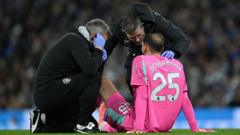
The grass smells different in the eighty-ninth minute. It is heavy with sweat, churned earth, and the distinct, copper tang of adrenaline. Your calves are iron bars. Your lungs burn with every microscopic intake of autumn air. You are a goalkeeper clinging to a single-goal lead, and the stadium is a roaring, suffocating ocean threatening to swallow you whole.
Then, the script fractures.
A teammate goes down. An ankle twist. Nothing catastrophic, but enough to halt the frantic heartbeat of the match. The referee blows the whistle. Relief washes over your aching muscles. You walk toward the edge of your six-yard box, hands on knees, sucking in oxygen.
Except the manager is not yelling tactical adjustments anymore.
Instead, a clipboard arrives. A quick conversation happens in the technical area. The goalkeeper coach gestures frantically. For thirty seconds, sixty seconds, sometimes longer, the chaos of the pitch freezes. It is a tactical timeout. A manufactured pause in a game designed to be an unbroken river of momentum.
You have felt this shift if you have ever stood between the posts while a match slips away. You know the exact weight of that pause.
English football has just decided to put an end to it.
The announcement slipped into the news cycle with the quiet dignity of a routine administrative update, but it marks a seismic shift in how the sport is played, managed, and weaponized. The English football authorities have agreed to trial a crackdown on goalkeeper tactical timeouts, aiming to strip away the manufactured delays that have turned the dying moments of tight matches into theatrical masterclasses in stalling.
To understand why this matters, you must understand the dark art of the modern stoppage.
Imagine standing in a packed arena where forty thousand people are screaming obscenities at your back. Every second ticks like a falling guillotine. Your team is winning one-nil. The opposition is swarming like hornets. Suddenly, your goalkeeper drops to the turf. He clutches his shoulder. He signals to the bench.
The physio jogs out. The game stops.
This is not medical care in the traditional sense; it is a psychological pressure valve. It allows the entire defensive block to catch their breath, recalibrate their shape, and drain the opponent's momentum like pulling a plug from a full bathtub. It is clever. It is cynical. It is entirely legal—until now.
Football has always danced on the razor-thin line between gamesmanship and integrity. We romanticize the dark arts when our team wins, and we scream for blood when it happens to us. But the sheer frequency of these faux-injuries had reached a tipping point. Matches were fracturing. The natural rhythm of the beautiful game was being traded for bureaucratic interruptions disguised as medical emergencies.
The trial agreed upon by English football governing bodies introduces strict protocols. If a goalkeeper goes down requiring treatment, they may be forced to leave the field for a designated period, or independent match officials will scrutinize the legitimacy of the stoppage with unprecedented severity. The message is absolute. Play the game, or step aside.
Skeptics call it heavy-handed. They argue that player welfare must come first, that forcing a potentially injured goalkeeper off the pitch creates dangerous risks.
They are right to be cautious. Safety is paramount.
Yet, the distinction between a genuine concussion or torn ligament and a tactical breather is usually as clear as day to anyone who has spent ten minutes on a muddy pitch. A player in agony does not check the scoreboard while clutching the wrong ankle. A team buying time moves with the deliberate, agonizing slowness of actors on a stage.
Football is fundamentally a continuous sport. Unlike American football or basketball, which rely on stop-start clocks and tactical timeouts embedded in the rulebook, soccer derives its hypnotic beauty from its unbroken flow. It is a canvas painted in real-time, where mistakes happen because exhaustion clouds the mind, and brilliance emerges because players find a way through the suffering.
When you introduce artificial pauses, you alter the chemistry of the contest.
Consider what happens next weekend on pitches across the country.
A team clinging to a lead faces a corner kick in the ninety-fourth minute. The pressure is absolute. In the past, the goalkeeper might have dropped to the turf to kill the noise, reset the defensive line, and let the referee’s watch bleed out. Now, that escape hatch vanishes.
The goalkeeper must stand tall. The defenders must communicate without a three-minute huddle. They must face the music.
This trial is not merely about time-wasting or technicalities. It is about the soul of the sport. It asks a fundamental question: Do we want a game defined by cinematic pauses and tactical loopholes, or do we want a game driven by raw, unvarnished endurance?
When the whistle blows and the ball rolls again without the safety net of a manufactured timeout, the game will feel naked. Unprotected.
And it will be magnificent.
The players know it. The managers pacing the technical area know it. And as you stand in the goalmouth, wiping the sweat from your eyes with a mud-caked glove, you realize there is nowhere left to hide.
Just the grass, the ball, and the ticking clock.