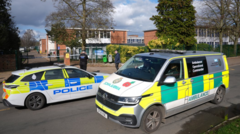
Schools aren't safe enough. We tell ourselves they are because we do the drills, we buy the brightly colored vests, and we hang the laminated maps by the door. But when a real crisis hits—whether it's a flash flood, an intruder, or a chemical leak at a nearby factory—those laminated maps don't do much. Most school response plans are too rigid. They’re built for a predictable world that doesn't exist anymore.
If you're a parent or an administrator, you need to stop thinking about "compliance" and start thinking about "adaptability." Compliance is checking a box for the state fire marshal. Adaptability is knowing what to do when the fire exit is blocked by smoke and the Wi-Fi goes down. Most schools fail because they prioritize the former over the latter. For a different look, check out: this related article.
How should schools respond in emergency situations? They should respond with decentralized authority. That’s the hard truth nobody wants to talk about. You can’t wait for a central command to give an order when seconds are the difference between safety and catastrophe.
The Myth of the Perfect Lockdown
We’ve obsessed over lockdowns for twenty years. While they have a place, the hyper-focus on one specific type of threat has left schools vulnerable to everything else. I've seen districts that can execute a silent lockdown in ninety seconds but have no idea how to handle a massive gas leak during a varsity football game. Similar reporting on this trend has been provided by Refinery29.
Real emergency response requires a "multi-hazard" mindset. This isn't just a buzzword. It means your response shouldn't change based on what is happening, but based on where the danger is.
Standard Response Protocols (SRP) developed by organizations like the I Love U Guys Foundation are a step in the right direction. They use clear, plain language: Hold, Secure, Lockdown, Evacuate, Shelter. No codes. No "Code Red" or "Condition Blue" nonsense that teachers forget the moment their adrenaline spikes. If you have to look at a cheat sheet to remember what a color means, the system is broken.
Communication is Always the First Point of Failure
Every after-action report from major school incidents says the same thing. The radios didn't work. The cell towers were overloaded. The intercom was inaudible in the gym.
You can’t rely on a single channel. Schools need redundant communication layers. This includes:
- Internal PA systems that are tested weekly, not annually.
- Peer-to-peer mesh networks or dedicated radio frequencies for staff.
- External notification systems that can push alerts to parents without crashing.
But here’s the thing. Even with the best tech, the message itself is usually the problem. In a crisis, people lose about 80% of their ability to process information. You don't send a paragraph. You send three words. "Evacuate to Site B." That’s it.
Why the Front Office Shouldn't Be in Charge
In many schools, the principal or the front office staff are the designated "commanders." This is a mistake. What happens if the incident starts in the front office?
Modern safety experts advocate for a distributed leadership model. Every teacher should be empowered to call a lockdown or an evacuation if they see a threat. Waiting for a "verified" announcement from the office wastes time. Empowerment saves lives. If a teacher sees a fire, they pull the alarm. If they see a weapon, they should be able to trigger the alert for the whole school immediately.
The Psychological Toll of Drills
We are traumatizing kids for no reason. High-intensity "active shooter" drills with fake blood and blanks are widely criticized by the National Association of School Psychologists. There is zero evidence that these "realistic" simulations make kids safer. They just make them anxious.
Response training should be for the adults. For the students, it should be about muscle memory and calm. You don't need a masked actor to teach a six-year-old how to get away from a window. You just need practice.
The goal is "procedural fluency." It should be as boring and routine as a chemistry lab. When the real thing happens, that routine is the only thing that keeps the panic at bay.
Digital Security is Physical Security
In 2026, an emergency isn't always someone walking through the front door. Ransomware attacks on school districts have tripled in the last few years. When a school's digital infrastructure is hijacked, the HVAC systems can be shut down, door locks can be glitched, and student records can be wiped.
A school that can't access its digital "go-bags"—the lists of students with severe allergies or emergency contact numbers—is a school in crisis. Response plans must include an offline, physical backup of critical data that is updated every single Friday.
Reunification is the Messiest Part
Everyone plans for the event. Almost nobody plans for the three hours after the event.
Picture this. You’ve successfully evacuated 800 kids to a nearby church. Within twenty minutes, 1,200 panicked parents have descended on that church. They’re double-parking, blocking ambulances, and screaming for their children.
If you don't have a formal reunification process, you’ve just traded one crisis for another. You need a "Gatekeeper" system.
- Greeting Area: Parents are met and given paperwork.
- Verification Area: IDs are checked against student records.
- Recovery Area: Students are brought to parents.
Never, ever just let kids run to their parents in a parking lot. It’s a liability nightmare and a massive safety risk. You need a paper trail to ensure every child is accounted for and handed to a verified guardian.
Beyond the "Run, Hide, Fight" Cliché
The FBI’s "Run, Hide, Fight" is fine for adults in an office. It’s often insufficient for a teacher responsible for thirty children.
A better approach is "ALICE" (Alert, Lockdown, Inform, Counter, Evacuate). It provides more options. It acknowledges that sitting in a corner like a "sitting duck" is sometimes the worst thing you can do. If there’s an exit ten feet away, use it. Don't stay in the room just because the "lockdown" rules say so.
Schools need to stop teaching blind obedience to rules and start teaching situational awareness.
The Role of Local Law Enforcement
Your school resource officer (SRO) shouldn't be the only person who knows the building. Local police departments should have digital blueprints and 360-degree photos of every hallway in their patrol laptops.
Invite the fire department to do their drills on your campus during summer break. Let them see the weird quirks of the boiler room. The time for a first responder to learn your floor plan is not when the building is full of smoke.
Stop Ignoring the "Soft" Signs
Most school emergencies have a "leakage" phase. According to Secret Service studies, in almost every school shooting, at least one other person knew about the plan beforehand.
A school’s best response to an emergency is preventing it. This requires a robust Threat Assessment Team. This isn't about "profiling" kids. It’s about identifying students who are in distress and getting them resources before they reach a breaking point.
If your school spends $50,000 on new security cameras but $0 on mental health counseling, you aren't actually making the school safer. You’re just buying a better view of the tragedy.
Hardening the Perimeter Without Making it a Prison
There’s a balance. You want "Crime Prevention Through Environmental Design" (CPTED).
- Natural Surveillance: Make sure the front office can see the parking lot clearly.
- Access Control: One single point of entry during school hours.
- Territorial Reinforcement: Clear boundaries that signal where "public" space ends and "school" space begins.
Magnetic locks that can be triggered by a single button are the gold standard. So are "shatter-resistant" films on glass entries. These don't make the school look like a fortress, but they buy those precious extra minutes for law enforcement to arrive.
Immediate Action Steps for Administrators
Stop reading and start doing. Here’s what matters right now.
Audit your PA system this afternoon. Go to the furthest corner of the playground and see if you can hear the "Evacuate" command. If you can’t, your plan is already broken.
Schedule a meeting with local EMS to discuss "Stop the Bleed" training for all staff. In many emergencies, the "first" first responders are the teachers. Having tourniquets in every classroom and the knowledge to use them is more important than having a fancy security camera in the hallway.
Review your "Go-Bags." Every classroom needs a physical bag with a first aid kit, a flashlight, a whistle, and a current class roster. If those rosters are from last semester, throw them out and print new ones today.
Finally, talk to your students. Ask them where they feel unsafe. They know the blind spots in your security better than any consultant ever will. Listen to them.