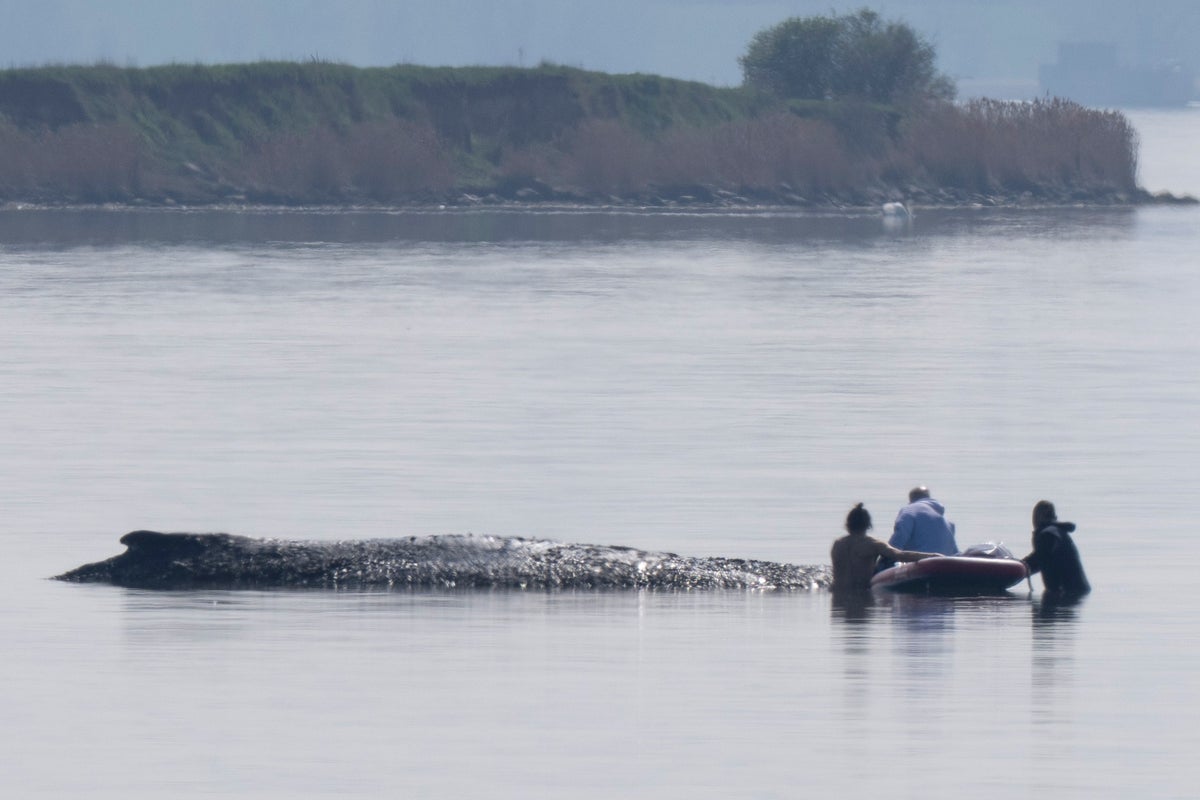
The water in the Baltic Sea isn't right. If you were to dip a finger in and taste it, you’d notice the difference immediately. It lacks the sharp, aggressive sting of the Atlantic. It is brackish—a watery compromise between the salt of the ocean and the runoff of European rivers. For a human swimmer, it’s refreshing. For a fifteen-meter-long humpback whale, it is a slow-motion catastrophe.
They call him Timmy. It’s a friendly name, the kind of name you give a neighbor’s kid or a golden retriever. But as the sun glints off a dark, arching back near the German coastline, the name feels increasingly like an epitaph. Timmy is lost. He is an apex wanderer who took a wrong turn at the Skagerrak strait, and now he is trapped in a bathtub of low-sodium water that is gradually failing him.
To understand why this matters, you have to stop looking at the whale as a biological curiosity and start looking at him as a mirror. We are watching a creature realize, in real-time, that his world has shrunk to the size of a cage he cannot see.
The Wrong Turn
Whales navigate by a combination of bathymetry, magnetic fields, and ancient, inherited memory. Usually, the humpback migration is a miracle of precision. They move from the freezing, nutrient-rich waters of the north to the warm breeding grounds of the south with the reliability of a Swiss watch. But sometimes, the gears slip. A solar flare interferes with magnetic sensing, or a young male, fueled by curiosity or a faulty internal compass, follows a school of herring into the narrow gap between Denmark and Sweden.
Once a humpback enters the Baltic, the countdown begins.
The Baltic is a "shelf sea." It is shallow. Its average depth is only about 55 meters. For a creature designed to dive into the crushing, cold depths of the abyssal plain, the Baltic feels claustrophobic. It is a labyrinth of shipping lanes, offshore wind farms, and recreational boat traffic. Imagine trying to find your way out of a dark, crowded basement while someone plays heavy metal music at a deafening volume. That is Timmy’s current reality. The sonar pings and engine hums of thousands of vessels create a wall of acoustic "fog" that makes it nearly impossible for him to find the exit.
The Invisible Hunger
The most pressing threat isn't the traffic, though. It’s the menu.
Humpbacks are gulpers. They utilize massive plates of baleen to filter thousands of pounds of krill and small fish from the water every single day. In the Atlantic, this is a feast. In the Baltic, the ecosystem is different. The fish are smaller, the caloric density is lower, and the sheer volume of food required to sustain a thirty-ton mammal simply isn't there.
Every time Timmy breaches—a sight that brings cheers from tourists on the shore—he is burning through his life insurance. That "insurance" is his blubber. It is a thick layer of fat that serves as both a thermal blanket and a fuel tank. In the low-salinity water of the Baltic, Timmy has to work harder just to stay buoyant. Salt water is dense; it pushes you up. Fresh or brackish water is "thinner." He is swimming harder, burning more fuel, and finding almost nothing to replace it.
He is starving in a scenic landscape.
The Human Spectacle
On the beaches of Rügen and the piers of Poland, people gather with binoculars. There is a strange, paradoxical energy in these crowds. On one hand, there is the thrill of seeing something ancient and majestic. It is a "once-in-a-lifetime" moment. But beneath the excitement is a heavy, collective dread. Everyone knows how this story usually ends.
We have a name for this: "charismatic megafauna syndrome." We care about Timmy because he is large, beautiful, and seemingly sentient. We project our own emotions onto the curve of his dorsal fin. We imagine he is lonely. We imagine he is scared. The truth is likely more mechanical and more tragic. He is probably just exhausted.
Consider the dilemma of the scientists watching him. They are the ones who have to explain the hard math to the public. Can we lead him out? Not really. You cannot "herd" a whale the way you herd cattle. Efforts to use "acoustic herding"—playing the sounds of orcas or other humpbacks to lure him toward the North Sea—are notoriously unreliable. Often, these noises just stress the animal further, causing it to beach itself in a panic.
So, the experts wait. They document the thinning of his girth. They watch for the telltale signs of "peanut head," a condition where the fat stores behind the blowhole disappear, leaving a visible indentation. It is the biological signal that the body has begun to consume itself.
The Weight of Salt
There is a chemical toll to being in the wrong water. A humpback’s skin is an organ. It is designed to be bathed in a specific concentration of salt. When that concentration drops, the skin begins to slough off. Lesions can form. Parasites that usually die in the high-salt ocean can suddenly thrive.
Then there is the physics of the thing. If a whale dies at sea, it eventually sinks, becoming a "whale fall"—a localized ecosystem that feeds deep-sea creatures for decades. But if Timmy dies in the shallow Baltic, or worse, if he beaches himself, he becomes a logistical problem. A thirty-ton carcass on a public beach is not a tragedy; it’s a biohazard.
This leads to the most uncomfortable question of all: Should we intervene?
In some cases, humans have tried to perform "mercy kills" on stranded or trapped whales. But how do you euthanize a creature the size of a city bus? The methods are violent and distressing. The alternative is "watchful waiting," which is essentially a polite term for letting nature take its course in a very public, very agonizing way.
The Ghost in the Machine
Why do we care so much? Why does a single whale in the Baltic dominate the headlines while thousands of other species vanish without a whisper?
It’s because Timmy represents our own fear of being out of place. We live in a world that is increasingly loud, increasingly crowded, and increasingly "brackish." We recognize the struggle of a creature trying to find its way back to a home that is just out of reach. We see a mirror in his confusion.
The Baltic Sea was never meant for him. It is a sea of history, of trade, and of human conflict. It is a sea of shipwrecks and submerged mines. It is a sea of boundaries. A whale knows no boundaries, and that is his undoing.
As the weeks pass, the sightings will likely become less frequent. The breaches will lose their power. The water will remain cold and grey, indifferent to the massive heart beating beneath its surface. Eventually, the news cycle will move on.
But for now, Timmy is still there. He is a dark shape against a darkening horizon, a reminder that the world is very big, very beautiful, and occasionally, very cruel. He is a saltwater ghost haunting a freshwater world, swimming toward an exit that might not exist, driven by an instinct that no longer serves him.
He is the cost of a single wrong turn. He is the weight of the sea.
The next time you look out over a body of water, don't just see the surface. Think of the math of survival. Think of the salt in your own blood. Then, think of the giant in the bathtub, waiting for a tide that will never come.


