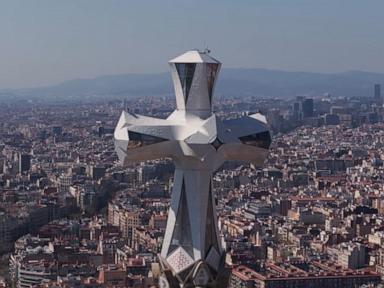
The recent release of high-altitude drone footage and internal 360-degree views from the upper reaches of the Sagrada Familia has sparked the usual wave of tourist wonder. Most viewers see a breathtaking cathedral finally nearing its finish line. What they miss is the reality of a project that has shifted from a religious labor of love to one of the most sophisticated industrial operations on the planet. This is no longer a stone-by-stone masonry project in the tradition of the great European cathedrals. It is a massive, data-driven assembly line where the "unseen views" are actually a testament to off-site prefabrication, structural tensioning, and 3D modeling that pushed the limits of architectural possibility.
The story of the Sagrada Familia is often told through the lens of Antoni Gaudí’s genius or the spiritual devotion of the builders. While those elements remain the foundation, the actual completion of the towers—specifically the towers of the Evangelists and the central Tower of Jesus Christ—is the result of a desperate race against physics and time. After over 140 years, the transition from artisanal stone-carving to high-tech structural engineering was not just an upgrade; it was a survival strategy.
The Secret of Pre-Stressed Stone
When you look at the newly finished towers, you are not looking at solid blocks of stone stacked one atop the other. That method would have been too heavy, too slow, and structurally insufficient for the heights Gaudí envisioned. Instead, the building team pioneered a technique called pre-stressed stone panels.
Each section of the tower is built off-site in a workshop at Galera. Massive blocks of stone are cut with CNC (Computer Numerical Control) machines, then fitted with internal stainless steel rods. These rods are tightened to a specific tension, compressing the stone into a singular, rigid unit. These panels are then trucked into the center of Barcelona and craned into place.
This method allows for a hollow structure that is incredibly light yet maintains the compressive strength of a mountain. It is the architectural equivalent of building with Lego bricks, but bricks that weigh several tons and must withstand the high-velocity winds that batter the Barcelona coastline. Without this leap in material science, the Sagrada Familia would likely have remained a ruin for another century.
The Digital Ghost of Antoni Gaudí
One of the greatest misconceptions about the "unseen views" of the interior is that they are a direct realization of a finished blueprint. They aren't. Gaudí was a master of three-dimensional modeling, but he didn't use paper. He used strings, weights, and hanging models to calculate catenary curves. When he died in 1926, and after his workshop was burned during the Spanish Civil War, the "original plan" effectively vanished.
Modern architects had to become forensic scientists. They used Aeronautical CAD software—the kind used to design fighter jets—to reverse-engineer the fragments of Gaudí’s plaster models. The geometry of the Sagrada Familia is based on ruled surfaces: hyperboloids, paraboloids, and helicoids. These are complex mathematical shapes that ensure that even the most chaotic-looking pillar or ceiling vault follows a strict, logical structural path.
The Problem of Modern Weight
The challenge wasn't just recreating the shapes; it was ensuring they could support the weight of the central towers. The Tower of Jesus Christ will eventually reach 172.5 meters. To put that in perspective, it will make the Sagrada Familia the tallest church in the world.
Structural engineers had to solve the "Gaudí Paradox." He wanted a structure that felt organic and light, like a forest, but it had to be made of heavy lithic materials. The solution lay in the columns. The interior pillars are not uniform; they are made of different materials based on the load they carry. The base of the central pillars is made of red porphyry, one of the hardest and most durable stones on Earth, sourced from Iran. As the columns rise and the load lightens, the material transitions to basalt and then to granite.
Tourism as an Industrial Engine
There is a tension at the heart of the Sagrada Familia that rarely makes it into the travel brochures. The church is a private foundation that receives zero funding from the government or the Vatican. Its billion-euro construction budget is fueled entirely by ticket sales and private donations.
This creates a feedback loop. The faster they build, the more tourists they attract. The more tourists they attract, the more money they have to speed up construction. This commercial reality has fundamentally altered the experience of the site. It is perhaps the only UNESCO World Heritage site that operates like a high-intensity construction zone and a pilgrimage site simultaneously.
The "never-before-seen views" provided by the temple's own media team are, in part, a sophisticated marketing campaign. By showing the world the progress on the towers of Luke, Mark, John, and Matthew, the foundation maintains the momentum necessary to keep the gates turning. The goal is to finish the main structural work by 2026, the centenary of Gaudí’s death, though the decorative elements and the controversial Glory Facade will likely take another decade.
The Battle for the Glory Facade
While the towers receive the most attention, the most significant conflict lies at the ground level. The planned Glory Facade involves a massive staircase that would extend over Mallorca Street. If built according to the original (and reconstructed) plans, it would require the demolition of several apartment buildings and the displacement of hundreds of residents.
This is where the "investigative" side of the architecture meets the harsh reality of urban politics. Local residents argue that the staircase was not part of Gaudí’s original vision and was an addition by later architects. The church foundation maintains that the staircase is essential for the theological and structural completion of the building.
The view from the top of the towers reveals this urban grid clearly. You see the Eixample district, a masterclass in 19th-century urban planning, butting right up against the sprawling stone limbs of the cathedral. It is a standoff between a 19th-century vision and 21st-century property rights.
Beyond the Aesthetic
When you look at the intricate carvings on the Nativity Facade compared to the stark, angular lines of the Passion Facade, you are seeing a timeline of 20th-century art history. The Nativity Facade, finished during Gaudí’s life, is ornate and dripping with naturalistic detail. The Passion Facade, sculpted by Josep Maria Subirachs starting in the 1980s, was initially hated for its brutalist, skeletal figures.
The Material Reality of the Facades
- The Nativity Facade: Built with soft Montjuïc sandstone. It is prone to erosion and requires constant conservation.
- The Passion Facade: Designed to evoke the pain and sacrifice of the crucifixion. Its sharp angles were a deliberate departure from Gaudí's curves, proving that the building is a living organism that evolves with its contributors.
- The Glory Facade: The final frontier. It will be the largest and most monumental, representing the path to God.
The engineering required to marry these different eras is staggering. Each facade acts as a structural anchor for the central nave. The "unseen" interior of these walls is a honeycomb of reinforced concrete and steel, a hidden skeleton that allows the outer stone skin to look effortless.
The Lighting Revolution
The interior views of the Sagrada Familia are famous for their light, but what people see today is a very recent invention. Gaudí intended the light to be "harmonious," not blinding. He wanted the stained glass to be darkest at the bottom and lightest at the top to create a sense of divine ascension.
The installation of the stained glass, designed by Joan Vila-Grau, was only completed in the last decade. The colors are not random. The "cold" side (blues and greens) faces the sunrise, symbolizing the Nativity and new life. The "warm" side (reds and oranges) faces the sunset, symbolizing the Passion and the fire of the spirit.
To manage the heat and light intensity of the Spanish sun, the windows are not just colored glass. They are complex filters that manage the thermal load of the building. Without modern glass technology, the interior of the Sagrada Familia would be an oven in the summer months.
The Final Ascent
The Tower of Jesus Christ will be topped with a four-armed cross, a classic Gaudí motif. This cross will be accessible to the public, offering a viewpoint that will be the highest in the city. However, the path to that cross is a marvel of vertical transport engineering.
Because the tower is hollowed out to save weight and provide a sense of space, the elevators had to be integrated into the narrowest parts of the structure. The "unseen" parts of the towers are a labyrinth of maintenance tunnels, tensioning cables, and sensor arrays that monitor the building's movement in real-time. If the wind blows too hard or the temperature shifts too rapidly, the building "knows."
A Temple of the Future
We are witnessing the final act of a long-form construction drama. The Sagrada Familia is no longer just a church; it is a proof-of-concept for the future of masonry. It proves that we can still build with stone on a monumental scale if we are willing to treat that stone as a high-tech material.
The drone footage and the high-definition tours are more than just eye candy. They are the documentation of a transition. We have moved from the era of the master mason to the era of the master coder. The beauty of the Sagrada Familia is that, when you stand in the center of the nave and look up at the stone forest, you can't see the computers, the stainless steel rods, or the Iranian porphyry's stress tests. You only see the light.
The real achievement isn't that they are finishing the building. It's that they found a way to use the tools of the 21st century to fulfill a 19th-century dream without losing the soul of the work. The "unseen views" are beautiful, but the unseen engineering is what actually saved the Sagrada Familia from becoming a permanent ruin.
Completion is no longer a question of "if," but "when." The infrastructure is in place, the pre-stressed panels are being cast, and the digital twin of the cathedral is guiding every crane movement. The race to 2026 is on, and for the first time in a century, the builders are winning.