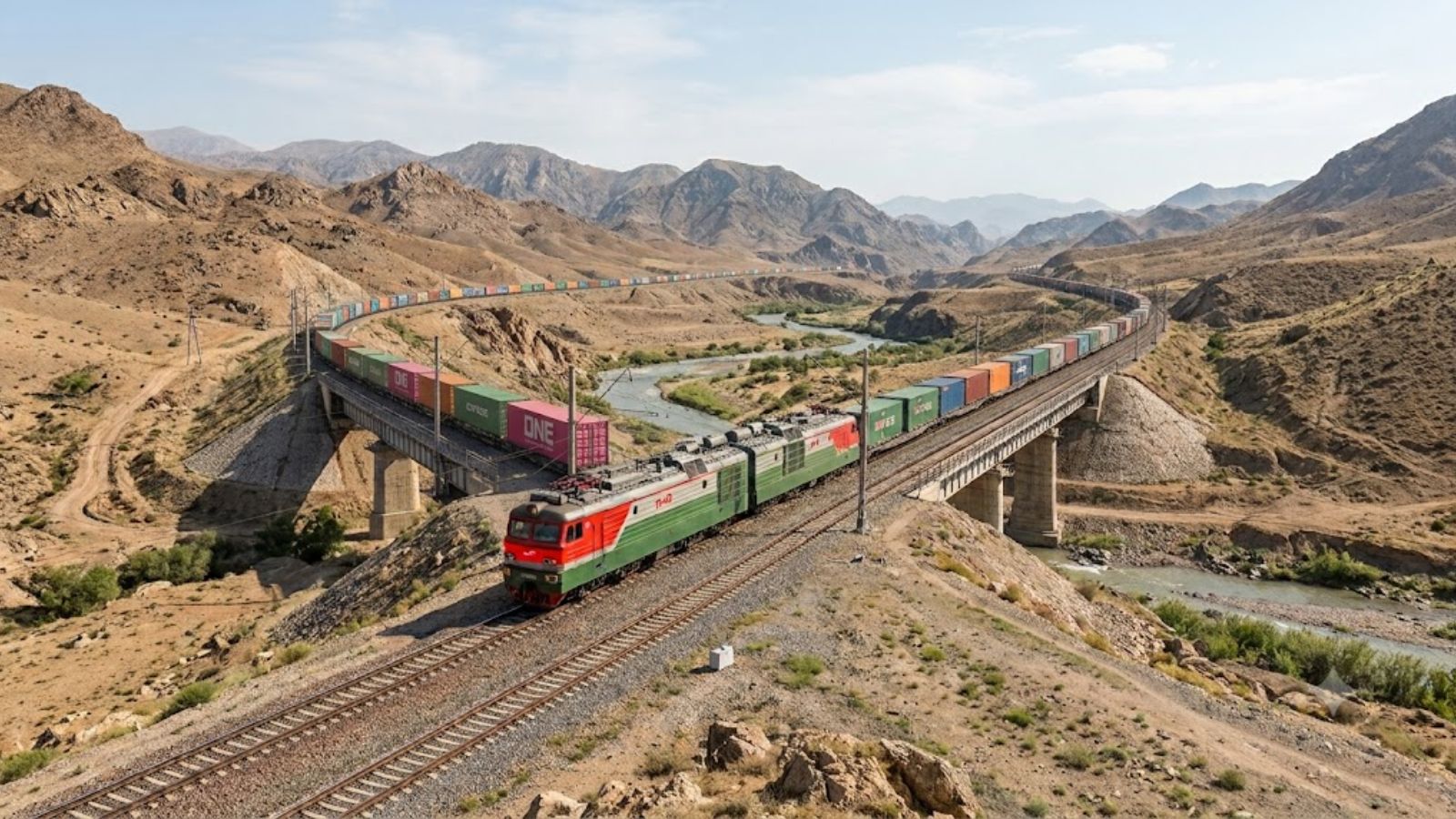
Every few months, armchair geopolitical analysts dust off old maps, trace a red marker from Moscow down through Central Asia, cross the jagged spine of the Hindu Kush, and proclaim the birth of a new Eurasian trade corridor. The latest iteration of this tired fantasy targets a railway linking Russia to India, supposedly saving traders from the perils of the Strait of Hormuz.
It sounds sophisticated over cocktails in Geneva or panel discussions in Dubai. It is complete economic illiteracy.
I have watched logistics budgets evaporate on promises of trans-continental rail shortcuts for two decades. The people pushing this rail route have never tried to clear a single container of steel pipes through Turkmenistan customs, nor have they calculated the absolute murder of multi-gauge transshipment costs. They look at a globe, see a straight line between two rising economic giants, and assume physical proximity equates to commercial viability.
Geography is destiny, but bureaucracy and engineering are the executioners.
The Gauge Paradox That Breaks Every Grand Strategy
Let us start with the physical reality that destroys this fantasy before the first sleeper is laid.
Russia operates on the 1520mm broad gauge standard, a legacy of the Russian Empire designed intentionally to make foreign invasions difficult by rail. Iran runs primarily on standard 1435mm tracks. Pakistan, moving eastward toward the South Asian market, uses 1676mm Indian broad gauge.
Every single time a freight train crosses one of these national borders, you face two choices: unload every pallet, box, and container by crane and reload it onto a different set of bogies, or hoist the entire train car hydraulically to swap the wheel assemblies.
Imagine a scenario where a fifty-car cargo train leaves St. Petersburg bound for Mumbai. By the time it clears Belarus, Russia, Kazakhstan, Turkmenistan, and Iran, it has encountered at least three major gauge breaks. Each transfer point requires massive terminal acreage, custom-built gantry cranes, security clearance from paranoid border guards, and days of idle waiting time.
Maritime shipping works because a container stays locked from Shanghai to Rotterdam. It moves from crane to ship once at departure and once at arrival. Rail freight across three distinct gauge regimes turns into a logistical obstacle course where every border crossing introduces a new point of failure, theft, and delay.
The Myth Of Hormuz Risk Mitigation
The primary selling point of this proposed rail corridor is security. Proponents point to regional instability, naval chokepoints, and potential blockades in the Strait of Hormuz as justification for building an expensive terrestrial alternative.
This argument collapses under the weight of basic risk analysis.
Passing cargo through the Strait of Hormuz puts your goods on a modern container ship capable of carrying twenty thousand twenty-foot equivalent units at a fraction of a cent per ton-mile. If a maritime route faces geopolitical friction, shipowners simply reroute around the Cape of Good Hope or negotiate naval escorts. The global maritime insurance market prices these risks efficiently every single day.
Now look at the land route. You are trading a maritime chokepoint for a gauntlet of hyper-volatile land borders. You are asking cargo to transit regions plagued by active insurgencies, heavy-handed authoritarian sanctions enforcement, secondary tariff regimes, and local political disputes.
To believe a trans-Eurasian rail line is safer than the open ocean is to misunderstand how terrestrial supply chains break. A single blocked tunnel in the Alborz mountains or a localized political dispute between Ashgabat and Tehran can halt an entire corridor for weeks. At sea, ships go around. On land, you wait for an army to clear the track.
The Economics Of Empty Return Trips
Logistics professionals judge a trade lane by its balance. If goods flow heavily in one direction and return empty, the transport cost doubles because someone has to pay to drag dead weight back to the origin.
Russia exports commodities: oil, coal, timber, fertilizer, and heavy metals. India imports those commodities and exports manufactured goods, pharmaceuticals, textiles, and agricultural products. At first glance, this looks complementary.
Look closer. Russia's primary trade partners are shifting eastward toward China due to sweeping international sanctions. When Russia sends commodities south toward India through Central Asia, what is coming back on those exact same trains? India does not have a massive surplus of heavy industrial machinery or raw material inputs that Russia cannot source cheaper domestically or directly from East Asia.
Running empty rail cars thousands of miles across hyper-arid deserts and high mountain passes to pick up the next load is a fiscal catastrophe. Ships absorb empty container repositioning through global network balancing. A dedicated bilateral rail line between two nations with asymmetrical trade profiles turns into a bottomless money pit subsidized by taxpayers or state-backed loans that never turn a profit.
The Sanctions Trap And Financial Friction
Even if we pretend engineering and geography are minor inconveniences, we must deal with the financial plumbing of international trade.
Russia remains cut off from major Western-dominated clearing systems like SWIFT. India trades with Russia under complex, bilateral currency arrangements, frequently settling energy transactions in rupees, dirhams, or rubles. While this works for bulk crude oil shipments handled by massive state-owned refiners and tankers, it creates an administrative nightmare for thousands of independent manufacturers and freight forwarders.
Try financing a multi-billion-dollar international rail infrastructure project when the primary destination country faces rolling packages of secondary sanctions from Western economies that still control the global banking machinery. International institutional lenders like the World Bank or the Asian Development Bank will not touch a project explicitly designed to bypass Western trade restrictions with a ten-foot pole.
That leaves state financing. And when governments fund infrastructure purely for geopolitical signaling rather than commercial return, efficiency drops to zero. We have seen this movie before with various segments of the International North-South Transport Corridor. Billions spent on ribbon cuttings, followed by decades of underutilization because the private sector refuses to use a route that makes no financial sense.
What You Should Do Instead
Stop looking for magical infrastructure shortcuts to solve complex geopolitical trade realities.
If you are moving goods between Russia and South Asia, accept the physics of global trade. Ocean freight through southern ports, combined with existing multimodal links through Iranian ports like Chabahar, offers a vastly superior cost-to-risk ratio than any pipe-dream railway sliced through the heart of the continent. Chabahar exists. It handles cargo. It connects maritime lanes directly to land routes into Afghanistan and Central Asia without requiring thousands of miles of brand-new track through hostile terrain.
Focus your capital on optimizing existing ports, streamlining customs documentation through digital trade corridors, and building resilient supply chains that can absorb maritime volatility rather than fleeing from it.
The next time an analyst claims a trans-continental rail line is about to redraw the map of global commerce, ask them who is paying for the bogie-changing stations at the borders.
They will change the subject.