The fat in the cast-iron cauldron was already starting to spit by the time the first blue thread of woodsmoke rose over the valley floor.
It was five in the morning in the Fergana Valley. Outside the low brick walls of the courtyard, the air smelled of dry dust, wild mint, and the cold, mineral bite of high-altitude dawn. Inside, an old man named Bakhtiyor was rhythmically slicing yellow onions with a heavy, carbon-steel blade that had belonged to his grandfather. Each stroke made a dull, wet thunk against the scarred poplar-wood board. He did not speak. He did not need to. For forty years, his hands had known the exact weight of mutton fat, the precise resistance of yellow carrots cut into thick matchsticks, and the moment when the rice—hard, white grains of devzira harvested from the silty runoff of the Tian Shan mountains—was ready to drown in broth.
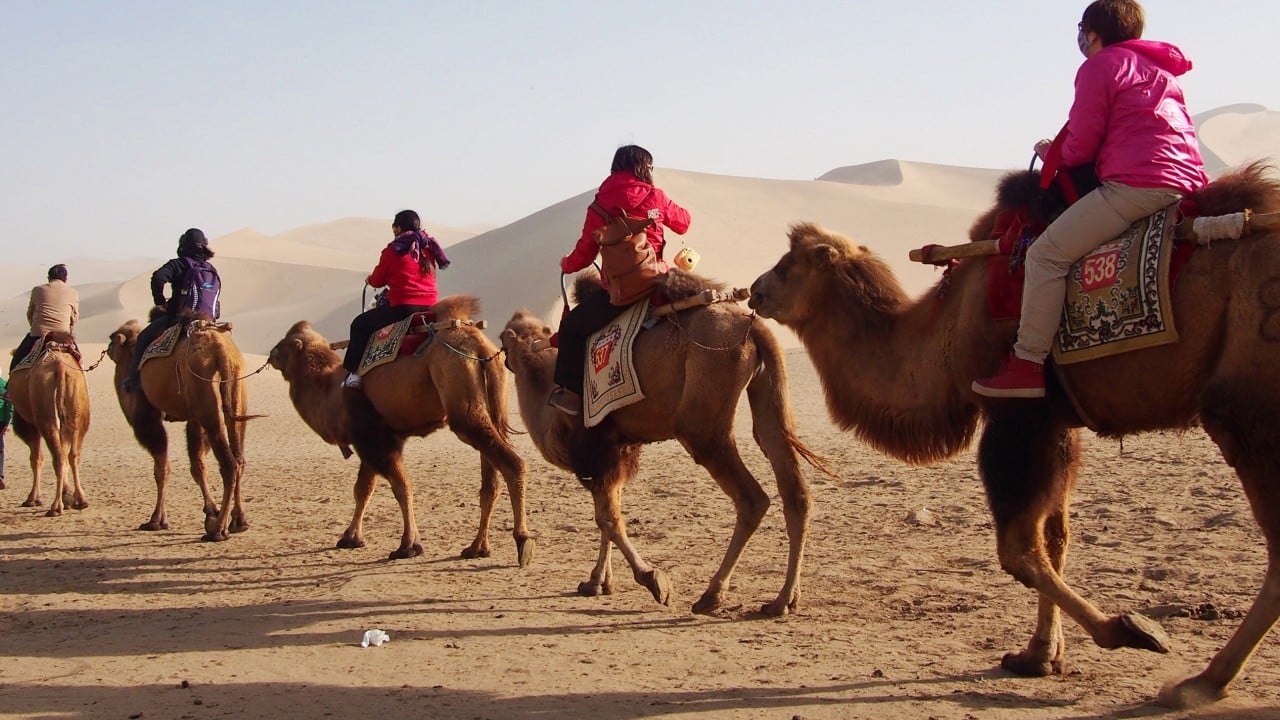
When people talk about the ancient trade routes that once stitched together the vast, brutal emptiness between China and the Mediterranean, they usually talk about silk. They talk about bales of shimmering white fiber packed onto Bactrian camels, crossing the freezing passes of the Pamirs, dodging bandits in the Taklamakan, and feeding the vanity of Roman senators who bankrupt their provinces for a single sheer tunic.
They talk about silk because silk is clean. Silk can be folded, counted, taxed, and stored in a museum vault under glass.
But silk does not feed a traveler who has spent three weeks freezing in a mountain gale. Silk does not stain your fingers with pomegranate molasses or leave the scent of charred cumin clinging to your wool coat for days. The real exchange along those ancient tracks was never just about what people wore. It was about what they ate.
Consider what happens when you drop a handful of cumin seeds into hot oil. The volatile oils shatter. The kitchen fills with a sharp, medicinal heat that smells instantly of the earth, of deserts, of open fires built from dried camel dung and scrub brush. That smell is older than any written alphabet found in Samarkand. It is the smell of convergence.
For centuries, Central Asia was not a destination on a tourist map. It was a giant, rolling meat grinder of empires. Persians, Mongols, Turks, Sogdians, Russians, and Chinese swept across these steppes and river valleys, leaving behind broken pottery, ruined fortresses, and, most importantly, their pots.
Imagine a Sogdian merchant pulling his donkey to a halt at a roadside caravanserai outside of Bukhara in the eighth century. He is half-blind from the glare of the salt flats and shivering despite the wool cloak wrapped tightly around his chest. The innkeeper does not offer him a silk handkerchief. He hands him a wooden bowl of steaming wheat broth thickened with dried curds and spiked with wild garlic. That bowl is a map. The wheat came from the Fertile Crescent. The garlic is native to the mountain foothills. The cooking technique—slow-simmering in a heavy metal vessel—belongs to the nomadic herdsmen who spent their lives riding the open steppe.
Every single meal served today in the tea houses of Tashkent, Osh, and Bishkek is a historical document written in fat, starch, and fire.
We forget this because modern travel has been sanitized. We like our destinations neatly packaged. We want direct flights, boutique hotels with infinity pools, and restaurant menus translated into three languages with polite little descriptions explaining that a dumpling is "a pocket of dough."
Central Asia refuses to be polite in that way. It is a harsh, beautiful land of extremes where the winters drop low enough to freeze your breath before it hits the scarf and the summers bake the clay until it cracks open like an old bone. To understand its food, you have to understand the geography that birthed it. You have to look at the map and realize that this is a region pinched between massive mountain ranges and inland seas, where survival depended entirely on preservation, animal husbandry, and the ability to turn sparse ingredients into something that could keep a rider in the saddle for twelve hours straight.
Take manti, those heavy, pleated dumplings stuffed with minced mutton and tail fat. To an outsider, they look simple enough—just meat wrapped in dough. But bite into one fresh from the steaming tiers of a massive aluminum manti-kaskon, and you are tasting a masterpiece of thermodynamic engineering designed for the steppe. The fat inside the meat melts during the twenty-minute steam, turning into a rich, savory broth trapped entirely within the dough walls. When you pierce it with your fork, the juice bursts out. It is hot, messy, and intensely carnivorous. It is designed to be eaten with your hands, dipped in sharp vinegar or slathered in sour cream, while you sit on a felt rug spread over a wooden platform in the shade of an apricot tree.
Why has it taken the rest of the world this long to notice?
For a long time, the region was locked behind political iron curtains and remote geography. When the Soviet Union collapsed, it left behind crumbling infrastructure, shattered economies, and a diaspora of nations trying to figure out who they were outside the shadow of Moscow. Tourism was an afterthought. The hotels smelled of damp carpet and cabbage soup. The roads shook your teeth loose.
But borders are porous, and hunger is universal.
Slowly, quietly, something shifted. Young chefs from Almaty to Dushanbe started looking at their grandmothers' blackened cauldrons not as relics of a backward past, but as a culinary treasure chest. They began to realize that the rest of the world was drowning in a sea of homogenous, industrialized dining, desperately searching for food with a pulse, food with a lineage, food that told a true story.
And what a story it is.
It is a story told in layers. When you eat a plate of plov—the undisputed king of Central Asian cuisine—you are eating a chronicle of human migration. The rice is the grain of the river valleys. The yellow carrots provide a sweetness that compensates for the lack of refined sugar in historical diets. The garlic heads, roasted whole and buried right in the center of the mound, are an offering to the center of the table, where everyone eats from the same communal dish.
Anthropologists will tell you that communal eating builds trust. When five people sit cross-legged around a single massive platter of rice and meat, reaching in with their fingers or spoons, a silent social contract is formed. You take your share, but you do not hoard. You respect the boundaries of the dish. You leave the best morsels of fat for your elders or your guests.
This is the hidden engine of Central Asian hospitality. It is not just a polite custom; it is a survival mechanism forged in a land where being caught alone in the desert without help meant death. If a stranger knocked on your door in the middle of a blizzard in the Pamir Mountains, you did not ask for his passport. You killed your best sheep, fired up the hearth, and fed him until he could sweat.
Today, travelers are returning to these ancient crossroads, but they are arriving by Boeing and Land Cruiser instead of camel caravan. They land in Tashkent, take the high-speed bullet train across the desert to Samarkand, and wander through the turquoise-tiled shadow of the Registan.
Yet the real monuments are not the tiled madrasas or the crumbling clay ramparts of ancient Khiva. The real monuments are bubbling away in the back alleys of every village from the Fergana Valley to the shores of Issyk-Kul.
Consider the baker in Bishkek who wakes up at three in the morning to stoke his clay tandyr oven. He doesn't use digital thermometers. He dips his bare arm into the roaring, glowing belly of the furnace, feeling the radiant heat against his skin to know if the temperature is right. He slaps rounds of dough against the hot clay walls, leaving them to bake until they emerge blistered, smoky, and golden brown. When you buy one of those breads—nan—it is still so hot it burns your palms. You break it with a sharp crack. The inside is soft and chewy, smelling of charred flour and wood smoke.
You can find variations of that bread all the way from the borders of China to the Mediterranean coast. It is the edible connective tissue of an entire continent.
When you travel through this landscape, you realize that the old divisions between East and West are a modern fiction. There was never a hard line where one culture stopped and another began. There was only a long, dusty road where traders, monks, soldiers, and nomads bumped into each other, dropped their spices in each other's pots, and learned to love the taste of things they had never seen before.
The old man Bakhtiyor finally drops the last handful of washed rice into the boiling mutton broth. He covers the heavy cast-iron cauldron with a thick quilted blanket to trap the steam, stepping back to wipe his brow with the back of a flour-dusted wrist. The sun is fully up now, burning the morning mist off the rooftops and turning the distant mountain peaks into jagged shards of blinding white.
In an hour, the family will gather. The lid will come off the pot, and a cloud of steam carrying the ancient, indelible scent of cumin, meat, and woodsmoke will spill out across the courtyard, just as it has for a thousand mornings before this one, and a thousand mornings yet to come.