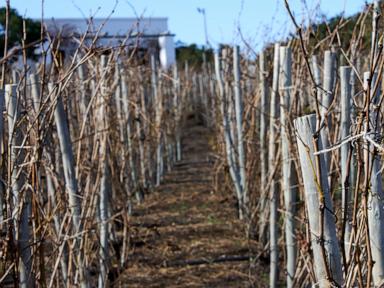
Stop applauding the lockdown hobbyists who planted grapevines in their parents' backyards. The media loves these stories. They serve up a warm, fuzzy narrative about a corporate refugee escaping the city, planting a few rows of Pinot Noir during a global crisis, and realizing a beautiful, artisanal dream. It sounds poetic. It feels inspiring.
It is also an absolute financial catastrophe waiting to happen.
The wine industry is littered with the financial corpses of wealthy amateurs who treated commercial agriculture as a lifestyle accessory. Planting a boutique vineyard without a massive capital cushion, a clear distribution strategy, and an understanding of raw agricultural scaling is the fastest way to turn a large fortune into a small one. The romantic narrative completely ignores the brutal math of viticulture, the unforgiving realities of plant pathology, and a global wine market that is currently drowning in oversupply.
If you think a backyard vineyard is your ticket to a slow, intentional, profitable life, you are asking the wrong questions. Let us dismantle the myth piece by piece.
The Capital Expenditure Trap
Amateurs look at a empty field and see romance. Insiders look at an empty field and see a bottomless pit of upfront capital expenditure.
To understand why small-scale viticulture fails, you have to look at the numbers that boutique owners conveniently leave out of their triumphant social media posts. Establishing an acre of commercial vineyard is not a matter of buying some vines from a local nursery, digging a few holes, and waiting for the magic to happen.
Consider the baseline costs required before you even harvest a single, usable grape cluster.
- Land Preparation: Deep ripping the soil to break up hardpans, grading, rock removal, and extensive soil amendments (lime, gypsum, organic matter) based on rigorous laboratory assays.
- Infrastructure: High-tensile trellis wire, end posts, line posts, grow tubes, and wildlife fencing. If you do not install an expensive deer and bird exclusion system, your entire crop will disappear into the stomachs of the local fauna before harvest week.
- Irrigation: Drip lines, filters, pumps, and automated moisture sensors. Even in regions with adequate rainfall, establishing young vines requires precise water management to ensure root development.
- Planting Stock: High-quality, certified virus-free grafted vines chosen specifically for your soil type and microclimate.
In a standard commercial setting, establishing a vineyard costs anywhere from $30,000 to $75,000 per acre, depending on the terrain and region. This does not include the price of the land itself. For a backyard hobbyist operating on a fraction of an acre, the per-plant cost skyrockets because you lose all economies of scale. You are paying retail prices for commercial-grade agricultural inputs.
Worse, you are writing these checks into a void. Grapevines operate on a strict biological timeline that cares nothing for your business plan or your bank account.
$$Year\ 1:\ Planting\ and\ training\ (Zero\ crop)$$
$$Year\ 2:\ Vegetative\ growth\ and\ framework\ building\ (Zero\ crop)$$
$$Year\ 3:\ The\ first\ "third-leaf"\ harvest\ (Minimal,\ low-quality\ yield)$$
$$Year\ 4-5:\ True\ commercial\ production$$
For at least three long years, you are pouring cash, water, fertilizer, and grueling physical labor into the ground without a single dollar of incoming revenue. If your operation is small, you cannot amortize the cost of specialized equipment like under-vine weed mowers, canopy trimmers, or air-blast sprayers. You are either doing backbreaking manual labor for thousands of hours or paying exorbitant rates to contract crews who treat your tiny plot as their lowest priority.
The Microclimate Illusion and the Myth of Backyard Terroir
The hobbyist narrative relies heavily on the concept of terroir—the idea that a specific piece of earth imparts a unique, magical soul to the wine. It is a brilliant marketing concept. Unfortunately, nature does not care about marketing.
A random backyard or family homestead is almost never an optimal site for high-quality viticulture. Commercial vineyards are cited after exhaustive multi-year analyses of macroclimates, mesoclimates, aspect, slope, and drainage.
If you plant vines on a flat piece of dirt at the bottom of a hill because that is where your parents' property happens to end, you are setting yourself up for failure. Flat terrain acts as a frost pocket. Cold air behaves like water; it flows downhill and pools in low-lying areas. A single spring frost can wipe out your entire season's primary buds in a single night, reducing your potential yield by 70% before summer even begins.
Furthermore, proper drainage is non-negotiable. Grapevines despise having "wet feet." Heavy clay soils retain water, starving the root zone of oxygen and encouraging devastating fungal pathogens. Commercial growers spend a fortune installing deep sub-surface drainage tiles to channel water away from the vines. If your backyard plot has poor drainage, your vines will suffer from stunted growth, poor fruit set, and root rot.
Then comes the relentless onslaught of disease. Amateurs envision walking through pristine, sun-dappled rows, plucking perfect berries from the vine. The reality of viticulture is a constant, exhausting war against biology. Depending on your region, you will face an endless parade of threats:
- Powdery Mildew and Downy Mildew: Fungal diseases that defoliate the canopy and rot the fruit if your canopy management and spray timings are off by even forty-eight hours.
- Botrytis Bunch Rot: A fungus that turns your beautiful ripening clusters into a grey, fuzzy, sour mush right before harvest.
- Black Rot: A disease that can shrivel berries into useless, mummified raisins.
- Vectors and Viruses: Leafroll virus, Red Blotch, and Pierce’s disease, which are spread by insects and can permanently stunt your vineyard's productivity, forcing you to rip out your entire investment and start over.
To combat this, commercial viticulture requires a rigorous, scientifically calculated spray program using sulfur, copper, or systemic fungicides. Managing this on a small backyard scale with consumer-grade backpack sprayers is a nightmare. You will either under-spray and lose your crop to rot, or you will over-spray out of panic, ruining the soil and creating chemical runoff issues that alienate your neighbors.
The Brutal Reality of Scale and Processing
Let us assume your backyard vineyard beats the odds. You survive the frost, you control the mildew, the birds do not eat your crop, and you reach harvest day. You have accumulated a few tons of beautiful grapes.
Now what?
You cannot make commercial-quality wine in a garage with plastic buckets and a hand press if you want to sell it legally. Wine production is a heavily regulated food manufacturing process. To move from a romantic hobby to a legitimate business, you need access to a bonded winery facility.
Building a small boutique winery requires an entirely new, massive wave of capital expenditure. You need temperature-controlled stainless steel fermentation tanks, expensive oak barrels, variable-capacity storage vessels, commercial destemmers, pneumatic presses, glycol chilling systems, and analytical laboratory equipment to monitor volatile acidity, pH, and residual sugar.
If you choose to bypass this by using a custom crush facility—paying an established winery to process your fruit—you are at their mercy. Custom crush operations charge premium fees per ton or per gallon. Because your backyard lot is tiny, you represent a logistical headache for them. Your fruit will be processed when they have free time, not necessarily at the exact, optimal moment of physiological ripeness. Your premium grapes will sit on a loading dock, oxidizing and degrading, while the facility handles their own multi-million-dollar estate crops first.
Furthermore, the conversion math is brutal for small volumes.
$$\text{One ton of grapes} \approx \text{150 to 170 gallons of juice}$$
$$\text{150 gallons} \approx \text{63 cases of wine (750ml bottles)}$$
$$\text{63 cases} = \text{756 bottles}$$
If your backyard vineyard yields two tons of fruit, you are looking at roughly 1,500 bottles of wine. That volume is a commercial dead zone. It is far too much wine for you and your friends to consume legally or safely, yet it is far too small to interest any commercial distributor or retail chain. You are stuck in an economic no-man's-land.
The Compliance and Distribution Nightmare
This is the rock upon which almost every amateur vineyard dream shatters. Making wine is relatively easy compared to the bureaucratic hell of selling it.
The wine market does not operate on standard free-market capitalism. It is governed by an archaic, Byzantine web of post-Prohibition regulations. If you are in the United States, you must navigate the Federal Alcohol and Tobacco Tax and Trade Bureau (TTB), alongside your state’s specific Department of Alcoholic Beverage Control (ABC).
Getting your labels approved, securing a basic permit as a winery, paying federal excise taxes, and filing monthly compliance reports requires an immense amount of administrative paperwork or thousands of dollars in compliance consultant fees. If you accidentally ship a bottle of wine to a consumer in a state where you do not hold a direct-to-consumer shipping license, you are committing a felony.
If you plan to sell through traditional retail or restaurant channels, you must face the reality of the three-tier system: producer to distributor, distributor to retailer, retailer to consumer.
Distributors have consolidated massively over the last two decades. The giants control the vast majority of the market, and they have absolutely zero interest in your 120 cases of backyard wine. It costs them more in administrative paperwork to onboard your tiny brand than they could ever make by selling your product.
Without a distributor, you are forced to rely entirely on direct-to-consumer (DTC) sales through a tasting room or a mailing list. But building a DTC brand requires sophisticated digital marketing, exceptional hospitality infrastructure, and a constant stream of tourism. A backyard at your parents’ house is not a commercial tasting room. It is a zoning violation waiting for a code enforcement officer to shut it down after your first three customers park on the grass.
What It Actually Takes to Survive
I have watched wealthy individuals burn through millions of dollars chasing the vigneron fantasy, only to sell their properties at a massive loss when they realize that agriculture is an unyielding, low-margin business.
If you want to get into the wine industry and actually survive, you must abandon the romantic backyard narrative and adopt a cold, calculating framework.
- Commit to Minimum Viable Scale: Do not plant half an acre or an acre. Unless you have at least 5 to 10 acres of plantable land, you cannot achieve the economies of scale necessary to lower your per-bottle production costs to a competitive level. If you do not have the space or capital for that scale, do not plant a single vine.
- Focus on the Brand Before the Land: The world does not need more wine grapes. The global market is saturated, and consumer trends are shifting toward moderation. If you want to enter the wine business, buy bulk juice or finished wine from established producers first. Bottle it under your own custom label. Test your branding, master the distribution compliance, and see if you can actually sell 500 cases of wine before you commit to digging a single trench or buying an expensive tractor.
- Accept the Real ROI: The return on investment for a newly planted vineyard is measured in decades, not years. If you are using capital that you need to live on or retire with within the next fifteen years, keep it in an index fund. A vineyard is a generational asset that requires continuous capital injections before it ever yields a steady, predictable profit.
The stories of lockdown backyard vineyards make for wonderful human-interest pieces, but they are terrible blueprints for business. Viticulture is a high-risk, capital-intensive branch of industrial agriculture that demands deep scientific knowledge, massive operational scale, and a ruthless focus on distribution mechanics. Treating it as an idyllic lifestyle choice or an extended pandemic hobby is an incredibly expensive delusion.
If you want to enjoy a beautiful vineyard, buy a bottle of high-quality wine from someone else who took the financial beating to make it, sit on your porch, and keep your life savings safely in the bank.