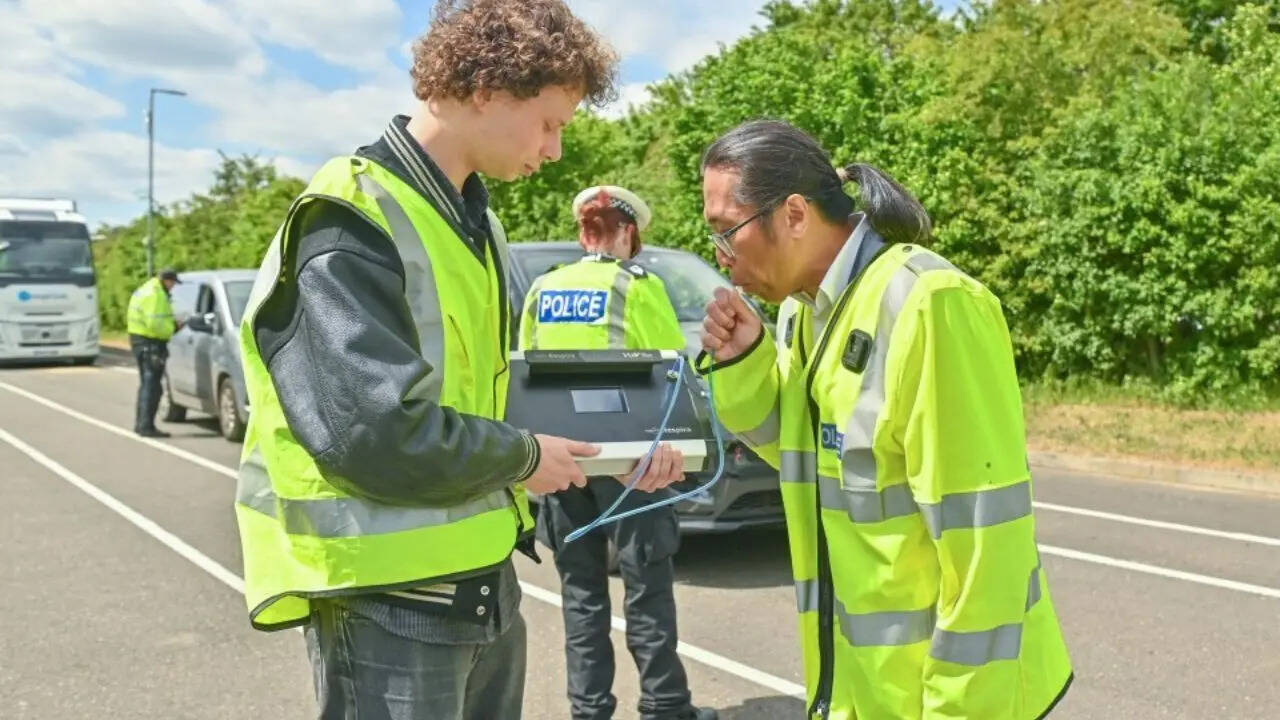
The headlines are shouting about a "world-first" roadside breathalyzer for nitrous oxide. The rhetoric is predictable. Politicians are patting themselves on the back for "getting tough" on drug-driving. Police forces are posing with shiny new handheld devices in Southern England. The public is being told that the scourge of "laughing gas" canisters in our gutters is finally being met with a technological silver bullet.
It is a performance. It is theater. Meanwhile, you can read other developments here: Inside the Senate Siege The Brutal Truth About Justice in the Philippines.
While the media obsess over the novelty of the tech, they are ignoring the chemical reality of how nitrous oxide interacts with the human body and the legal nightmare that is about to unfold in the UK court system. This isn't a solution to road safety. It is a high-tech dragnet for a problem that is already covered by existing law, using a methodology that is scientifically precarious at best.
The Half Life Fallacy
The fundamental flaw in the "roadside breathalyzer" logic is the pharmacokinetics of nitrous oxide. To explore the bigger picture, we recommend the excellent analysis by Associated Press.
Nitrous oxide is an inorganic gas. It does not linger. Unlike alcohol, which has a predictable burn-off rate ($0.015%$ BAC per hour on average), or THC, which hides in fatty tissues for days, nitrous oxide is inhaled, enters the bloodstream, crosses the blood-brain barrier, and is exhaled almost entirely unchanged within minutes.
When a driver is "high" on nitrous oxide, the window of acute impairment is incredibly narrow—usually between 30 seconds and two minutes. By the time a police officer sees a car swerve, hits the blue lights, waits for the driver to pull over, approaches the window, and prepares a breath test, the nitrous oxide has likely already left the driver's system.
We are spending millions of pounds on a device designed to catch a chemical ghost. If an officer finds a driver slumped over the wheel with a balloon in their mouth, they don't need a "world-first" breathalyzer; they have eyes. They have the existing Section 4 of the Road Traffic Act 1988, which covers driving while unfit through drink or drugs.
The push for a specific breathalyzer is a search for a "hard number" where one isn't needed—and where one might not even be accurate.
The Calibration Crisis
Let’s talk about the science the press releases skipped. Nitrous oxide is naturally present in the atmosphere at about $0.33$ parts per million (ppm). It is also used in medical settings, dentistry, and even in food production (whipped cream chargers).
For a roadside test to hold up in court, it must differentiate between:
- Acute intoxication.
- Residual "background" nitrous oxide from the environment.
- Recent legitimate exposure (e.g., a trip to the dentist).
- Endogenous production (the body naturally produces trace amounts).
Existing breathalyzers for alcohol use infrared spectroscopy or fuel cell sensors to measure ethanol. They are calibrated to a specific legal limit: $35$ micrograms of alcohol per $100$ milliliters of breath.
Nitrous oxide has no such legal limit. There is no "per se" level defined in UK law for $N_2O$.
This means every single positive result from these new devices will be challenged. Defense solicitors are already sharpening their pencils. They will argue that a "positive" reading doesn't prove impairment at the time of driving, only presence in the breath. Given the gas's rapid dissipation, a driver could be sober by the time the handcuffs click but still register a trace amount. This creates a legal gray area that will clog the courts and drain public funds, all for a "win" that doesn't actually make the roads safer.
The Waste of Police Resources
I have worked alongside forensic analysts and seen how police budgets are vaporized on "innovative" tech that collects dust two years later.
The UK is currently facing a massive backlog in forensic toxicology labs. Blood samples for established killers on the road—cocaine, heroin, and ketamine—are taking months to process. Drivers who are legitimately dangerous are remaining on the road because the labs can't keep up.
Instead of fixing the core infrastructure, the government is chasing a headline-grabbing "world first." They are asking officers to carry yet another piece of kit, undergo yet another training module, and perform yet another roadside procedure for a substance that is effectively gone by the time the driver winds down the window.
If we want to stop drug-driving, we should be investing in more "Section 4" training—teaching officers how to recognize the physical signs of impairment that apply to any substance, rather than betting the farm on a specific sensor for a gas that lasts sixty seconds.
Nitrous Oxide vs. Reality
The "crisis" of nitrous oxide is largely an aesthetic one. People hate seeing the silver canisters in parks. They hate the "hiss" of the balloons. It feels like societal decay.
But if we look at the data on road fatalities, nitrous oxide is a rounding error compared to the "Big Three":
- Alcohol: Still the king of road deaths.
- Cannabis: Increasingly common and far more persistent in the system.
- Cocaine: Linked to aggressive, high-speed maneuvers.
By centering the national conversation on a "laughing gas breathalyzer," we are distracting ourselves from the fact that we are failing to manage the substances that actually kill people every single day. It is easier to ban a gas used by teenagers than it is to fix the cultural obsession with "one for the road" at the local pub.
The False Sense of Security
There is a hidden danger in this tech: the "Clean Breath" fallacy.
When you tell the public you have a magic machine that catches drug-drivers, you create a false sense of security. You also inadvertently tell the "innovative" drug user what to avoid. If $N_2O$ is the only thing being checked at the roadside beyond alcohol and basic "drug wipes," users will simply pivot to other short-acting inhalants or synthetic cannabinoids that these devices can't see.
We are playing a game of chemical Whack-A-Mole. The "contrarian" truth is that you cannot solve a behavioral problem—impairment—with a purely chemical solution.
The Actionable Reality
If you are a policymaker or a taxpayer, stop cheering for the "world-first" gadget. Start asking the following:
- What is the "per se" limit? If there isn't one, the device is a paperweight in court.
- What is the false-positive rate? Especially for people in trades that use compressed gases.
- Why are we prioritizing this over the 6-month toxicology backlog?
The roadside nitrous test is a placebo for a worried public. It provides the illusion of control while the actual mechanics of road safety—police numbers, forensic lab capacity, and robust impairment testing—continue to erode.
Stop buying into the hype of the "New Device." It isn't a game-changer. It is a distraction from the fact that we are losing the war on road safety because we would rather fund a PR campaign than fund a lab.
Toss the gadget. Fund the forensics. Train the officers. Everything else is just hot air.


:max_bytes(150000):strip_icc():focal(819x186:821x188)/Murdaugh-Family-e90854a716884d608fb6fd925e18d840.jpg)
