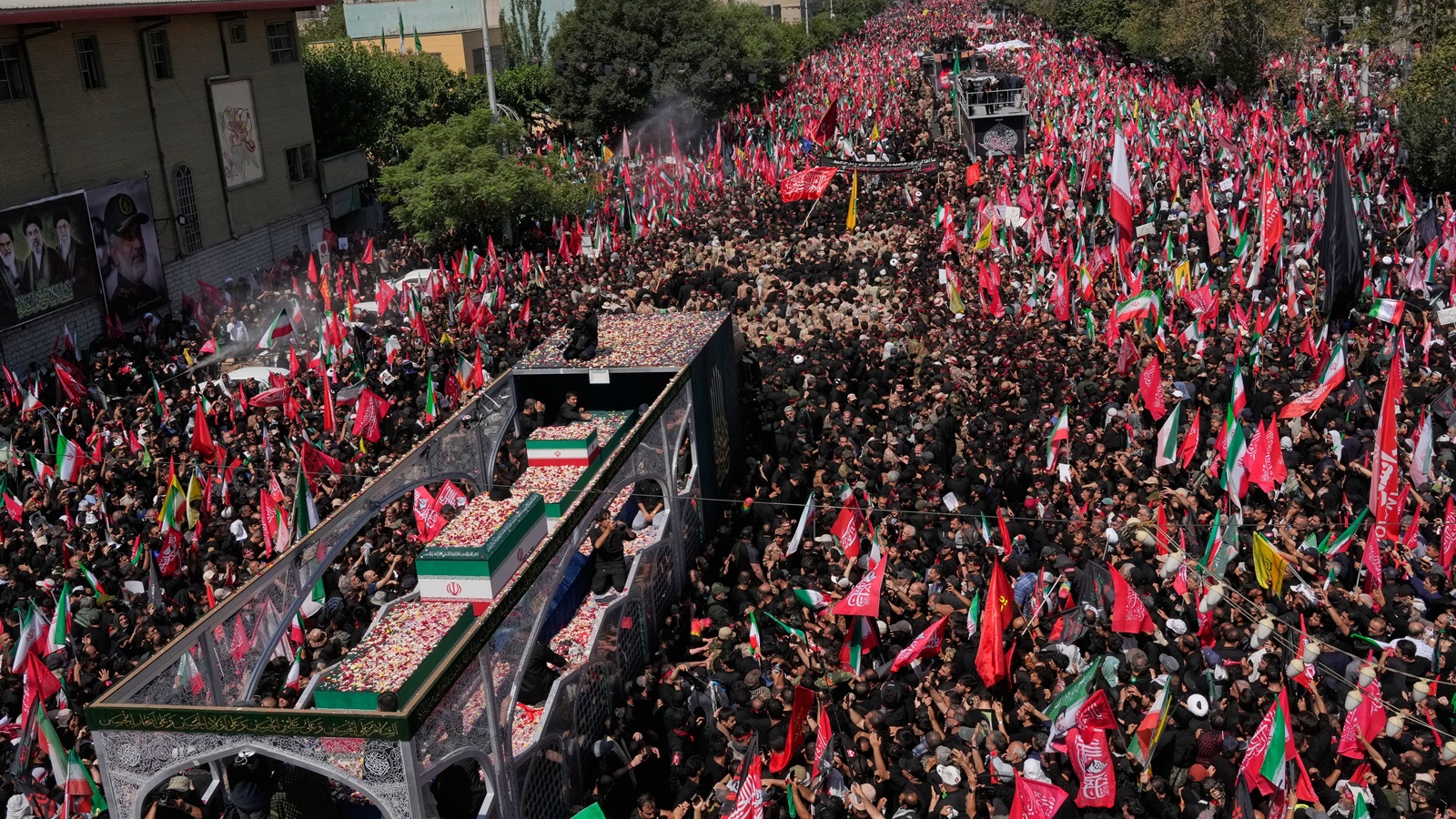
The sea of red flags choking the streets of Tehran during the multi-day funeral procession for Ayatollah Ali Khamenei is not a standard display of state mourning. It is a explicit declaration of unfulfilled blood vengeance and impending military escalation. In Shia Islamic tradition, a red flag inscribed with the phrase Ya Hussein represents blood unjustly spilled that must be avenged. By deploying these symbols across a crowd of millions following the assassination of the Supreme Leader, the Iranian state has committed itself to an multi-generational conflict with the United States and Israel, signaling that the current ceasefire is nothing more than a temporary pause.
The Theological Architecture of Retribution
To understand the strategic calculation behind the funeral choreography, one must look beyond modern geopolitics to seventh-century theology. The red banners deployed by state organizers evoke the Battle of Karbala, where Prophet Muhammad’s grandson, Imam Hussein, was killed. Historically, a red flag flew over Hussein's dome in Karbala to indicate that his death had not yet been avenged, only being replaced with a black mourning flag once retribution was enacted.
Iran previously utilized this exact psychological warfare tactic in 2020 after the assassination of Qassem Soleimani, hoisting the red flag over the Holy Dome of Jamkaran Mosque. This time, the scale is vastly expanded. The banners are no longer confined to a single mosque dome. They are carried by hundreds of thousands of state-mobilized mourners and draped directly over the Supreme Leader’s casket.
This total saturation serves a dual internal purpose. First, it reframes a devastating security failure—the targeted assassination of the longest-serving head of state in West Asia—as a holy martyrdom that cleanses the regime of its perceived weakness. Second, it locks the ruling elite into a policy of hardline resistance. By invoking the ultimate Shia symbol of vengeance, the Islamic Revolutionary Guard Corps (IRGC) leaves itself no diplomatic off-ramp. To back down now would be viewed by the regime's core loyalists as theological betrayal.
A Secretive Succession Under Fire
While the streets echo with state-sanctioned chants demanding retribution, a far more precarious crisis is unfolding inside the walls of the regime. The newly elected Supreme Leader, Mojtaba Khamenei, remains entirely absent from his father’s public funeral ceremonies.
Reports indicate that Mojtaba is in deep hiding. He was reportedly wounded in the very same joint US-Israeli airstrike that killed his father in late February. The younger Khamenei now faces the impossible task of consolidating his rule over a fractured political apparatus while under active threat of assassination. Israel has made it clear that his ascension does not grant him immunity.
The Fragmented Front Line
The regime’s internal fractures became visible during the mourning ceremonies.
- The Pragmatic Faction: President Masoud Pezeshkian and Foreign Minister Abbas Araghchi continue to advocate for delicate negotiations with Washington to preserve the fragile April ceasefire. Their position is incredibly dangerous. During a recent visit to Karbala, Araghchi was openly heckled by hardline crowds chanting "death to the appeaser."
- The Hardline Faction: The IRGC command structure, led by figures like Mohsen Rezaee, is leveraging the public anger to marginalize the reformists. They are pushing for immediate, asymmetrical retaliation along global shipping lines.
The Strait of Hormuz Chokehold
The most immediate consequence of this vow of vengeance will likely be felt in global energy markets. Iran has already begun translating the symbolic red flags into concrete maritime policy.
Iranian authorities have issued strict warnings to international oil tankers, demanding they use tightly controlled, state-approved routes within the Strait of Hormuz or face a forceful military response. Tehran is moving to impose aggressive new transit fees on maritime traffic. In a calculated move to divide the international coalition, Iran's diplomatic corps has signaled that friendly nations like Russia and China will receive special exemptions and streamlined passage.
This economic brinkmanship exposes the true nature of the regime's current strategy. Recognizing that a conventional military confrontation with the United States would be catastrophic, the IRGC is opting for economic warfare. They are forcing the international community to choose between absorbing massive shipping disruptions or forcing Washington to rein in Israeli operations permanently.
The red flags will eventually be lowered as Khamenei's body is finally interred in the Imam Reza shrine in Mashhad. But the theological and political machinery those flags set in motion cannot be easily disassembled. The Islamic Republic has signaled to its people and its enemies that the war is far from over, and the price of blood has yet to be paid.