The newly minted Washington apparatus tasked with rebuilding a flattened Gaza has hit its first major operational wall. Officials at the White House Board of Peace confirmed this week that they are bypassing deadlocked negotiations with Hamas to unilaterally construct a pilot humanitarian zone in the southern border city of Rafah. The initiative intends to place tens of thousands of screened Palestinian civilians into an administrative enclave run by a Western-backed committee of technocrats. But behind the promises of security and aid lies a harsher, more complicated blueprint. Diplomats and aid organizations on the ground argue that the project looks less like a humanitarian refuge and more like an open-air screening facility designed to institutionalize civilian displacement.
The strategy represents a high-stakes gamble by the American administration. It attempts to force a transition of power in Gaza without a formal diplomatic settlement. The Board of Peace, established under the chairmanship of Donald Trump following UN Security Council Resolution 2803 late last year, has watched its 20-point stabilization plan grind to a near-total halt. While the administration points to the pilot zone as an innovative operational starting point, veteran analysts recognize it as an admission of failure. The peace plan is stuck because it requires two opposing factions to accept an administrative arrangement that neither genuinely supports.
The Architecture of the Rafah Enclave
The mechanics of the proposed pilot zone are complex. Under the plan, a multi-national body called the International Stabilization Force will deploy to secure the perimeter of the zone, operating out of the Israeli military post at Camp Amitai just outside the Gaza border. Inside the perimeter, day-to-day administrative authority is supposed to rest with the National Committee for the Administration of Gaza, an assembly of Palestinian technocrats created under the American framework.
The vetting process is where the strategy becomes highly controversial. Security checkpoints will control access to the zone. Western planners intend to use biometric tracking and database checks to ensure that no armed individuals or individuals with active ties to militant groups can enter the enclave. The Board of Peace insists that movement for unarmed civilians will remain entirely voluntary and free.
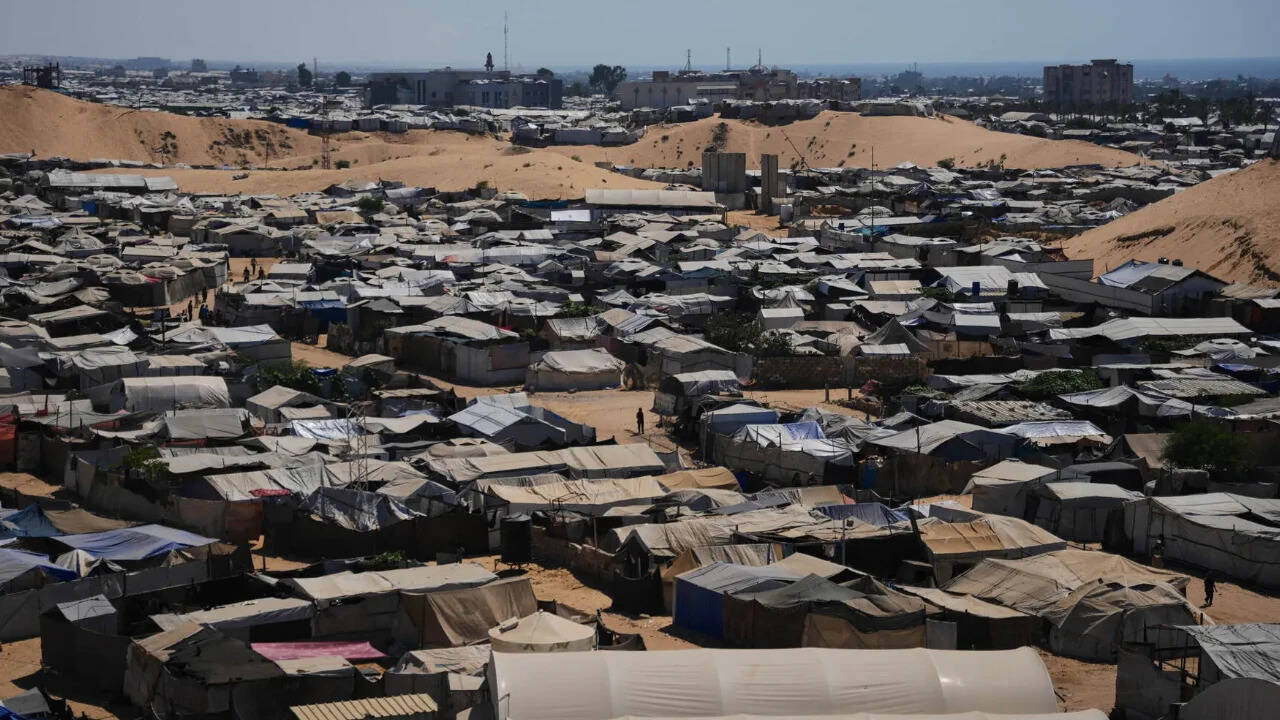
The ground reality tells a different story. Rafah has been thoroughly devastated by two years of heavy bombardment and urban warfare. The infrastructure is non-existent. Water networks are smashed, the power grid is completely destroyed, and the ground is contaminated with unexploded ordnance. To build this zone, planners are not pouring concrete or erecting permanent structures. They are instead relying on rows of mobile caravans and temporary tents.
The legal implications of this design have alarmed international legal experts. Grouping thousands of desperate civilians into a tightly controlled, heavily monitored zone with strict security screening borders on a violation of international humanitarian law. Humanitarian aid is supposed to be distributed based purely on human need, not as a reward for passing a political or military vetting process. When an occupying power or an international coalition conditions basic human survival on entry into a restricted geographic area, the line between relief and forced internment begins to blur.
The Security Buffer Paradox
The role of the International Stabilization Force presents another profound contradiction. According to internal planning documents, these international troops will be equipped primarily with non-lethal weapons to maintain internal order. They are meant to serve as a buffer. Their presence is designed to keep the Israeli military from interacting directly with the civilian population inside the enclave.
This operational layout ignores the strategic realities of the surrounding terrain. The Israeli military currently maintains direct physical control over more than 60 percent of the Gaza Strip, a figure that Israeli defense officials openly plan to expand to 70 percent under their current operational mandates. The international force will be surrounded on all sides by Israeli military positions, checkpoints, and patrol routes. If a security breach occurs inside the enclave, a force armed with rubber bullets and tear gas will have no choice but to rely on heavy Israeli military intervention. The illusion of an independent, internationally protected civilian zone vanishes the moment the first shot is fired.
The Cairo Standoff and the Disarmed Government
The political foundation of the American initiative is equally fragile. The technocrats of the National Committee for the Administration of Gaza have spent months living in hotels in Cairo, unable to actually set foot in the territory they are designated to govern. They lack a domestic political mandate, they lack an institutional presence on the ground, and they are deeply distrusted by the local population, who view them as administrative proxies imposed by Washington and Jerusalem.
Hamas has played its own tactical hand with calculated precision. The militant group recently announced the formal dissolution of its de facto civil government in Gaza, claiming it is ready to hand over administrative duties to the Cairo-based technocrats. This was a sophisticated political maneuver. By dissolving its public-facing ministries, Hamas is forcing the American administration and its allies to assume financial and logistical responsibility for a starving, desperate population of two million people.
The catch is that Hamas refuses to disarm. The group has made it clear that while it may cede control over trash collection, sewage treatment, and hospital administration, its military wing will remain completely intact. It will continue to operate from its underground network and its remaining urban pockets.
This creates an impossible situation for the incoming technocrats. No civilian administration can govern effectively when a heavily armed shadow organization retains the power to veto any decision through violence. The Board of Peace official who briefed reporters on the condition of anonymity admitted that the pilot project is an attempt to build a governance structure out of thin air, independent of a final disarmament agreement. It is an exercise in wishful thinking.
The Logistics of Temporary Settlements
The financial ledger of the Gaza reconstruction effort is staggering. The United Nations estimates that rebuilding the basic civilian infrastructure of the enclave will cost upwards of 70 billion dollars. The current American plan does not allocate funds for true reconstruction. It focuses almost entirely on temporary containment.
The decision to prohibit the use of concrete in the reconstruction of these pilot areas is telling. Israeli authorities have long classified cement and concrete as dual-use materials that can be diverted to build military tunnels and fortifications. By agreeing to a concrete ban, the Board of Peace is signaling that the Palestinian families moving into these zones will be living in temporary plastic and metal shelters for the foreseeable future.
The social consequences of long-term caravan cities are well documented across the Middle East. Temporary camps quickly turn into permanent slums. They lack economic engines, they foster deep-seated resentment, and they become prime breeding grounds for future radicalization. A generation of children growing up behind barbed wire fences, waiting in lines for vetted water rations distributed by foreign soldiers, is not a recipe for regional stability.
The Problem with International Funding
Funding the pilot zone is another unresolved crisis. The Board of Peace has stated that it intends to raise specific international funds for the Rafah project, but global donors are showing severe fatigue. European allies are wrestling with their own domestic economic pressures and deep strategic anxieties regarding shifting American foreign policy priorities.
Wealthy Gulf Arab states have repeatedly stated their position. They will not write blank checks to rebuild Gaza only to see it destroyed in the next inevitable round of military escalation. They require a clear, irreversible path to a sovereign Palestinian state before they commit billions of dollars in capital. The current pilot project offers no such path. It offers a permanent holding pattern disguised as a humanitarian transition.
The Shrinking Map of Gaza
The geographical reality on the ground undermines any narrative of a viable transition to self-governance. Since the implementation of the fragile truce last autumn, the Israeli military has steadily consolidated its hold on the land. The establishment of wide security corridors, buffer zones, and military bypass roads has carved the Gaza Strip into isolated cantons.
The Rafah pilot zone will occupy a tiny corner of an already restricted territory. If tens of thousands of people are concentrated into a few square kilometers in Tel al-Sultan, the population density will be catastrophic. The basic mathematics of space, sanitation, and resource allocation simply do not add up.
The broader strategy appears to be the creation of a series of these vetted enclaves across the strip, a network of isolated civilian islands managed by international security personnel and surrounded by a permanent military presence. This arrangement would allow the Israeli defense establishment to maintain indefinite security control over the territory while outsourcing the logistical nightmare of feeding and policing the population to a coalition of Western and Arab states.
The internal contradictions of the Board of Peace policy are tearing the plan apart before the first caravan is even delivered to Rafah. You cannot build an independent Palestinian administration while keeping its members exiled in Cairo. You cannot guarantee civilian safety using non-lethal peacekeepers in a territory controlled by a conventional army. Most importantly, you cannot achieve peace by treating an entire population as a security threat to be vetted, contained, and managed inside a temporary zone. The Rafah pilot project is not the beginning of a reconstruction era; it is the formalization of a partition that settles nothing.