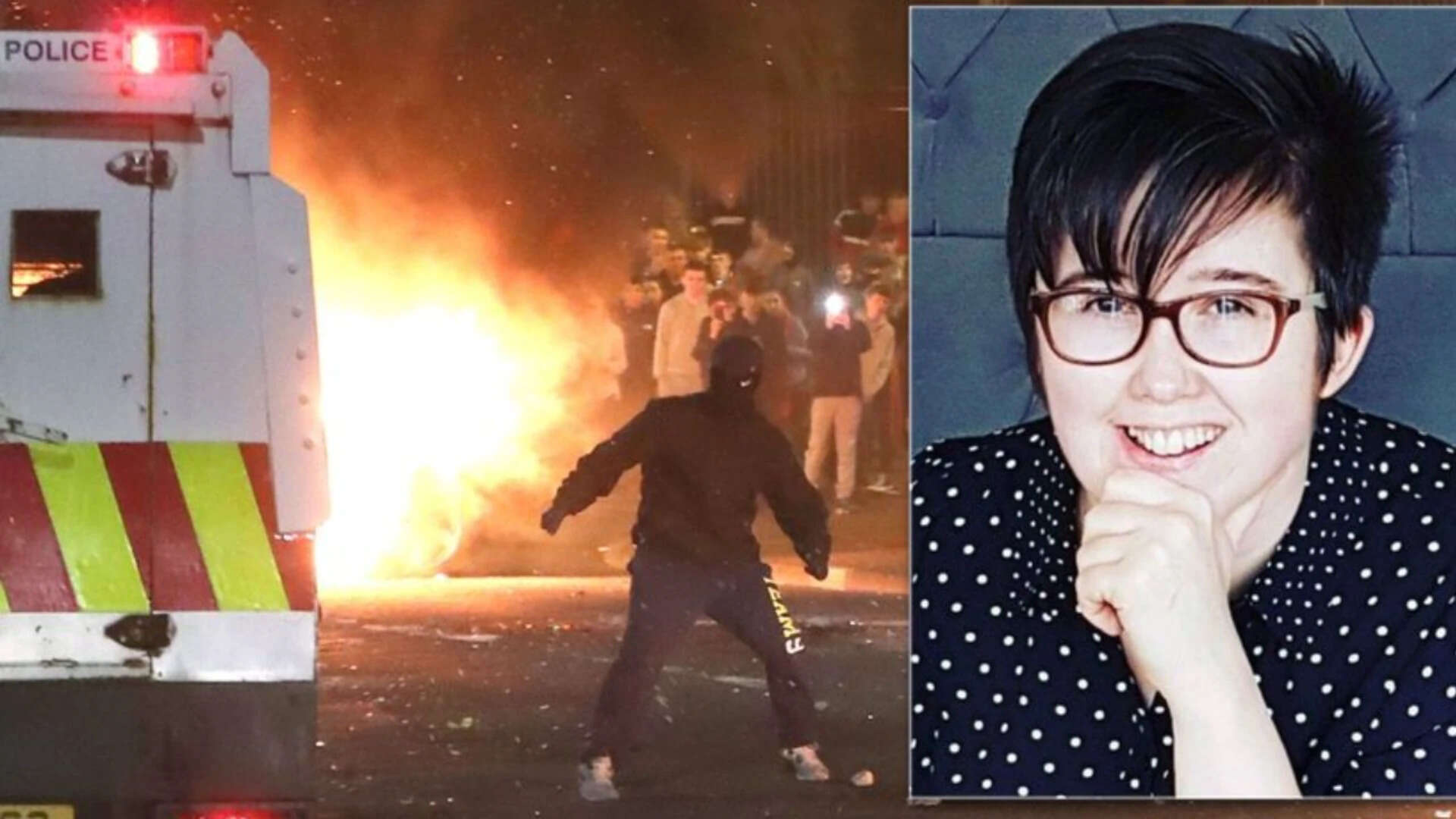
The Belfast Belfast Crown Court ruling that acquitted three men of the murder of journalist Lyra McKee did not shock those who understand the mathematics of Northern Irish paramilitary trials. It exposed a systemic breakdown. McKee, a gifted twenty-nine-year-old investigative writer, was shot in the head in April 2019 while standing near a police vehicle during a night of orchestrated rioting in Derry’s Creggan estate. The New IRA claimed responsibility, offering a hollow apology for killing a civilian. Yet, five years later, the state’s attempt to secure a murder conviction against the individuals it placed at the scene dissolved into a familiar judicial dead end.
The failure to secure these convictions underscores a deeper, more troubling reality. The legal framework of Northern Ireland remains structurally unequipped to pierce the wall of silence that protects paramilitary leadership, relying instead on flawed visual evidence and archaic joint-enterprise doctrines that frequently buckle under intense legal scrutiny.
The Anatomy of a Modern Riot
To understand why the prosecution’s case disintegrated, one must look at how modern paramilitary violence operates in places like Creggan. This is not the spontaneous rage of an aggrieved crowd. It is a highly choreographed urban theater designed specifically to draw police forces into narrow enclaves where they can be targeted.
On the night McKee died, local youths were directed to throw petrol bombs and stones at armored police Land Rovers. The purpose was chaos, a smoke screen. Behind the front lines of teenagers stood the older, more experienced members of the New IRA. They wore matching tracksuits, surgical masks, and gloves. They worked in cells, ensuring that the person who pulled the trigger was insulated by multiple layers of scouts, lookouts, and human shields.
When the gunman stepped from behind a wall and fired a handgun toward police vehicles, he did so with the certainty that dozens of cell phone cameras would capture the flash, but none would capture his face. The state’s case rested heavily on mobile phone footage and television documentaries being filmed in the area that night. Prosecutors tried to use clothing matches, height estimations, and gait analysis to prove that the three accused men were the individuals standing alongside the gunman, thereby making them legally culpable for the murder under the principle of joint enterprise.
It was a gamble that underestimated the meticulous nature of paramilitary counter-forensics.
The Joint Enterprise Trap
The British legal system relies heavily on joint enterprise to prosecute gangland and paramilitary killings. The doctrine dictates that if you are part of a group that intends to commit a crime, and you foresee that someone in that group might commit murder, you are just as guilty as the person holding the weapon.
In Northern Ireland, this doctrine faces an insurmountable hurdle. The defense teams dismantled the prosecution’s identification evidence piece by piece. They argued that in a crowd of dozens of similarly dressed individuals moving through dark, smoke-filled streets, matching a specific pair of trainers or a generic dark jacket to a specific defendant is an exercise in guesswork, not law.
The judge agreed. Without definitive forensic proof—such as DNA on the weapon or gunshot residue directly linking the defendants to the exact moment the trigger was pulled—the legal standard of beyond a reasonable doubt could not be met. The men were convicted of rioting and possession of petrol bombs, but the murder charge evaporated.
This exposes the fundamental flaw in the state’s strategy. By trying to fit a complex, asymmetric paramilitary operation into the standard box of a criminal trial, the Public Prosecution Service exposed its own limitations. The state tried to prove presence and intent through grainy, obscured video footage, while the real architects of the violence remained completely out of frame.
The Silence of the Streets
There is a myth that communities like Creggan stay silent out of sympathy for republican dissidents. The reality is far more transactional. It is driven by fear and a historical distrust of the apparatus of the state.
Following the murder, there was a public outcry. Politicians from all sides condemned the killing, and local residents held vigils, placing red handprints on the walls of the local dissident republican headquarters. For a brief moment, it looked as though the community might turn its back on the gunmen.
That moment passed quickly. When the police began knocking on doors looking for witnesses, they were met with the traditional closed lip. In these neighborhoods, giving a statement to the Police Service of Northern Ireland is not seen as doing your civic duty. It is seen as an act of betrayal that carries a sentence of exile, knee-capping, or death.
The state has failed to provide a witness protection infrastructure that feels safe to the average citizen. To testify against a member of an active paramilitary group means abandoning your home, your family, your job, and your identity. The state asks ordinary people to perform acts of extraordinary heroism while offering them nothing but a life on the run in return. Until that calculus changes, the courts will continue to rely on flawed circumstantial evidence and video clips, and trials will continue to fail.
The Evolution of the New IRA
The group that killed Lyra McKee is not the provisional IRA that signed the Good Friday Agreement. The New IRA is a amalgam of unaligned dissidents, criminal elements, and younger recruits who never lived through the worst of the Troubles but are captivated by its mythology.
They do not possess the military capability of their predecessors, but they are lethal enough to destabilize a fragile peace. They fund their operations through smuggling, extortion, and fuel fraud, operating more like an organized crime syndicate with a political veneer than a true liberation movement.
By failing to secure a murder conviction for McKee, the state has inadvertently handed these groups a propaganda victory. It allows them to tell their young recruits that the state is weak, that its courts cannot convict them, and that their tactics of anonymity and intimidation are effective.
The prosecution’s defeat in the Belfast Crown Court is a warning sign. It demonstrates that the current legal tools are spent. If the justice system cannot evolve to handle the realities of modern, masked, urban guerrilla tactics, then the individuals who pull the triggers will continue to walk away from the docks, leaving the victims of their violence with nothing but empty promises of justice.