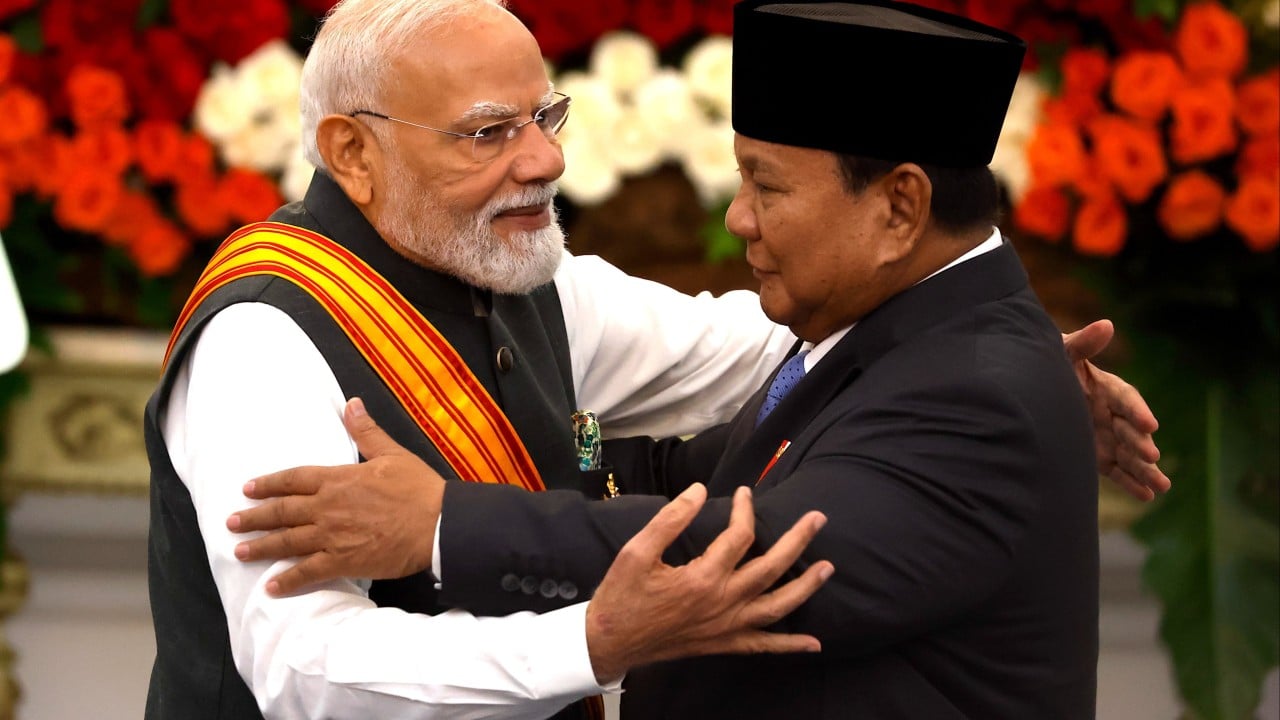
India will supply Indonesia with two batteries of BrahMos supersonic cruise missiles and Astra beyond-visual-range air-to-air systems under a sweeping defense package worth an estimated $630 million. The deal, signed in Jakarta during Prime Minister Narendra Modi’s state visit with Indonesian President Prabowo Subianto, marks a critical shift in how Southeast Asian nations defend their sovereign maritime boundaries. This is not a simple transaction between a supplier and a buyer. It is an aggressive, calculated restructuring of regional deterrence that targets the exact vulnerabilities of a changing Indo-Pacific balance of power.
For years, Southeast Asian capitals watched Beijing rewrite the rules of the South China Sea through island reclamation and aggressive naval policing. Western defense contractors offered expensive, highly conditional alternatives that often came with political strings or long production backlogs. New Delhi offered something else entirely. It offered immediate, lethal asymmetry. By placing supersonic anti-ship missiles on the rim of the Natuna Islands, Jakarta is telling Beijing that the cost of encroaching on its exclusive economic zone has just gone up exponentially. For a different view, check out: this related article.
Breaking the Western Monopoly on Maritime Deterrence
Capital warships are extraordinarily expensive to build and maintain. A modern frigate can easily cost a middle-income country close to a billion dollars, requiring years of crew training and specialized maintenance facilities. Missiles are different. A single battery of land-based, mobile anti-ship cruise missiles can hold an entire naval task force at bay from a hidden position on a remote coastline.
Indonesia has an immense coastline to defend. The archipelago spans thousands of islands, making traditional naval patrolling an impossible game of whack-a-mole against illegal fishing fleets and foreign maritime militia vessels. By selecting the BrahMos system, Jakarta is opting for defensive denial. The system travels at speeds approaching Mach 3, flies low to skim the water, and can alter its trajectory to evade shipboard radar and defense systems. Similar coverage on the subject has been provided by The New York Times.
This contract alters the calculus of regional defense procurement. Historically, Southeast Asian nations relied on American, European, or Russian hardware. The American options often come with restrictive end-user monitoring agreements that limit where and how the weapons can be deployed. European systems are high-quality but come with premium price tags and extended delivery schedules. India has positioned its domestic defense industry as a middle ground, providing high-velocity weaponry without the geopolitical lecturing or fiscal strain.
The Sukhoi Connection and the Astra Integration
The broader strategic reality of this deal lies in the secondary component of the package, which includes the Astra beyond-visual-range air-to-air missile system. This choice reveals the pragmatic nature of Indonesian defense planning. The Indonesian Air Force operates a mixed fleet of fighter aircraft, including Russian-made Sukhoi Su-27 and Su-30 jets.
Integrating Western weaponry onto Russian airframes is a notorious engineering nightmare. Software source codes are closely guarded secrets, and neither Washington nor Moscow is particularly eager to help their hardware communicate with a competitor’s system. India, however, has spent decades managing exactly this type of hybrid fleet. The Indian Air Force successfully integrated its indigenous Astra missiles onto its own fleet of Su-30MKI fighters, resolving the complex software and mechanical hurdles that come with mixing disparate defense technologies.
Jakarta noticed. By purchasing the Astra missile from India, Indonesia avoids the necessity of buying brand-new, Western fighter jets just to acquire modern, long-range air combat capabilities. It breathes new life into its existing Russian-built fleet without having to negotiate directly with a sanctioned Moscow. This technical compatibility provides Jakarta with immediate capability upgrades while completely bypassing the diplomatic minefields associated with purchasing directly from Russian state export agencies under current global restrictions.
The Shadow of Moscow in the South China Sea
The BrahMos missile itself is a product of a joint venture between India’s Defense Research and Development Organization and Russia’s NPO Mashinostroyeniya. This joint lineage is highly significant. While Western nations have tried to isolate Moscow from global defense supply chains, India has maintained its defense production lines by serving as the primary manufacturing hub for these systems.
This arrangement suits Jakarta perfectly. Indonesia has historically maintained a non-aligned foreign policy, refusing to take sides in great-power rivalries. Buying weapons from India allows Indonesia to access Russian-derived missile technology without triggering Countering America's Adversaries Through Sanctions Act penalties from the United States. It creates a convenient diplomatic buffer.
Furthermore, this supply chain configuration exposes a quiet, under-reported geopolitical consensus. Moscow is highly dependent on Beijing for economic survival, but it remains deeply uncomfortable with total Chinese hegemony in Asia. By allowing India to export BrahMos technology to Southeast Asian states like the Philippines, Vietnam, and now Indonesia, Russia subtly hedges against its dominant northern neighbor without openly alienating Beijing. It is a quiet balance of power played through the mechanism of third-party defense manufacturing.
Why Beijing Cannot Easily Counter This Deal
The reaction from Beijing has been predictably muted but watchful. China has long used its economic leverage and massive coast guard vessels to bully smaller littoral states in the South China Sea. However, the introduction of supersonic cruise missiles across the First Island Chain changes the risk equation for the People’s Liberation Army Navy.
If a crisis occurs, a Chinese surface combatant entering the waters around the Natuna Islands must now account for multiple, unpredictable launch points. The BrahMos can be launched from mobile autonomous launchers hidden in dense coastal jungle, making pre-emptive destruction exceptionally difficult for foreign intelligence agencies to guarantee. This introduces a high level of operational uncertainty into Chinese naval planning.
Beijing’s typical toolkit of economic coercion is also less effective in this scenario. Indonesia is not a small, economically vulnerable island state; it is a massive, resource-rich G20 economy with a rapidly modernizing military under a defense-minded president. President Prabowo has made it clear that while Indonesia values its trade relationship with China, territorial integrity is non-negotiable. The acquisition of these long-range missiles provides the hard military backing required to make that diplomatic stance credible.
A Trade for Critical Minerals
Defense deals do not happen in a vacuum, and this agreement is anchored by a deeper economic exchange that extends far beyond rocket motors and guidance systems. Alongside the missile contracts, Modi and Prabowo signed extensive agreements regarding critical minerals and steel production supply chains.
Indonesia controls roughly 21 percent of the world’s known nickel reserves and ranks as a global leader in the production of copper, bauxite, and tin. India needs these materials to power its own domestic industrial expansion and electronic manufacturing sectors. The convergence of India’s need for raw industrial inputs and Indonesia’s need for sophisticated defense hardware created the perfect foundation for a long-term strategic swap.
This economic linkage ensures that the relationship is sustainable over decades. Security partnerships built solely on shared anxieties about a neighbor often dissolve when political leaders change or regional tensions temporarily cool. By binding the missile transfers to the physical flow of critical industrial minerals, New Delhi and Jakarta have constructed a defense relationship grounded in mutual commercial dependence. This makes the partnership resistant to shifting political winds in either capital.
The strategy of the modern Indo-Pacific is no longer defined by massive, overarching alliances like NATO. It is defined by overlapping, transactional, and intensely practical security partnerships. By supplying Indonesia with the means to defend its own waters, India has established itself as an indispensable security provider in Southeast Asia, turning the Malacca Strait into a shared zone of defense rather than a vulnerable chokepoint.