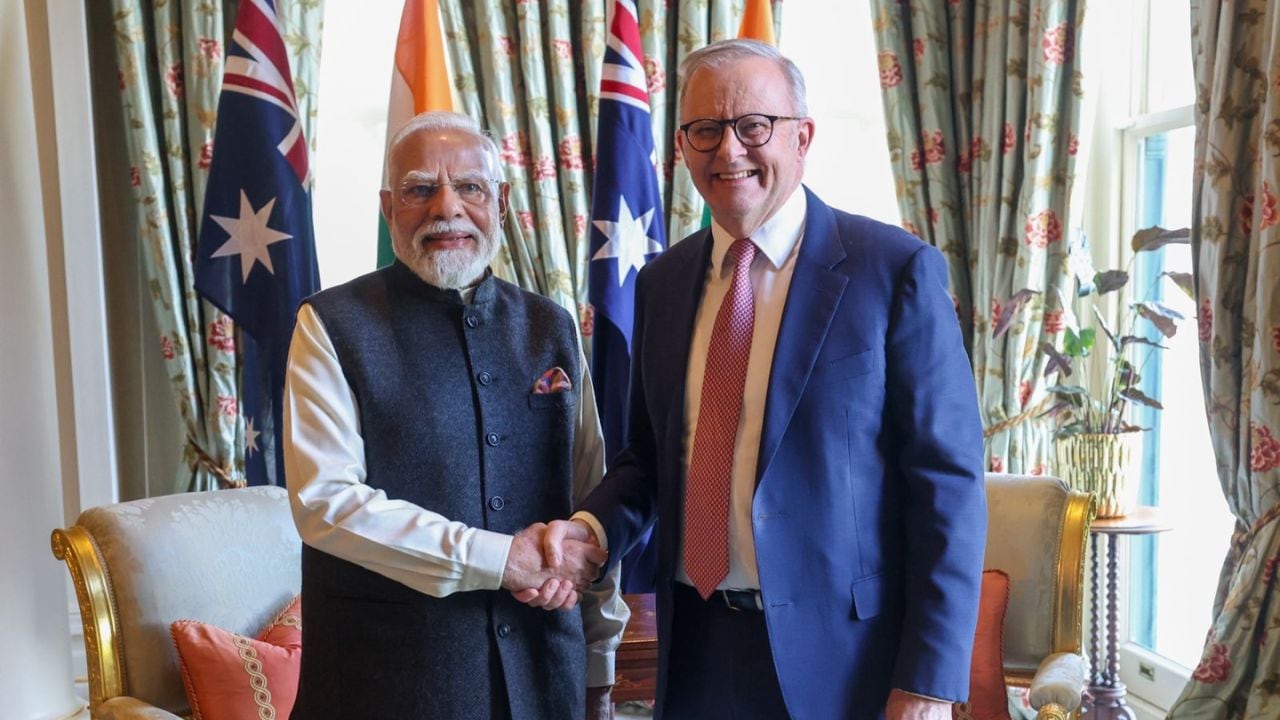
The newly minted critical minerals and uranium corridor between New Delhi and Canberra is being hailed as the master stroke that will finally decouple global tech supply chains from China. When Prime Ministers Narendra Modi and Anthony Albanese finalized the historic administrative arrangement for commercial uranium supply in Melbourne, alongside the multi-pillared Partnership for Cyber, Critical Technologies and Supply Chains, the markets cheered. The primary reality, however, is far less celebratory. This alliance will struggle to loosen Beijing’s stranglehold because Australia owns the raw ore, but China still owns the processing infrastructure required to turn that ore into usable technology.
Signing eighteen accords and setting up a diplomatic framework does not instantly build refineries, nor does it magically bypass the decades-old processing monopolies that Western democracies spent years outsourcing. What occurred in Melbourne was not a commercial solution, but a geopolitical positioning exercise.
The Downstream Bottleneck Nobody Talks About
For over a decade, the 2014 civil nuclear cooperation pact between India and Australia sat frozen. The obstacle was never a lack of desire; it was a grueling, two-year bureaucratic standoff over tracking protocols, IAEA safeguards, and the strict accounting of fissile material. Resolving this allows Australia to ship yellowcake uranium to fuel India’s ambitious target of 100 gigawatts of nuclear capacity by 2047.
But mining uranium or unearthing lithium, neodymium, and dysprosium is only the first step of an incredibly complex industrial ladder. The market frequently confuses resource abundance with supply chain independence. Australia possesses the world’s largest reserves of uranium and immense deposits of critical minerals, yet it ships the vast majority of its unrefined lithium spodumene directly to Chinese ports.
Why? Because building a refinery is an environmental nightmare and a financial black hole.
[Raw Ore Extraction] ---> [Chemical Refining & Purification] ---> [Component Manufacturing] ---> [Final Tech Output]
   (Aus / India)                  (China Dominance)                     (India Production)            (Global Markets)
China controls over 60 percent of global lithium processing, 70 percent of cobalt refining, and an astonishing 90 percent of rare earth element magnet production. If India wants to build electric vehicles, advanced defense systems, or solar panels using Australian minerals, it cannot simply import raw dirt from Western Australia. The material must be converted into high-purity chemicals and metals. Currently, all roads to that conversion run through mainland China.
The Mirage of the Critical Minerals Corridor
The newly established critical minerals corridor aims to map new deposits and coordinate bilateral investments to build a trusted vendor framework. The economics, however, tell a different story.
Consider the capital expenditure required to establish a modern rare earth separation plant. It takes nearly a decade to clear environmental regulatory hurdles, construct the facilities, and stabilize the delicate chemical processes required to separate elements that are structurally almost identical. China achieved its dominance not through luck, but through three decades of deliberate state-subsidized underpricing that bankrupted Western competitors.
Whenever a viable alternative refinery emerges in the West or in Asia, Beijing possesses the market power to flood the global market, crash commodity prices, and render the new facility financially unviable.
+---------------------------+---------------------------+---------------------------+
| Mineral Type              | Mining Dominance          | Refining Dominance        |
+---------------------------+---------------------------+---------------------------+
| Rare Earth Elements       | Diverse (Global)          | China (~90%)              |
| Lithium                   | Australia / South America | China (~60%)              |
| Cobalt                    | DRC                       | China (~70%)              |
+---------------------------+---------------------------+---------------------------+
India’s domestic manufacturing push, driven by Production Linked Incentive schemes, expects a steady stream of processed materials to feed its new factories. Relying on Australia for raw materials without an intermediate processing strategy means New Delhi is merely shifting its vulnerability from one node of the supply chain to another.
Defense Interoperability is the Real Prize
While the media focuses heavily on the commercial prospects of green energy and battery tech, the true engine of this sudden diplomatic urgency is maritime defense in the Indo-Pacific. The signing of the Maritime Security Collaboration Roadmap and the launch of the India-Australia Defense Innovation Corridor reveal the actual priorities of both capitals.
Canberra’s decision to commission a temporary space tracking terminal on the Cocos Islands to support India’s Gaganyaan human spaceflight mission is a significant strategic shift. The Cocos Islands sit atop critical Indian Ocean sea lanes. By placing tracking infrastructure there and expanding aircraft deployments from each other’s territories, both nations are quietly constructing an intelligence and surveillance net designed to monitor Chinese naval movements.
This is where the alliance holds real weight. The integration between the Indian Coast Guard and Australia's Maritime Border Command provides concrete operational utility. It allows for real-time information sharing and joint logistics in ship repair and maintenance, which creates a highly functional naval partnership even if the economic agreements take years to yield results.
The Fragile Economics of the Trade Treaty
The push to expedite the Comprehensive Economic Cooperation Agreement highlights another structural friction point. The two countries signed an interim trade deal in 2022, but progressing to a full treaty has exposed deep domestic protectionist instincts on both sides.
India remains intensely protective of its agricultural sector, particularly its dairy industry, which fears being overwhelmed by highly efficient Australian agribusinesses. Australia, conversely, faces domestic political pressure regarding the influx of temporary skilled labor and the environmental impact of rapidly scaling up mining operations to meet foreign demand.
The rhetoric of being "natural and trusted partners" cannot erase these basic economic frictions. For the partnership to mature into a genuine counterweight, both governments must move past the easy wins of signing memoranda and confront the harder task of funding joint refining infrastructure. Without direct state capital injections to build processing plants that can withstand Chinese price manipulation, the critical minerals corridor will remain a collection of well-intentioned press releases. Securing the mines is meaningless if you do not secure the factories that turn the ore into assets.