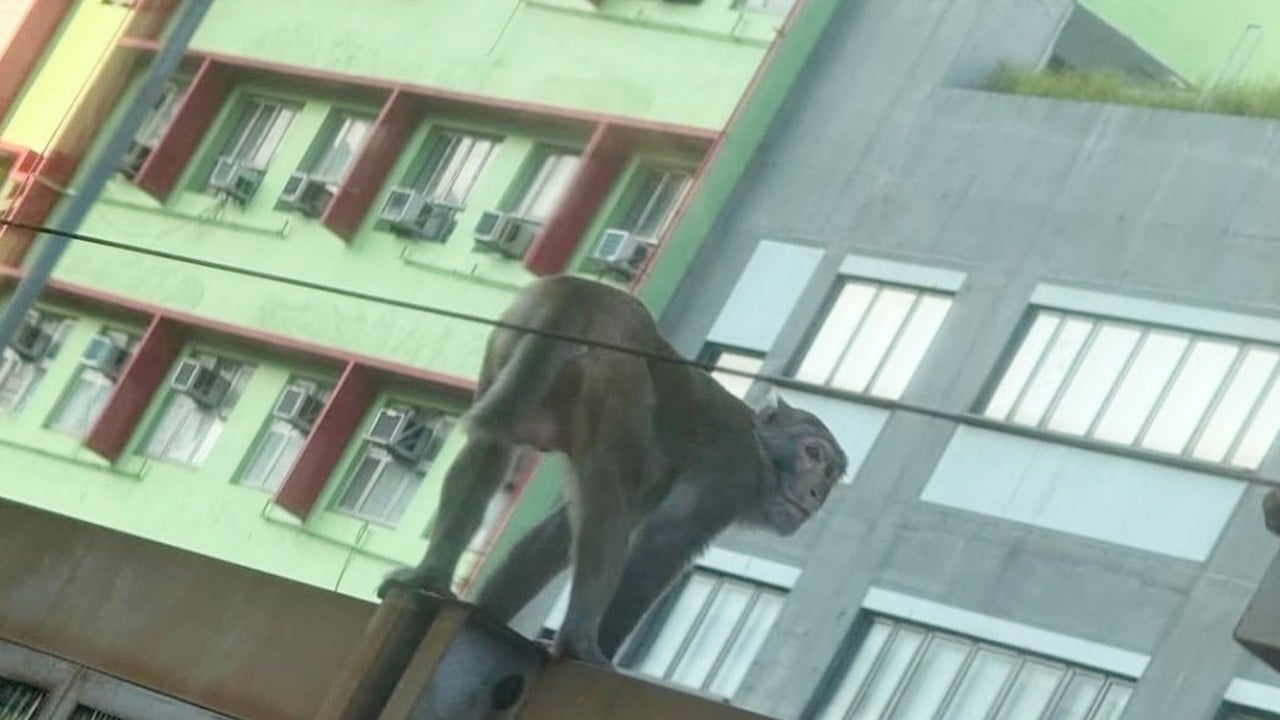
Blaming a wild monkey for crippling one of the world's most sophisticated rail networks during morning rush hour is top-tier corporate public relations. It is also an absolute lie.
When news broke that a lone macaque made its way onto the MTR tracks between Sha Tin and Tai Wai, the media parroted the official narrative without hesitation. Outraged commuters vented on social media, tabloid headlines cracked predictable puns about primate disruption, and transit authorities quietly congratulated themselves on prioritizing safety over speed.
It is a comfortable story. A chaotic act of nature invades a hyper-engineered urban system, leaving helpless operators with no choice but to hit the emergency brakes.
Except that is not how modern mass transit engineering works.
The real breakdown in Hong Kong was not biological. It was structural, algorithmic, and operational. Blaming wildlife is merely the convenient cover story masking a far deeper issue: the MTR's hyper-fragile optimization protocol that sacrifices operational resilience for micro-efficiency gains.
The Myth of the Unpredictable Primate
Hong Kong’s native rhesus macaques have lived in the Kam Shan and Shing Mun country parks for over a century. Their presence is not a black swan event. It is a known, permanent geographic variable.
Tai Wai station sits at the literal threshold of these forested hills. Expecting monkeys not to enter urban rail infrastructure when concrete corridors continuously encroach on their natural habitats is not bad luck; it is incompetent risk management.
I have spent years analyzing urban infrastructure resilience, watching multi-billion-dollar transit authorities sink massive budgets into automated train control systems while ignoring basic boundary engineering. When a single animal on a track perimeter brings a network carrying over four million passengers daily to a grinding halt, you are not looking at a wildlife problem. You are looking at a system design failure.
Transit operators love blaming external intrusions because it absolves them of responsibility. If a power grid fails due to poor maintenance, executives face accountability. If a monkey climbs an overhead power line, management gets to shrug, quote safety protocols, and issue a polite apology on a digital display board.
The public swallows it every single time.
Safety Margins or Safety Theater?
Let us dissect what actually happens when a track intrusion occurs on a modern automated rail line.
The MTR relies heavily on Communication-Based Train Control (CBTC). CBTC is designed to maximize throughput by allowing trains to run at tight headways—sometimes less than 90 seconds apart. It relies on precise positioning, automated trackside sensors, and continuous radio communications to maintain dynamic moving blocks around every train.
When a sensor detects an unauthorized object or track breach, the default system action is binary: immediate service interruption.
Here is the catch that MTR engineers rarely talk about.
Modern track detection systems cannot differentiate between a 15-kilogram monkey, a fallen tree branch, a piece of windblown trash, or a human intruder. To avoid liability, transit operators configure track safety parameters to the absolute highest sensitivity setting.
This sounds responsible until you realize the trade-off.
By setting sensitivity to zero-tolerance thresholds without implementing physical exclusion barriers or secondary verification layers, operators create a system that is wildly hyper-sensitive to false alarms and minor disturbances. They build networks that are mathematically optimized for blue-sky conditions, yet functionally brittle the moment reality interferes.
Imagine a scenario where a highway department shuts down a four-lane interstate for two hours every time a stray squirrel runs across the shoulder. Drivers would revolt. Yet on urban railways, this exact lack of proportionality is rebranded as "uncompromising safety standards."
It is not safety. It is risk aversion masquerading as system integrity.
The Cost of Hyper-Efficiency
The Hong Kong MTR is globally celebrated as a transit benchmark. It boasts on-time performance metrics above 99 percent. It operates at an enviable profit, primarily by combining real estate development with rail transport.
That very obsession with top-line metrics creates the vulnerability.
When a system operates at 98 percent capacity with 90-second train intervals, there is zero buffer. No redundancy. No elasticity. A three-minute delay on a single line causes a cascade failure across three connecting lines within fifteen minutes.
To maintain that fragile 99 percent reliability statistic on paper, operators train the system to trigger immediate hard stops at the slightest anomaly. The metric stays intact because the stop is classified as a "safety delay" rather than a system fault, keeping management bonuses safe while commuters bake on overcrowded platforms.
The true operational breakdown occurs in the ripple effects:
- Platform Crowding Hazards: Halting trains mid-route dumps tens of thousands of passengers onto narrow station platforms, creating genuine crowd-crush risks that far exceed the physical danger posed by a monkey on a distant track bed.
- Secondary Network Strain: Surface transport options—buses, taxis, ride-shares—are instantly overwhelmed, causing citywide gridlock.
- Systemic Stress: Rapid emergency braking and restarting puts unnecessary mechanical stress on rolling stock and overhead line equipment.
The refusal to build elastic operational buffers into high-frequency rail schedules means every minor track intrusion carries the economic disruption of a major power outage.
Physical Isolation vs. Algorithmic Blindness
How do you actually solve a problem that Hong Kong transit officials treat as an act of God? You stop relying solely on track-circuit software to do the job of physical civil engineering.
The solution is neither complex nor impossibly expensive for an organization with the financial resources of the MTR Corporation.
First, standard physical exclusion zones near country park borders are shockingly outdated. High-tension anti-climb fencing, modern acoustic deterrents, and physical track enclosures at critical junction points near Tai Wai and Sha Tin should have been standard infrastructure decades ago.
Second, the insistence on manual visual inspection every time an intrusion sensor triggers is an obsolete paradigm. High-speed computer vision systems mounted on lead maintenance vehicles or trackside AI cameras can instantly categorize intrusions in real time. Distinguishing a human on the track bed from a small mammal takes modern visual recognition software milliseconds.
If the system identifies a non-hazardous animal away from high-voltage catenary wires, operational protocols should allow automated trains to proceed at restricted speed under driver oversight, rather than shutting down an entire line for an hour while staff hunt down a monkey with nets.
Why has this not been deployed across every vulnerable sector? Because updating operational handbooks requires regulatory courage, and buying physical barriers offers lower short-term returns than building another shopping mall over a station depot.
The Uncomfortable Reality of Mass Transit Failures
There is a cost to challenging the narrative. Adopting nuanced intrusion responses instead of total network shutdowns shifts legal liability back onto the operator. If a train strikes an animal and suffers minor damage under a "proceed at restricted speed" protocol, the MTR Corporation bears direct responsibility. If they freeze the network for two hours, the wild monkey takes the blame.
Corporate risk mitigation will always choose public inconvenience over corporate liability.
The morning commute in Hong Kong did not break down because nature invaded the machine. It broke down because the machine is designed to break down at the first sign of friction, shielding its operators from risk while forcing millions of citizens to bear the cost of lost time, missed work, and degraded urban mobility.
Until transit authorities stop hiding behind animal scapegoats and start designing resilient systems that account for real-world variables, a single monkey will always have the power to bring a global financial center to its knees.