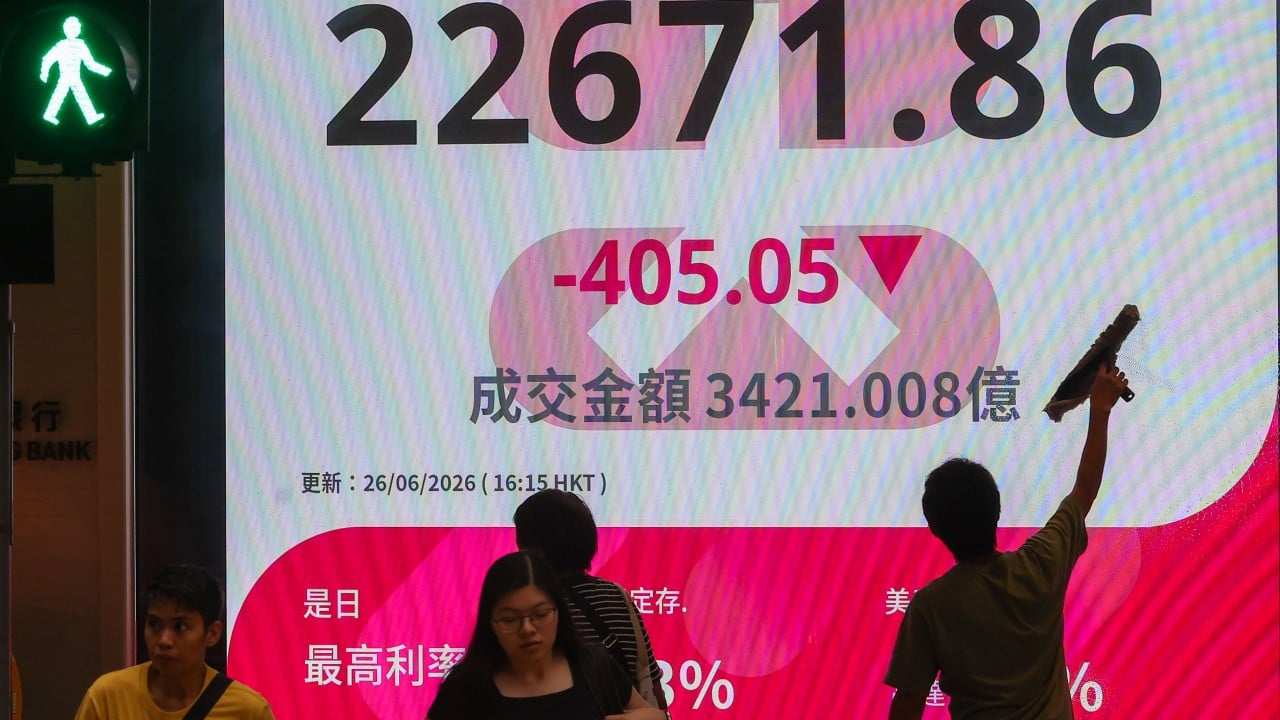
The Hong Kong stock market is lagging behind global peers because its largest component sectors are locked in structurally damaging domestic price wars, coupled with an acute absence of the hardware-focused artificial intelligence infrastructure driving other Asian indexes.
While the S&P 500, Japan's Nikkei, and Taiwan's TWSE break historic valuation records, the Hang Seng Index has slid into a painful technical correction. It is down nearly 9% from its January highs. Worse yet, the Hang Seng China Enterprises Index recently crossed the threshold into a formal bear market, dropping 20% from its October peak. Meanwhile, you can read related developments here: Why Everything You Know About Trumps Two Billion Dollar Fortune Is Completely Wrong.
The prevailing narrative blames a generalized slowdown in China or lingering geopolitical friction. That analysis is incomplete. The underlying reality is far more specific and deeply institutional. To understand why Hong Kong has become an underperforming outlier, one must look at the structural mechanics of its dominant tech giants and a punishing consumer slump on the mainland.
The Burden of E-Commerce and Delivery Price Wars
The primary engines of the Hang Seng Index are no longer high-growth tech platforms. They have transformed into low-margin, fiercely competitive battlegrounds. To understand the full picture, check out the detailed report by The Wall Street Journal.
Consider Meituan. The food and grocery delivery titan has dropped more than 22% this year, weighed down by a relentless price war against JD.com and Alibaba. In an attempt to protect market share, these firms are funneling capital into consumer subsidies, fast-delivery logistics, and aggressive user-experience incentives. This has savaged their operating margins.
Alibaba Group presents an even starker warning. Despite a massive push into cloud computing and corporate restructuring, its net profit recently plummeted by 84% in a single quarter as it attempted to fund both its AI development and its defensive retail price cuts. In a mature market, long-term investors buy equities based on predictable corporate earnings and sustainable cash flow. In the current mainland environment, the focus of competition has devolved from expanding order volumes to brutal margin preservation.
The strategy has fundamentally changed how global institutions view these assets. Buy-and-hold investing has vanished from the tech sector. It has been replaced by short-term trading strategies designed to capture momentary policy shifts from Beijing rather than fundamental business growth.
The Hardware Disadvantage
A glaring flaw in the Hang Seng Index is its structural imbalance. It lacks the massive, hardware-focused semiconductor and networking leaders that have fueled explosive growth in neighboring markets.
- South Korea relies on Samsung Electronics and SK Hynix to anchor the Kospi Index, capturing global memory chip demand.
- Taiwan rides the wave of Taiwan Semiconductor Manufacturing Company (TSMC) to consecutive record highs.
- Hong Kong features an index dominated by consumer internet software, real estate developers, and traditional banking institutions.
The few tech hardware firms listed in Hong Kong simply lack the scale to offset the index laggards. Lenovo Group has surged by over 60% due to soaring PC and server demand, but its weighting is insufficient to drag the wider benchmark out of its rut.
Xiaomi, frequently viewed as a hardware alternative, fell 27% as rising global memory and component chip prices compressed its hardware margins. The company pays more for the semiconductors it needs to build its products, yet it cannot fully pass those costs on to an increasingly cautious consumer base.
Hang Seng Structural Imbalance:
[Consumer Internet / Financials / Property] ----> ~80% of Index Weight
[AI Infrastructure / Advanced Semiconductors] --> Minimal Footprint
The Catch-22 of AI Capital Expenditure
Tech giants on the Hang Seng Index are caught in an expensive trap. To stay relevant, companies like Tencent and Baidu must spend aggressively on AI research, development, and data centers.
Tencent Holdings recently posted disappointing financial results, missing revenue expectations by booking 196.5 billion yuan against the 199 billion yuan Wall Street anticipated. The culprit was a clear slowdown in its core gaming segment, combined with an escalation in capital expenditure for artificial intelligence.
The returns on these massive AI investments remain highly muted for Chinese internet firms compared to their American counterparts. While US software giants can readily monetize AI infrastructure through global cloud architectures, domestic limitations and regulatory guardrails compress the monetization funnel for mainland enterprises. Money goes out; minimal profit comes in.
A Consumer Slump the Data Cannot Hide
Beyond the boardroom, the macroeconomic reality on the ground is stifling equity valuations. Mainland retail sales figures have decelerated sharply, contracting on a month-on-month basis. May retail data recorded its first year-on-year contraction since the pandemic era.
The ongoing property market unwinding remains a severe anchor. Massive liabilities among mega-developers have locked up domestic household wealth. Chinese household deposits reached a staggering RMB 167 trillion, yet this capital sits completely frozen in traditional bank accounts. Consumers are refusing to spend, and retail herds are refusing to invest in equities.
Even minor regulatory relaxations, such as the quiet abandonment of the strict "three red lines" balance sheet indicators for property developers, have failed to spark a revival. The psychological damage to the domestic consumer is already done.
The Institutional Disconnect
Global fund managers are looking at alternative regions where corporate earnings growth is backed by structural tailwinds rather than state-directed reflation efforts. In past cycles, a depressed Hang Seng Index signaled a generational buying opportunity based on low price-to-earnings ratios.
Today, those low multiples are increasingly viewed not as a discount, but as a value trap. Cheap stocks can always get cheaper when the underlying mechanism for corporate earnings recovery is tethered to an economy undergoing a protracted structural transition. Until the dominant constituents of the Hang Seng Index can prove they can grow their bottom lines without cannibalizing each other in domestic price wars, the market will likely remain a trading arena for shorts and quick rotations rather than a destination for long-term global capital.