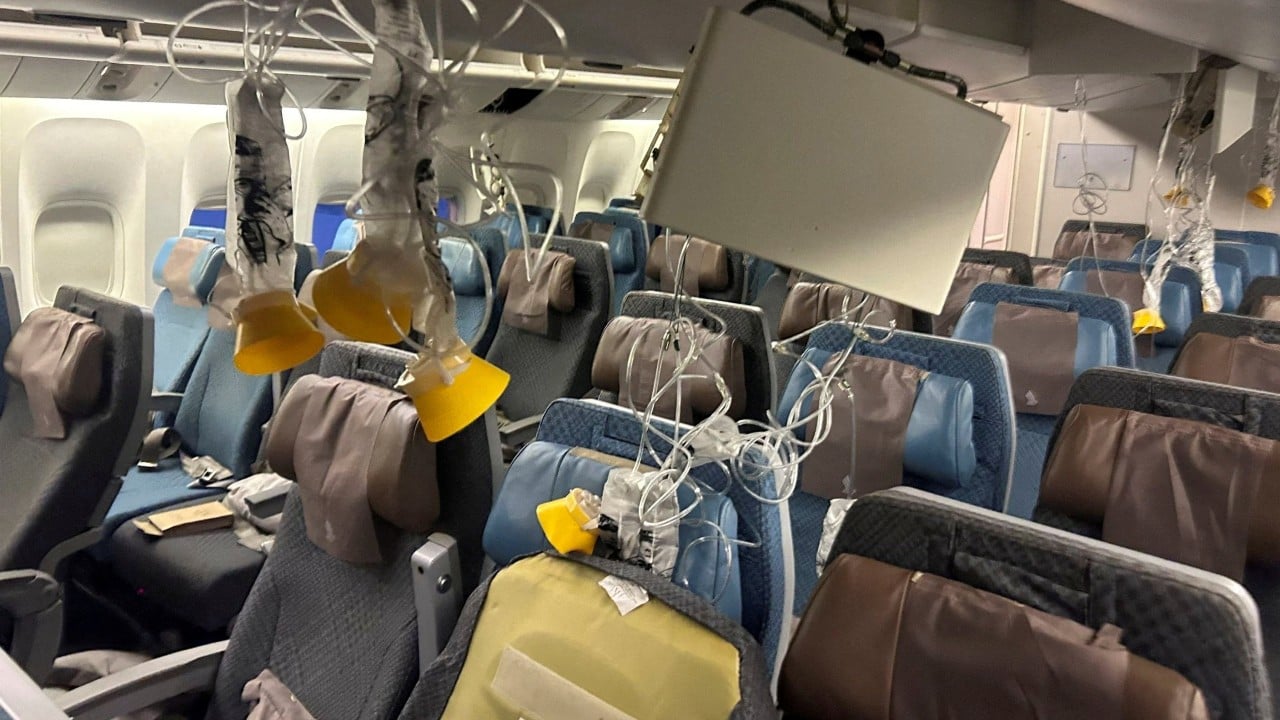
The catastrophic turbulence encounter on Singapore Airlines Flight SQ321, which resulted in the death of a 73-year-old passenger and left 79 others injured, was fundamentally caused by a severe, rapid convective updraft that went entirely undetected by the aircraft’s onboard weather radar. The final report by Singapore’s Transport Safety Investigation Bureau (TSIB) reveals a terrifying reality. The highly experienced flight crew was flying completely blind into a monster storm system that their instruments insisted was not there. The disaster was not born of pilot error or clear-air turbulence, but rather a chilling technical failure where a rapidly blooming thunderstorm outpaced or escaped modern aviation radar.
The Illusion of Clear Skies
For two years, the prevailing narrative surrounding the May 21, 2024 disaster focused on clear-air turbulence—the invisible pockets of air that plague high-altitude flights without warning. The final investigation shattered that assumption. Flight SQ321 flew directly over a rapidly growing convective cloud over south-west Myanmar that spiked from 27,500 feet to 40,000 feet in a mere ten minutes.
The Boeing 777-300ER encountered a localized updraft moving at a violent 8,000 to 9,000 feet per minute. Data from the digital flight data recorder shows that vertical wind speeds slammed the jet at 150 feet per second.
The cockpit voice recorder captured a haunting sequence. The pilot-in-command had set his weather radar sensitivity to maximum. The augmenting captain alongside him had his display on automatic. Yet, both navigation screens were completely blank.
"I was on MAX," the pilot-in-command was recorded saying shortly after the upset. "I don't see anything here."
Even more puzzling to investigators was the visual discrepancy. Four other commercial aircraft operating in the same airspace saw widespread cloud coverage and actively steered around the weather cells. The SQ321 crew, looking out the cockpit windshield, reported seeing nothing but high-level cirrus clouds in the far distance.
Five Seconds of Violence
The physical reality of what happens when a widebody jet slams into an undetected 9,000-foot-per-minute updraft is a matter of brutal physics. The autopilot attempted to compensate for the sudden lifting force by pitching the nose down five degrees to maintain its 37,000-foot cruising altitude. The aircraft accelerated rapidly to 0.88 Mach, prompting the augmenting pilot to deploy speed brakes.
Then came the drop.
In a span of just 0.6 seconds, the vertical acceleration inside the cabin violently swung from a positive 1.35G down to a negative 1.5G.
G-Force Profile during the 4.6-Second Upset:
+1.35G (Normal/Slightly Heavy) -> -1.5G (Catastrophic Drop) -> +1.5G (Slamming Recovery)
At negative 1.5G, gravity is effectively reversed and amplified. Anything and anyone not securely fastened became immediately weightless and was accelerated toward the ceiling. Passengers eating breakfast, cabin crew pushing heavy meal carts, and unbuckled travelers were thrown headfirst into the overhead compartments.
Two seconds later, the G-forces swung back to positive 1.5G. This pinned the airborne passengers back down with one and a half times their body weight, causing severe compression injuries. The cabin suffered structural damage, with cracked ceiling panels and punctured luggage bins stained with blood. Most of the 79 injuries involved severe skull fractures, brain trauma, and spinal cord damage. Geoffrey Kitchen, the British passenger who lost his life, succumbed to heart failure brought on by the immense shock and sudden fluid buildup in his lungs.
The Electronic Blind Spot
The investigation focused heavily on the failure of the unnamed radar manufacturer's equipment. While factory testing of the physical radar components after the incident showed no inherent mechanical defects, the TSIB explicitly stated that a localized system failure or data under-detection "cannot be ruled out."
The maintenance history of this specific Boeing 777-300ER revealed a troubling pattern. Just six days prior to the fatal flight, logs indicated that the radar had failed to properly display active weather events. Furthermore, the ferry pilots who flew the battered aircraft back to Singapore from its emergency landing site in Bangkok reported that the system was noticeably understating the intensity of storm cells along their path.
The technological breakdown highlights a vulnerability in how modern avionics process meteorological data. When a convective storm cell develops at hyper-speed, the liquid water content inside the upper layers of the cloud may be too sparse or consist of ice crystals that possess low radar reflectivity. If a radar lacks the processing algorithms to interpret these high-altitude ice particles, it paints the sky as perfectly clear.
Industry Repercussions
The TSIB final report bypasses typical diplomatic pleasantries and targets systemic flaws in commercial aviation technology. It issues explicit mandates that demand swift action from major aviation entities.
| Target Entity | Mandatory Recommendation |
|---|---|
| Boeing | Develop comprehensive flight crew and maintenance guidelines to detect and troubleshoot active radar under-detection or non-detection events. |
| Radar Manufacturers | Engineer and implement secondary diagnostic recording tools that capture real-time weather images displayed to pilots for post-flight analysis. |
| ICAO | Mandate retrofitting protocols for older aircraft built before 2023 to ensure flight data recorders can capture exact pilot display readouts. |
The International Civil Aviation Organization (ICAO) faces pressure to force airlines to retrofit older widebody aircraft with digital black box systems capable of recording exactly what the pilots see on their navigation displays. Currently, investigators are left guessing what a crew saw based on cockpit voice recordings and post-accident hardware simulations.
Singapore Airlines has already revamped its operational procedures. The carrier has deployed real-time turbulence monitoring software across all pilot and crew tablets, established stricter mandatory seatbelt sign policies during weather anomalies, and instituted a fleet-wide reporting system for suspected radar anomalies.
The definitive takeaway from the SQ321 investigation is an uncomfortable truth for the modern traveler. Aviation technology has advanced to a level of extreme automation, but it remains susceptible to the raw, vertical acceleration of tropical meteorology. When an updraft moves faster than the software can refresh, the seatbelt is the only safety system that actually matters.