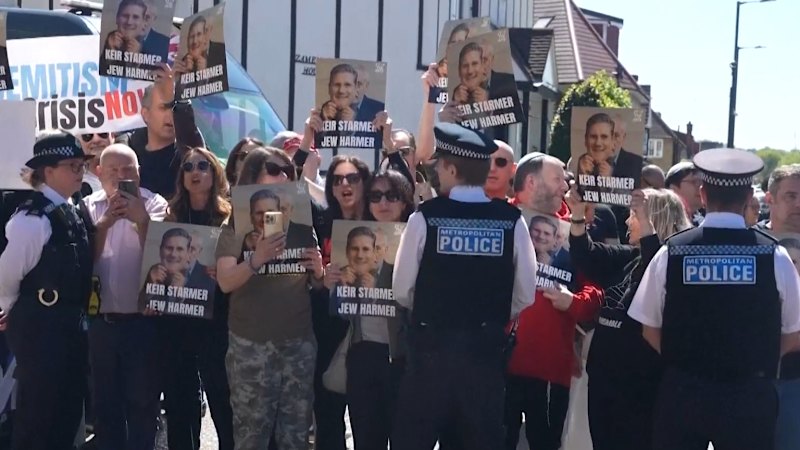
The visceral anger that met Keir Starmer in Golders Green on Thursday was not merely a reaction to a single stabbing. It was the sound of a community’s social contract snapping in real-time. When the Prime Minister arrived to pay his respects after the knife attack on two Jewish men, he didn’t find the somber, grateful reception usually reserved for grieving leaders. Instead, he was met with boos and cries of "traitor."
To understand why a community traditionally known for its quiet resilience is now heckling the head of government at a crime scene, one must look beyond the immediate bloodshed of the April 29 attack. The suspect, 45-year-old Essa Suleiman, was already known to the state. He had been referred to the Prevent counter-terrorism program as far back as 2020. This revelation has turned a local tragedy into a national scandal, exposing a systemic failure to monitor high-risk individuals before they strike.
The Prevent Paradox
For years, the Prevent program has been criticized from all sides, but the Golders Green incident highlights its most lethal flaw: a lack of teeth. When an individual is referred but not detained, the state enters a holding pattern of "monitoring" that clearly failed to account for Suleiman’s escalating risk. The Prime Minister’s promise of "swift, agile, and visible" justice rings hollow to those who point out that the justice should have been preemptive.
This isn't just about one man with a knife. It is about a pattern of escalation that the British state seems unable—or unwilling—to contain.
Iran and the Shadow of Foreign Interference
Starmer’s subsequent statement from Downing Street introduced a chilling geopolitical dimension to the domestic unrest. He explicitly linked the safety of British Jews to the "malign threat" of hostile states, specifically naming Iran. This isn't mere political posturing. Intelligence officials have grown increasingly vocal about foreign actors leveraging domestic tensions to incite violence on British soil.
The proximity of the stabbings to a memorial wall for victims of the Iranian regime—itself targeted by arson just days prior—suggests a coordinated effort to import Middle Eastern conflicts into London’s suburbs. While the government pledges an additional £25 million for Jewish community security, many residents feel that no amount of CCTV can replace the fundamental loss of public order.
A Community at the Edge
The most damning indictment of the current situation came from the government’s own independent adviser on antisemitism, John Mann. His assessment was blunt: British Jews are at a "breaking point."
- The Fear Factor: 70% of the public feels the state has lost control of core functions.
- The Agency Gap: Local volunteer groups like Shomrim and Hatzola are increasingly doing the work that taxpayers expect from the Metropolitan Police.
- The Exit Strategy: For the first time in decades, serious conversations about emigration are moving from the fringes to the dinner tables of Jewish families in North London.
When the Prime Minister calls on the public to "open their eyes to Jewish pain," he is met with skepticism because that pain has been visible for months on the streets of London during weekly protests. The hecklers in Golders Green weren't just shouting at Starmer; they were shouting at a political class they believe has traded their safety for social cohesion.
The Failure of Traditional Policing
Metropolitan Police Commissioner Mark Rowley has surged officers into Barnet, but the community sees this as "policing by aftermath." The presence of heavy security after an attack only serves as a visual reminder of the danger. The real issue lies in the incubation of hatred. Jonathan Hall, the independent reviewer of terrorism legislation, has already warned that the "demonization of Jews" in public spaces is a national security emergency.
The government’s response—more funding, more "visible" police, and talk of new powers—misses the psychological reality on the ground. You cannot fund your way out of a collapse in trust. If the state cannot manage individuals already in the Prevent system, no amount of ministerial roundtables will convince the residents of Golders Green that the next "Essa Suleiman" isn't already walking among them.
Britain is currently navigating a period where foreign intelligence operations and domestic extremism have fused. The result is a volatile environment where the Prime Minister is no longer seen as a protector, but as a representative of a system that waited for a stabbing to show up.
The immediate action step is clear: the government must overhaul the transition between counter-terrorism monitoring and active intervention. If "Never Again" is to mean anything in 2026, the state must stop treating antisemitic terror as a series of isolated "one-offs" and start treating it as the systemic national security crisis it has become.