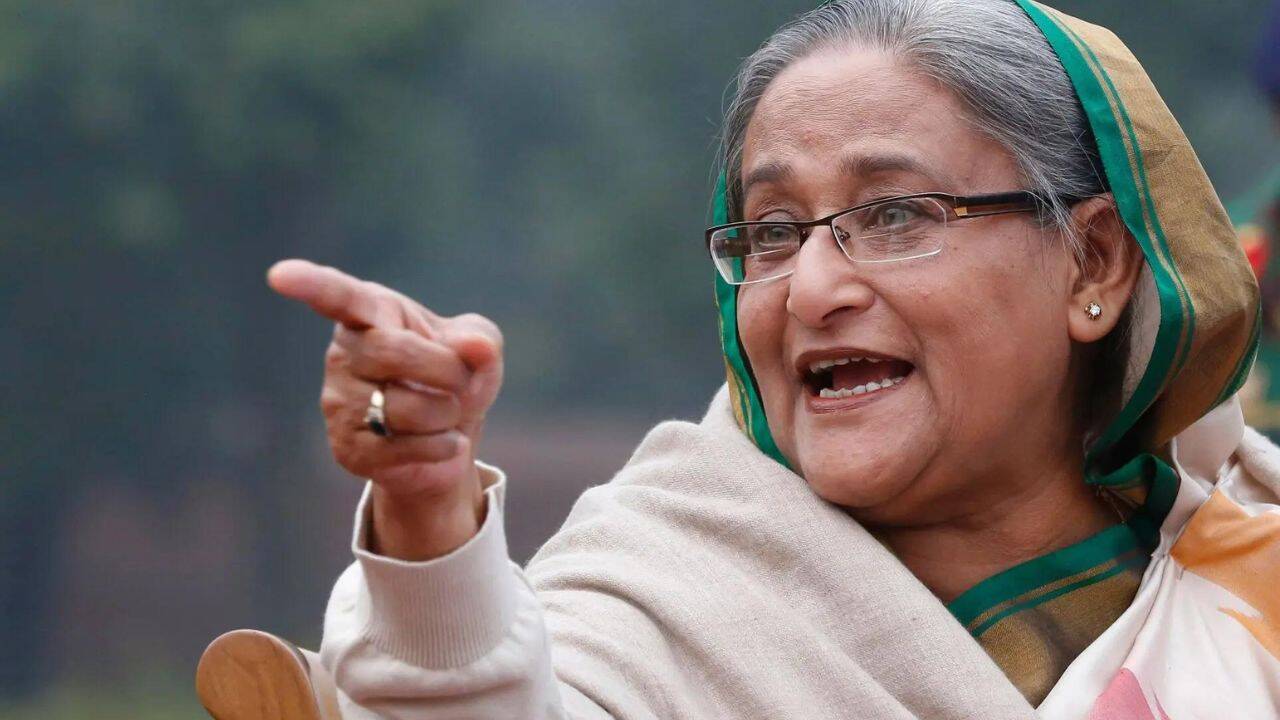
The newly elected government of Bangladesh has threatened domestic media outlets with severe legal consequences if they continue to broadcast statements from ousted Prime Minister Sheikh Hasina. This official directive comes immediately after Hasina granted a defiant television interview from her exile in India, declaring her intention to return to Dhaka before the end of the year. By moving swiftly to censor the former leader, the administration of Prime Minister Tarique Rahman is signaling that while regimes change, the state apparatus of information control remains fully intact. Information and Broadcasting Adviser Zahed Ur Rahman explicitly warned that transmitting Hasina's words violates standing court orders, a move that exposes the profound fragility of the country's fresh political transition.
The directive highlights a persistent structural reality in South Asian politics. Governments view the airwaves not as an open forum for public record, but as a strategic territory that must be defended against adversarial narratives. For fifteen years, Hasina herself utilized state machinery to mute her political rivals, particularly the Bangladesh Nationalist Party (BNP). Now, with the BNP back in power after winning a landslide victory in the February 2026 general elections, the tables have completely turned. The speed with which the new executive branch has targeted broadcast rooms indicates that the fear of a counter-revolution outweighs any theoretical commitment to total media freedom.
The Battle of the Airwaves
The immediate trigger for the government warning was an exclusive broadcast by an Indian news channel, where Hasina broke her prolonged public silence. Speaking from an undisclosed location in India, where she has resided since her government collapsed during the mass student-led uprising of August 2024, the seventy-eight-year-old former premier struck an uncompromising tone. She dismissed her recent conviction and death sentence by Dhaka’s International Crimes Tribunal as a politically motivated sham. She insisted that her party, the Awami League, remains deeply rooted in the national psyche rather than being a mere historical relic.
Domestic broadcasters immediately faced a logistical and legal dilemma. Do they cover the pronouncements of a figure who dominated the country for over a decade, or do they comply with an administrative apparatus that holds the keys to their broadcasting licenses? Several news channels chose to run excerpts of the interview. They viewed it as a legitimate, high-profile news event that directly affected national security and foreign relations.
The state responded with immediate hostility. Within hours of the broadcasts, Zahed Ur Rahman called a press conference to reprimand the industry. He asserted that because a Dhaka court had placed a legal prohibition on the dissemination of her speeches, any domestic channel carrying her voice was in active defiance of the judiciary. The administration also reiterated its stance that the Awami League, which was outlawed under the previous interim administration, has no legal right to conduct political activities under any designation.
This rapid enforcement reveals how the current administration intends to handle dissent. Media executives in Dhaka report receiving informal calls from regulatory bodies hinting at swift financial and administrative audits if they do not comply with the state directive. It is an old tactic wrapped in a new political context.
Inheriting the Tools of Control
To understand the current media environment in Dhaka, one must look at the legislative infrastructure left behind by the previous regime. Hasina’s administration spent years constructing a formidable legal network designed to police digital speech and broadcast journalism. Laws like the Digital Security Act and its subsequent iterations gave law enforcement sweeping powers to detain individuals for spreading anti-state propaganda or harming the image of the nation.
When the interim government led by Nobel laureate Muhammad Yunus took over in late 2024, there were widespread expectations that these restrictive measures would be permanently dismantled. The reality proved far more complicated. The eighteen months of interim rule were defined by deep institutional instability. While some prominent political prisoners were released, the legal codes used to restrict speech were kept on the books, ostensibly to prevent remnants of the old regime from inciting violence or destabilizing the transition.
Journalists discovered that the climate of fear had merely shifted orientation. Media watchdogs reported that throughout late 2025 and early 2026, dozens of journalists perceived as sympathetic to the Awami League were subjected to arbitrary detentions, job terminations, and street-level harassment by political activists. Mobs attacked several prominent newspaper offices in Dhaka without facing significant intervention from local law enforcement.
When Tarique Rahman’s BNP alliance assumed power in February 2026, they did not inherit a clean slate of democratic institutions. They inherited a broken, highly polarized media sector accustomed to self-censorship. Instead of reforming this framework, the new government is now using it to ensure that Hasina cannot build a media bridge back to her domestic support base.
The Extradition Dilemma and Geopolitical Friction
The restriction on broadcasting Hasina’s speeches is tied to an unresolved diplomatic standoff between Dhaka and New Delhi. Since fleeing across the border in an army helicopter in August 2024, Hasina has lived under the protection of the Indian government. Her presence has become an obstacle to normalizing bilateral relations between the neighbors.
Dhaka has repeatedly demanded her formal extradition to face the death penalty handed down by the International Crimes Tribunal in November 2025. The tribunal found her guilty of ordering and failing to prevent state violence during the July 2024 protests, an uprising that resulted in an estimated 1,400 civilian deaths. India has consistently avoided taking direct action on the extradition request, maintaining that her stay remains a matter of humanitarian sanctuary.
+-------------------------------------------------------------------------+
|                    The Post-Uprising Political Timeline                |
+-------------------------------------------------------------------------+
| August 2024:    Sheikh Hasina flees to India after student uprising.     |
| November 2025:  Dhaka Tribunal sentences Hasina to death in absentia.   |
| February 2026:  BNP wins general elections; Tarique Rahman becomes PM.  |
| June 2026:      Hasina vows return; government issues media warning.    |
+-------------------------------------------------------------------------+
By allowing Hasina access to major Indian broadcast networks, New Delhi is signaling to Dhaka that the former prime minister remains an active political asset. The current Bangladeshi government interprets these television appearances as a deliberate attempt to undermine its internal stability. When Hasina speaks to an Indian camera, her words are beamed directly back into millions of Bangladeshi homes via satellite and internet streams.
The media ban is an admission that the Bangladeshi state cannot control what happens in New Delhi television studios. It can only penalize its own citizens for watching or sharing the output. This creates a dangerous precedent where domestic news organizations are forced to ignore major international developments involving their own country out of fear of state retaliation.
The Reality of Press Freedom Under the New Order
The warning issued to the media complicates the narrative that the 2024 revolution was a simple victory for absolute democratic freedoms. While the student-led movement succeeded in dismantling a repressive one-party state, the construction of an open society has stalled. The current environment forces media owners to make calculated choices about survival.
Independent journalism requires the space to cover all facets of a political landscape, including unpopular or controversial figures. When a government dictates which public figures can be quoted and which must be scrubbed from the evening news, the boundary between state public relations and independent journalism disappears. The administration argues that Hasina is an escaped convict rather than a political opponent, utilizing legal technicalities to justify a blanket ban on political speech.
This distinction fails to recognize that millions of citizens still follow the political developments of the old ruling party. Silencing the coverage does not eliminate the underlying political polarization. It simply drives it underground into unverified social media channels and encrypted messaging networks where rumors replace reported facts.
A Systemic Pattern of Information Management
The current situation reveals that the fundamental relationship between the state and the press in Bangladesh has not evolved. Every major political transition in the nation’s history has been followed by a purge of the media landscape. Editors are replaced, broadcasting frequencies are reassigned, and selective prosecutions are used to discipline the remaining press corps.
The Tarique Rahman administration faces genuine economic and social pressures, including high inflation and deep-seated institutional corruption left by decades of misrule. Controlling the political narrative is seen by political strategists as an easy way to maintain public order while addressing these complex economic challenges. By focusing public attention on the threat of a potential return by Hasina, the government can rally its political base and deflect scrutiny away from its own policy shortcomings.
The long-term consequences for the domestic news industry are severe. Journalists are forced to operate with a moving set of editorial boundaries. What is considered standard political reporting today could easily be labeled treasonous tomorrow if the political winds shift again. This systemic uncertainty stifles investigative reporting, restricts public debate, and reduces public trust in domestic institutions. The warning issued to Dhaka's newsrooms is not an isolated incident. It is a calculated affirmation that the state intends to maintain its absolute authority over what the public can see, hear, and believe.