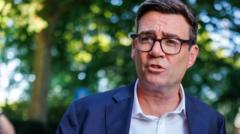
Andy Burnham will walk into 10 Downing Street on Monday as Britain’s next prime minister because the Parliamentary Labour Party chose self-preservation over a civil war. By locking down 349 nominations out of 403 Labour MPs, the former Mayor of Greater Manchester did not just win a leadership contest. He extinguished it. The sheer volume of endorsements mathematically starved any potential challenger of the 81 signatures required to even get on the ballot, converting what should have been a fractious national debate into a ruthless coronation.
This was not a sudden burst of affection from a parliamentary party that historically viewed Burnham with deep suspicion. It was a calculated capitulation by a Westminster establishment terrified of its own electorate. For months, the underlying reality of British politics was defined by a quiet, agonizing collapse in public trust toward Keir Starmer’s government. When Starmer finally bowed to the inevitable and announced his resignation, the party machine faced a choice between months of ideological bloodletting or a rapid pivot to the only brand in Labour politics that still carried currency with working-class voters. They chose the brand from the North.
Behind this historic shift lies a deeper story of institutional failure, panic, and a highly sophisticated parallel political operation that bypassed the traditional gatekeepers of British power. Burnham’s return to Westminster via the Makerfield by-election in June was not an isolated local event. It was the final move in a multi-year chess game designed to exploit the vacuum left by a central government that ran out of ideas within two years of winning a landslide.
The Coronation of the King in the North
The final numbers delivered on Monday night left no room for ambiguity. An additional 27 MPs added their names to Burnham’s sheet, pushing his total from an already insurmountable 322 to 349. Only 54 Labour MPs held back their signatures, a group consisting mostly of outgoing frontbenchers bound by institutional neutrality or individuals frozen in shock by the speed of the transition.
To understand the scale of this capture, one has to look at who signed. This was not a factional victory engineered by the party's left wing or a coup by disgruntled regionalists. The nomination list includes the entire remaining cabinet, right down to figures like Communities Secretary Steve Reed, a politician long considered an architect of the party’s southern, urban strategy. When the pragmatic center of the party moves in unison, it does so out of survival.
During his online hustings with the Parliamentary Labour Party on Monday evening, Burnham spoke to an audience that had effectively surrendered its leverage. He promised a broad church cabinet, a phrase that in Westminster usually translates to an uneasy truce. He assured MPs that his administration would value, see, and listen to every wing of the movement. He spoke with the easy confidence of a man who knew that his audience had nowhere else to turn.
The speed of this transition is unprecedented in modern political history. Usually, a change of prime minister during a parliamentary term involves weeks of briefings, televised debates, and policy pledges tailored to specific factions. By wrapping up the contest before it even began, Burnham has denied the public, and his own party, an open debate on his platform. The country is getting a new leader and an entirely new philosophy of governance by default.
The Controlled Collapse of the Starmer Project
The conventional wisdom in Westminster was that the 2024 landslide victory had secured Labour a decade in power. That illusion crumbled with terrifying speed. The central defect of the Starmer administration was its belief that managerial competence alone could heal the deep economic scars of the last twenty years. By treating politics as a series of administrative problems to be solved by former civil servants, the government alienated the very communities that had returned to the party out of desperation rather than conviction.
As the government's polling numbers plummeted throughout late 2025 and early 2026, a sense of paralysis took hold in Downing Street. Policy announcements became timid. Economic growth failed to materialize in the post-industrial towns that had been promised a new deal. Meanwhile, outside the Westminster bubble, Burnham was running Greater Manchester as a semi-detached state, introducing integrated transport systems, championing housing reform, and building a distinct regional identity that made London look increasingly stagnant.
The contrast became unsustainable. Every time Starmer gave a defensive press conference in Downing Street, the media turned to Manchester for an alternative vision. Burnham became the standard-bearer for a different kind of politics, one that rejected the fiscal caution of the Treasury in favor of visible, localized public investment. The internal polling within Labour headquarters showed a devastating trend. In the seats Labour needed to hold to retain power at the next election, Burnham’s personal approval ratings dwarfed those of the prime minister.
When the internal crisis finally came to a head in June, it was not sparked by a dramatic policy disagreement. It was triggered by a collective realization among backbench MPs that they were on course for a historic defeat at the next general election. The resignation of Starmer was not an act of nobility. It was a managed exit forced by a parliamentary party that had lost the will to defend a failing project.
How the Makerfield Machine Bypassed London
The most remarkable aspect of Burnham’s ascent is that less than two months ago, he was not even a member of parliament. He was an outsider, blocked by the party's National Executive Committee from contesting previous vacancies as the centralized leadership tried to keep him as far from Westminster as possible. The breakthrough came in Makerfield.
The sudden vacancy in this safe Greater Manchester seat created an opening that the party leadership could no longer defend. With Starmer’s authority fundamentally weakened, the local party machine asserted its independence, selecting the sitting mayor as their candidate with an overwhelming majority. The subsequent by-election victory in June was treated by the national media as a local curiosity, but inside the corridors of parliament, it was recognized as a clear declaration of intent.
By winning that seat, Burnham forced a constitutional anomaly. He was required by law to resign his mayoralty immediately, a move that triggered a separate regional crisis but placed him squarely on the green benches of the House of Commons. Four days later, Starmer announced his departure. The coordination was flawless. It suggests that the plan had been drawn up months in advance by a network of northern MPs, trade union leaders, and regional mayors who had concluded that the London-centric leadership was terminal.
This parallel operation completely destabilized the traditional factions within the PLP. Usually, the center-right and the soft-left of the party would spend weeks organizing rival campaigns, testing lines, and horse-trading over shadow cabinet positions. Burnham’s team bypassed these negotiations entirely by presenting MPs with a simple proposition. Sign the nomination form immediately, or explain to your local party members why you are delaying the arrival of the only leader capable of saving your seat. The strategy worked brilliantly.
The Uneasy Peace Within a Fractured Cabinet
The 349 MPs who signed Burnham’s papers did not do so because they suddenly agreed on the future direction of the country. They did so because they were terrified of the alternative. This means that the unity Burnham boasted of during Monday’s hustings is largely artificial. Below the surface, deep ideological and regional fault lines remain completely unaddressed.
Southern Labour MPs, particularly those representing suburban seats around London and the South East, are already expressing private alarm at the incoming prime minister’s rhetoric. They worry that a government obsessed with the North will neglect the economic realities of the South. They fear that the phrase "good growth in every postcode" is code for shifting infrastructure spending away from the capital toward the M62 corridor. These MPs know that their majorities are fragile, built on a temporary coalition of affluent liberals and traditional commuters who could easily defect to the Liberal Democrats or the Conservatives if the government appears indifferent to their concerns.
PLP Nomination Distribution (July 2026)
==================================================
Burnham Nominations:           349 (86.6%)
Remaining Eligible MPs:         54 (13.4%)
Total Labour Seats:            403
==================================================
Note: Figure excludes the NEC Chair and Party Chair
by convention.
There is also the problem of the Treasury. The current economic framework, built on strict fiscal rules designed to reassure international bond markets, leaves almost no room for the kind of grand public investment Burnham championed in Manchester. If the new prime minister attempts to break these rules to fund his regional regeneration plans, he risks a confrontation with his own chancellor and a potentially disastrous reaction from the financial sector. If he maintains the current fiscal constraints, he will quickly disillusion the working-class voters who expect his arrival to bring immediate material change.
The left of the party, represented by figures like Richard Burgon who offered their nominations on Monday, are also playing a dangerous game. They have backed Burnham because he represents a break from the rigid factionalism of the Starmer era, but their support is transactional. They expect concessions on public ownership, welfare spending, and workers' rights. When those concessions clash with the demands of the party's centrist majority, the current display of unity will vanish.
The Devolution Dilemma Facing Downing Street
The central premise of Burnham’s political identity is that Westminster is broken and that power must be pushed out of London to the regions. Now, he is taking charge of the ultimate centralized machine. The irony of his position is acute. To dismantle the over-centralized state, he must first use the absolute authority of that state to force through his reforms against the wishes of an entrenched civil service.
The British state is remarkably resistant to genuine devolution. For decades, successive prime ministers have promised to empower local communities, only to claw back control the moment a local authority mismanaged a budget or deviated from national policy. The Treasury, in particular, views regional autonomy as a threat to fiscal discipline. Burnham’s plan to recreate the Manchester model across the entire country will require a fundamental restructuring of how public money is allocated and spent.
"We cannot fix a broken country using the same centralized tools that broke it in the first place."
That sentiment, expressed frequently by Burnham during his final months as mayor, is about to collide with the reality of governance. When a crisis hits the National Health Service or the transport network, the public does not look to regional mayors for answers. They look to Downing Street. The temptation to intervene, to direct from the center, and to micro-manage is almost irresistible for any prime minister, regardless of their past rhetoric.
Furthermore, his focus on regional devolution raises difficult questions about the future of the United Kingdom as a whole. Senior figures in Wales and Scotland are already watching his ascension with a mixture of hope and anxiety. While they welcome his criticism of the Westminster bubble, they are deeply concerned that his vision of devolution is fundamentally English, focused on mayoral authorities that do not match the constitutional realities of the devolved nations. If his administration treats Edinburgh and Cardiff as merely larger versions of Greater Manchester, it will trigger a fresh constitutional crisis that could destabilize the union.
The coming days will reveal the true nature of the Burnham administration. The special party conference on Friday and the subsequent walk into Downing Street on Monday are merely the theatrical elements of a profound political transition. The real test begins when this artificial consensus meets its first economic reality check. By clearing the board and ensuring that no other voice could be heard during this leadership transition, Burnham has secured absolute power within his party. He has also ensured that when things go wrong, he will have absolutely nowhere to hide.