The rhythm of a modern intensive care unit is dictated by machines. There is the steady, electronic hiss of a ventilator pushing oxygen into compromised lungs. There is the rhythmic, reassuring beep of a heart rate monitor. In the middle of this sterile environment lies Stephen Ogilvie. He is a man caught between worlds, held in a medically induced coma while his body attempts to heal from injuries that sound like something out of a medieval chronicle.
He lost his left eye on Monday night. Deep, violent cuts mark his head, his face, and his back.
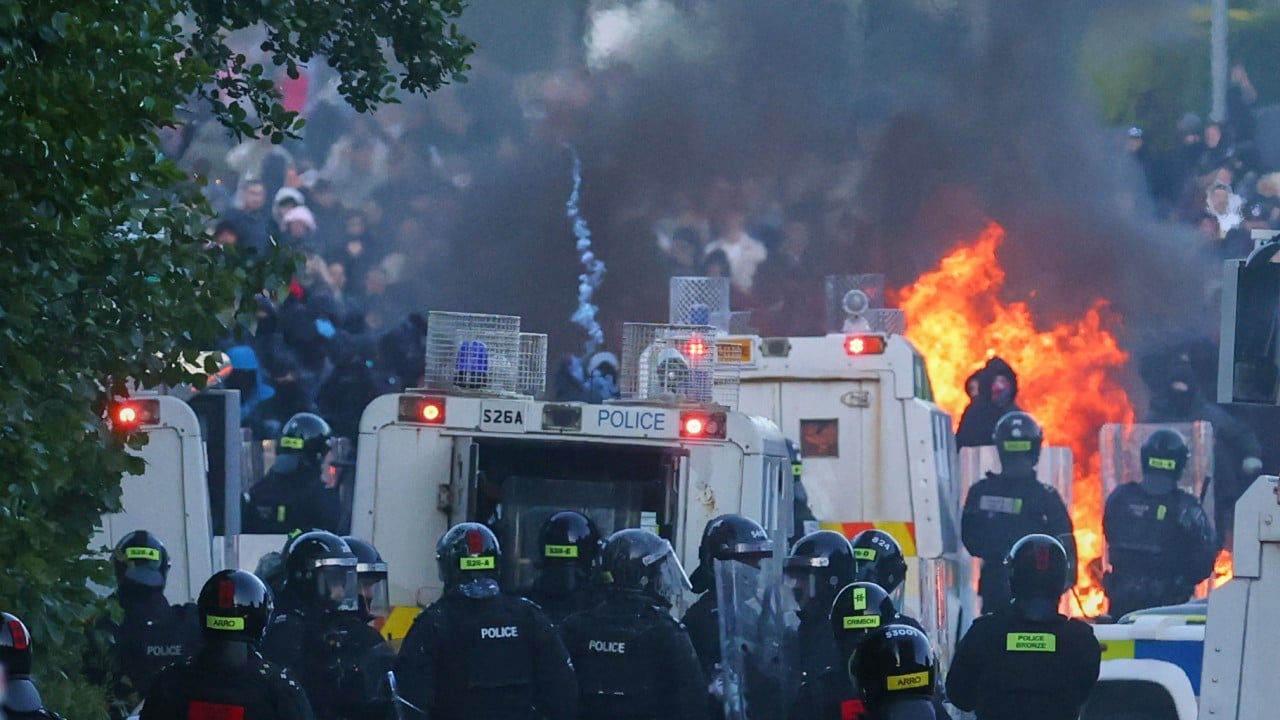
To read the official statements, Stephen is a set of clinical indicators. He is "improving." He is expected to be awoken within the next twenty-four to forty-eight hours. But a man is not a status update, and a recovery room is not a vacuum. Outside the hospital walls, the city of Belfast spent the subsequent nights burning. Bricks flew through the air. Petrol bombs painted the darkness orange. Masked youths clashed with riot police, and a nurse on her way to save lives at the Ulster Hospital was chased and intimidated through the streets.
It is a familiar, tragic cycle. An act of horrific violence occurs, and the community fractures along its oldest, most fragile fault lines. The suspect, a thirty-year-old Sudanese national named Hadi Alodid, sits in a remand cell, charged with attempted murder. Online, the digital machinery of outrage has already spun the event into a weaponized narrative, transforming a human tragedy into a proxy war over immigration, borders, and national identity.
But inside the quiet room at the hospital, the perspective is entirely different.
Consider his parents. Gavin Robinson, the DUP leader, stood at Stormont after visiting them and described them simply as "broken." They are ordinary people thrust into the worst nightmare a parent can endure, sitting by a plastic-and-chrome bedside, watching a machine breathe for their son. Yet, in their grief, they chose to issue a statement that carries more moral weight than any of the political rhetoric bouncing around the capital.
They begged for the violence to stop. They explicitly asked that the atrocity committed against their son not be used as an excuse for intimidation or division. They asked for an end to the misinformation, the falsehoods, and the digital rumors that travel faster than the truth.
Imagine the strength required to hold that position while your child is unseeing and unresponsive.
The human body possesses a remarkable, quiet intelligence. When the trauma is too great, the brain retreats. A medically induced coma is not a natural sleep; it is a calculated pharmaceutical pause, a way for doctors to lower the brain’s metabolic demand while the swelling goes down. For the family, this pause is excruciating. It is a period of suspended animation where every second stretches into an hour.
When the doctors finally turn down the sedatives over the coming days, the real reckoning begins.
Awakening from a coma is not like waking up on a Sunday morning. It is a slow, confusing, and often terrifying drift back into consciousness. Stephen will have to learn the geography of his new reality. Doctors will begin the delicate, heartbreaking process of assessing his remaining sight and measuring the permanent neurological and physical scars left by the blade. He will wake up to a world that changed entirely in a single Monday evening, to a face he will no longer recognize in the mirror.
Outside, the authorities are trying to piece the city back together. Assistant Chief Constable Ryan Henderson has promised bolstered police numbers and long sentences for the rioters. Officers have been flown in from Great Britain to help keep a fragile peace.
But police officers cannot heal the cultural wounds that reopen every time blood is spilled on these streets. The rioters burning cars on the Newtownards Road are not thinking about Stephen Ogilvie. They are leveraging his suffering to feed an appetite for destruction. They are, as one local politician accurately noted, people who could not find North Belfast on a map before this week, bad actors exploiting local fear.
The true battleground is not the pavement where the water cannons are deployed. It is the hospital room where a family waits for a young man to open his one remaining eye.
The story of Belfast this week is often told through images of smoke, fire, and angry faces hidden behind scarves. Those images are loud, but they are hollow. The real story is quiet. It is found in the dignity of a broken mother and father refusing to let their son’s blood become fuel for a riot. It is found in the healthcare workers who continue to walk through hostile streets to clock into their shifts.
We tend to look at statistics and court charges to understand the world, but they only provide the skeleton of an event. The muscle, the nerves, and the pain belong entirely to the people left behind in the wake of violence. As the sedatives slowly clear from Stephen Ogilvie’s system, his city faces a choice: to follow the path of destruction orchestrated by bad actors online, or to mirror the quiet resilience of the family waiting by the bedside.


