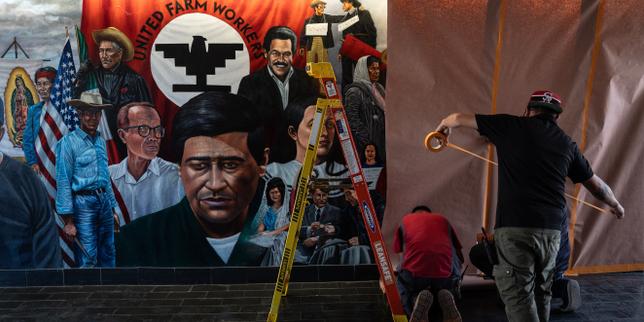
Cesar Chavez would have hated your favorite immigration activist.
Modern history has scrubbed the grit and the "incorrect" politics from Chavez, turning him into a harmless stained-glass saint for the open-borders movement. It is a convenient lie. Today’s activists wear his face on t-shirts while advocating for the very policies he spent his life fighting with a ferocity that would get him canceled in ten minutes on modern social media.
The sanitized version of Chavez is a man of universal Latino solidarity. The real Chavez was a labor protectionist who viewed undocumented workers as "scabs" and "strike-breakers." He didn’t just disagree with illegal immigration; he campaigned against it with a zeal that makes today's hardline politicians look soft.
The Illegitimacy of the "Allied" Narrative
The competitor’s piece tries to frame Chavez’s stance as a historical quirk or a product of a different era. That is a cowardly evasion of the truth. Chavez’s opposition to undocumented labor wasn't a side quest; it was the core of his strategy. He understood a fundamental economic reality that the modern left refuses to touch: you cannot raise wages for the poorest citizens while simultaneously allowing an infinite supply of cheap, exploitable labor to flood the market.
In the 1960s and 70s, the United Farm Workers (UFW) didn’t just march for dignity. They organized "wet lines"—patrols along the Arizona-Mexico border to physically stop people from crossing. Think about that the next time you see his name invoked at a rally for amnesty. Chavez’s cousin, Manuel Chavez, led these patrols. They weren't there to hand out water; they were there to protect the bargaining power of the union.
Labor Protectionism is Not Xenophobia
We have lost the ability to distinguish between racial animus and economic survival. Chavez was a strategist, not a bigot. He knew that the Bracero program and the subsequent waves of undocumented migration were tools used by big growers to smash the UFW’s leverage.
When a union goes on strike, it only wins if the employer cannot find replacements. If a grower can simply call a recruiter and have a hundred desperate people bused in overnight from across the border, the strike dies. Chavez called these workers "illegals" and "wetbacks" in public testimony. While those terms are rightfully radioactive now, his intent was clinical. He saw them as tools of the capitalist class, used to keep the Chicano working class in a state of permanent poverty.
The "lazy consensus" of modern reporting suggests that Chavez eventually "softened" his stance. This is a half-truth designed to keep his icon status intact for a new generation. While he later moved toward advocating for "amnesty," it was a tactical pivot to organize those already here, not a sudden conversion to the church of open borders. He remained a hawk on enforcement because he knew that a flooded labor market is a graveyard for workers' rights.
The Silicon Valley Connection
Why does this matter now? Because we are seeing the exact same dynamic play out in the 2020s, just with different uniforms.
The tech giants of Silicon Valley love the "immigrant rights" narrative because it ensures a steady flow of both high-skilled H-1B visa holders to suppress engineering salaries and low-skilled labor to keep the service economy cheap. They use the language of social justice to mask the mechanics of wage suppression.
Chavez would have seen right through the H-1B lobby. He would have recognized the "holistic" corporate DEI statements for what they are: a smokescreen for avoiding the high costs of a domestic, unionized workforce. If you want to understand why real wages for the American working class have stagnated for decades, look at the supply of labor. Chavez did the math. Modern activists do the optics.
Dismantling the "People Also Ask" Delusions
People often ask: "Was Cesar Chavez a Republican?" No. He was a radical labor leader. People ask: "Did he support the farm workers?" Yes, but only the ones who were legal residents or citizens.
The premise that being "pro-Latino" requires being "pro-undocumented" is a modern invention that Chavez would find baffling. To him, the undocumented worker was the primary obstacle to the Chicano worker’s prosperity. He didn't see a shared identity; he saw a zero-sum game for bread and butter.
If you are an industry insider in the world of non-profits or labor organizing, you know this tension exists. I have seen unions quietly lobby for stricter enforcement behind closed doors while tweeting "Refugees Welcome" from their public accounts. It is a cynical double-game. Chavez, for all his faults, was at least honest about the conflict.
The Risk of Authenticity
The contrarian truth is that you cannot have a strong labor movement and an open border simultaneously. Pick one.
- Option A: A high-wage, high-protection labor market where workers have immense leverage because their labor is scarce.
- Option B: A globalized, fluid labor market where "human rights" are prioritized over national labor standards, resulting in the commodification of people and the erosion of the middle class.
Chavez chose Option A. The modern movement has chosen Option B while wearing the mask of Option A.
This creates a massive "authenticity gap" in modern politics. When working-class voters—including many legal Latino citizens—express concerns about border security, the elite media calls them "misinformed" or "self-hating." In reality, they are following the exact logic of the most famous Latino civil rights leader in American history. They understand that their value in the marketplace is tied to the scarcity of their skill set.
Stop Deifying the Image and Start Reading the History
We have turned history into a series of comfortable clichés. We want our heroes to be perfectly aligned with our current year's sensibilities. But Chavez was a man of the dirt and the picket line, not a faculty lounge. He was a prickly, often authoritarian leader who purged his own union of suspected communists and viewed the border as a literal battleground for his people's economic life.
If you want to honor Chavez, stop lying about what he stood for. He wasn't a precursor to the "No Human is Illegal" bumper sticker. He was a hard-nosed protectionist who believed that the first duty of a leader is to the people already in the union, not the people waiting to cross the line to take their jobs.
The competitor article wants to paint this as a "complex relationship." It wasn't complex. It was a cold, hard calculation of power. Chavez knew that in a capitalist system, your only power is your ability to withdraw labor. And that power is worth exactly zero if you can be replaced by someone more desperate than you.
Stop trying to reconcile the real Chavez with your modern political platform. You can't. He was the ultimate gatekeeper. He was the wall before there was a wall. He understood that a movement that belongs to everyone eventually belongs to no one.
Burn the t-shirt. Read the transcripts. Stop pretending the man who organized the "wet lines" would be on your side today. He’d be on the other side of the line, holding a sign, making sure his workers got paid what they were worth, and he wouldn't care whose feelings he hurt to do it.