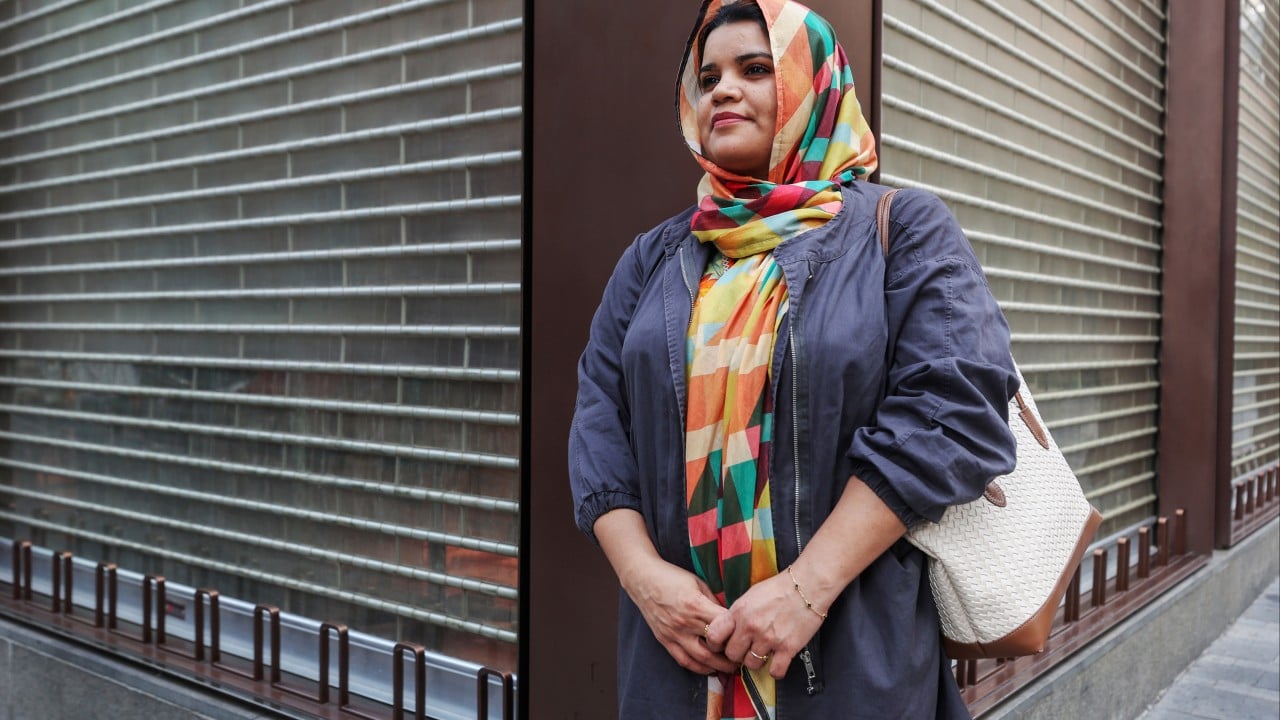
The notification on the smartphone screen should have been a spark of pure, unadulterated joy. For most people, being shortlisted for a global award—an accolade that recognizes the relentless pursuit of human rights—is the pinnacle of a career. It is the moment the world finally looks up and nods in collective respect. But for a woman living in the shadow of Hong Kong’s high-rises, the light of that recognition felt less like a spotlight and more like a flare. It illuminated a person who had spent years trying to remain both useful and invisible.
She is a refugee. In the clinical language of bureaucracy, she is a "non-refoulement claimant." In the reality of the street, she is a ghost with a heartbeat.
The city of Hong Kong is a marvel of kinetic energy and vertical ambition. Money moves here with the speed of thought. Yet, beneath the neon glow of Causeway Bay and the polished marble of the financial district, there exists a parallel world. It is a world of waiting. For those seeking asylum, life is a series of infinite pauses. They are caught in a legal limbo where they are forbidden to work, barred from contributing to the economy of the city they call home, and kept afloat by a monthly government allowance that barely covers a grocery run in one of the most expensive urban centers on the planet.
When news broke that she was a finalist for an international prize, the irony was thick enough to choke on. The world wanted to give her an award for her bravery and her advocacy, yet the very system she lived within wouldn't allow her to buy a bag of rice with money she had earned herself. It is a psychological tightrope. On one side, the validation of her soul’s work. On the other, the crushing weight of a "voluntary" existence that feels like a slow-motion erasure of the self.
The Mathematics of Survival
Consider the numbers, though numbers are often a poor substitute for the truth. A refugee in Hong Kong receives a housing allowance of roughly HK$1,500 per month. In a city where a parking space can sell for millions, that sum buys a "coffin home" or a subdivided unit where the bed is often the only furniture. They receive HK$1,200 in food coupons. There is no cash. No dignity of choice. No ability to buy a coffee for a friend or a toy for a child without navigating a labyrinth of charity and red tape.
The stakes are invisible until you try to move. To advocate for others while your own status is a question mark is a form of quiet heroism that rarely makes the evening news. This woman—let’s call her the Advocate—spent her days helping others navigate the same system that kept her shackled. She translated documents. She sat in cold waiting rooms. She whispered encouragement to the newly arrived who looked at the skyline and saw a wall instead of a window.
Then came the award nomination.
The mixed feelings weren't about modesty. They were about the terrifying discrepancy between who the world thought she was and who the law allowed her to be. If she won, what then? Would the prize money be confiscated? Would the sudden burst of publicity make her a target for deportation? In the world of the displaced, being "known" is a double-edged sword. To be known is to be seen, and to be seen is to be reachable by the hands of a state that might decide your time is up.
The Invisible Glass Wall
We often talk about the "refugee crisis" as if it is a singular, distant event—a boat on a horizon or a tent in a desert. We rarely talk about the refugee who is standing next to us in the elevator, the one whose brilliance is being mothballed by policy. Hong Kong has one of the lowest acceptance rates for asylum claims in the developed world, hovering around 1%. The process can take a decade.
Imagine ten years of your life.
Think about the milestones you’ve hit in the last decade. A promotion? A marriage? The birth of a child? A mortgage paid down? Now, strip all of that away. Replace it with a document that says you cannot work. Replace it with a monthly queue for coupons. Replace it with the constant, gnawing knowledge that you have skills—perhaps you were a teacher, a lawyer, or an artist in your previous life—that are rotting away like fruit left in the sun.
The Advocate's internal conflict wasn't a "glitch" in her gratitude. It was a rational response to an irrational situation. She was being honored for her voice while the system was designed to keep her mute.
One might assume that an international award would be a golden ticket. In reality, it can be a complication. The publicity brings a flurry of questions. "Why are you still here?" "Why can't you just work?" These questions, though often well-meaning, are tiny daggers. They remind the recipient that despite their "global" importance, they are still fundamentally stuck. They are a "success" to the world and a "burden" to the bureaucracy.
The Weight of the Trophy
When the cameras eventually find her, she smiles. It is a practiced smile, one that hides the calculation running through her mind. She has to be the "perfect refugee." Grateful but not greedy. Strong but not threatening. Remarkable but not so loud that she disrupts the status quo.
The mixed feelings stem from the realization that the award is for her suffering as much as it is for her service. It celebrates her ability to endure a system that shouldn't exist in the first place. It’s like being given a medal for how well you can breathe underwater while the person awarding it is the one holding your head down.
This isn't just about one woman in Hong Kong. It’s about the way we consume the stories of the displaced. We love the triumph. We love the "overcoming." But we are far less interested in the systemic rot that makes the overcoming necessary. We want the narrative arc to end with a trophy on a mantle, but for the Advocate, the trophy doesn't come with a work permit. It doesn't come with a passport. It doesn't even come with the certainty of a bed for next month.
The real stakes are the pieces of herself she has to give away to remain "worthy" of help. Every interview is a re-traumatization. Every photo op is a risk. She is playing a game where the rules change every time she moves a piece, and the prize is simply the right to keep playing.
A Different Kind of Value
What would happen if we looked at the Advocate not as a "refugee in need of an award," but as a human being whose potential is being artificially suppressed?
Suppose we stopped seeing asylum seekers as a monolith of misery and started seeing them as a wasted resource. The Advocate has more resilience in her pinky finger than most corporate executives have in their entire boards. She manages logistics, handles complex legal negotiations, and provides social services on a budget that wouldn't cover a lunch at a Michelin-starred restaurant in Central.
She is a master of the human condition.
And yet, she walks home to a room that smells of damp concrete and old dreams. She logs onto a donated laptop to check the news, seeing her own face reflected back in articles that wonder why she isn't more excited. The "mixed feelings" are the most honest part of the story. They are the friction between the myth of the "Refugee Hero" and the reality of the "Refugee Subject."
The award is a beautiful gesture. It is a testament to a spirit that refuses to be broken by the grinding wheels of administrative indifference. But a trophy is cold comfort when you are forbidden from building a fire.
She stands on the shore of the harbor, watching the Star Ferry cut through the green water. The city is loud, vibrant, and indifferent. She holds the news of her nomination in her pocket like a secret she isn't sure she wants to tell. She is a winner in the eyes of the world, a claimant in the eyes of the law, and a woman who just wants to be allowed to earn her own keep in the eyes of herself.
The sun sets behind the peaks of Lantau Island, casting long shadows over the water. In those shadows, thousands of others are waiting. They are waiting for a letter, a phone call, or a change in the wind. The Advocate is one of them, even with a global award bearing her name. She turns away from the view and walks back toward the crowded streets, merging into the sea of people, a ghost once again, carrying the heavy, shimmering weight of a recognition that changes everything and nothing at all.
One day, the city might realize that its greatest wealth isn't in the vaults of the banks, but in the people it refuses to see. Until then, the Advocate will keep her folders organized and her heart guarded. She will accept the praise of strangers and the silence of the state. She will keep going. Because for those who have lost everything, the only thing left to do is to be excellent, even when the world makes it illegal to be anything at all.
The flashbulbs will eventually fade, and the headlines will move on to the next tragedy or the next triumph. But she will still be there, in that small room, looking at a piece of paper that says she is one of the best in the world, while waiting for permission to simply exist in it.