Every four years, a bunch of tenured political scientists and partisan historians sit in a wood-paneled room, stroke their chins, and rank American presidents. The latest iteration of this academic circle-jerk produced a predictable headline: Donald Trump ranked dead last.
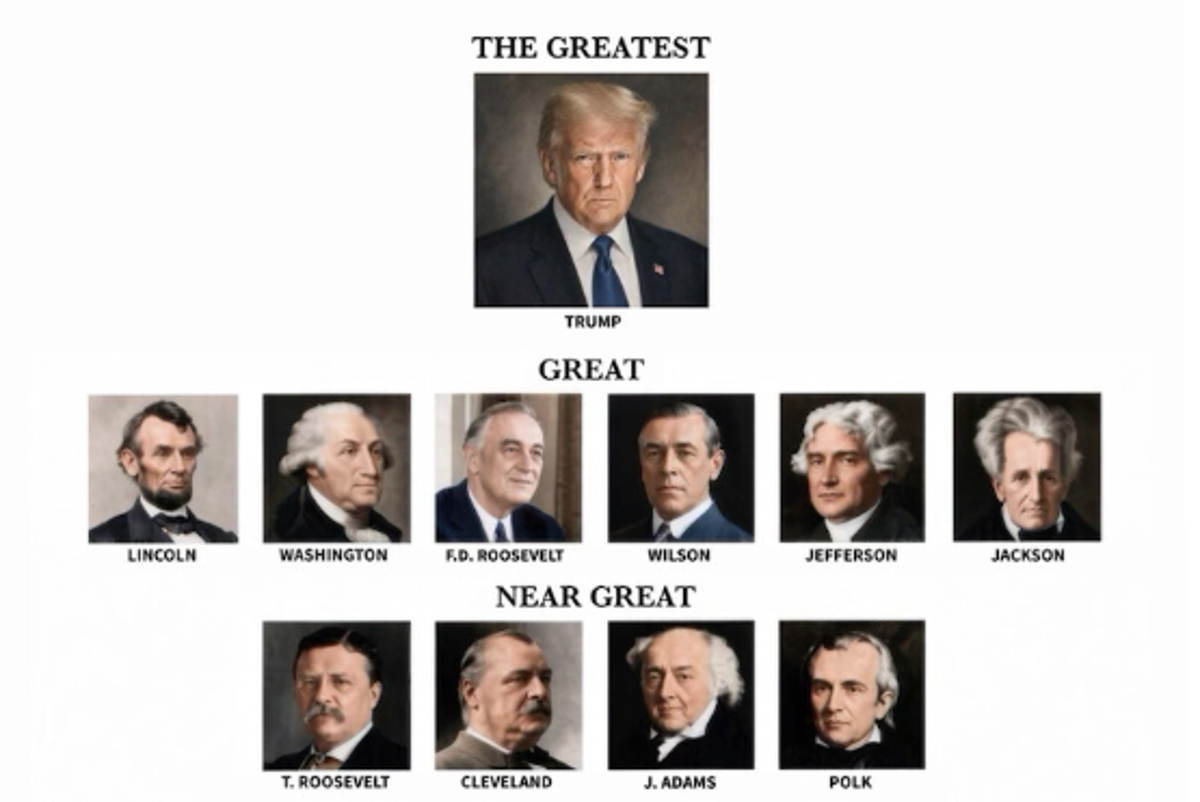
Naturally, Trump responded by publishing his own chart putting himself at the top.
The media rolled their eyes. The commentariat mocked his ego. But everyone missed the real story, which is far more uncomfortable for the establishment: Trump is right about the rankings, even if his self-assessment is self-serving.
The entire presidential ranking apparatus is a biased, lagging-indicator scam designed to reward compliance and punish disruption. If you want to understand why political analysis is broken, you have to look past the orange paint and examine the scorecard itself.
The Academic Echo Chamber
Let us look at how these surveys work. Organizations like the American Political Science Association routinely survey presidential historians. The criteria are ostensibly objective: economic management, moral authority, administrative skills, and international relations.
In practice, these surveys measure how closely a president adhered to elite consensus.
If you start foreign wars based on faulty intelligence, expand the surveillance state, and pass bipartisan trade pacts that gut the industrial Midwest, historians will reward you with a cozy spot in the upper third. You played the game. You respected the institution. You didn't make the cocktail party awkward for the faculty lounge.
Conversely, if you tear up trade deals, mock international bodies, pick fights with the press, and openly treat the federal bureaucracy like an adversary rather than an employer, you get punished. It does not matter what the actual metrics look like on the ground. It matters that you offended the sensibilities of the people grading the papers.
I have spent decades watching institutional gatekeepers protect their models while reality burns down around them. I have seen corporate boards fire disruptive founders because they lacked "executive presence," only to watch the clean, polite successor steer the company straight into bankruptcy.
The academic ranking of presidents suffers from the exact same institutional bias. They are grading the neatness of the uniform while ignoring whether the army actually won the war.
The Lagging Indicator Fallacy
Consider the metric of institutional respect. Historians love a president who "upholds norms."
Norms are lovely things until they calcify into a protective shell for incompetence. When the system is producing endless foreign quagmires, stagnant median wages, and an opioid crisis that hollows out entire states, defending the norms isn't virtue. It is complicity.
A disruptive president enters Washington and treats those norms like speed bumps. That is why the establishment hates them. They break the china.
When you look at Trump’s presidency through the lens of traditional metrics—decorum, press relations, legislative unity—he scores poorly. But those metrics are lagging indicators of an old world order that most Americans had already checked out of.
If your baseline is that the pre-2016 status quo was working fine, then Trump is a disaster. But if you recognize that the pre-2016 status quo was a slow-motion catastrophe for working-class America, then breaking the china was a prerequisite for survival.
The ranking systems penalize disruption because disruption threatens the historians' own narrative of how government is supposed to work. They want a neat story of linear progress steered by wise technocrats. Trump’s existence is a middle finger to that narrative.
The Data They Ignore
Let us look at actual policy outcomes without the emotional filter of a Twitter feed.
Prior to the pandemic, the administration secured the lowest unemployment rates in half a century for African American, Hispanic, and Asian American workers. Median household income hit historic highs.
On foreign policy, the administration avoided starting new wars—a radical departure from the post-Cold War consensus—and brokered the Abraham Accords in the Middle East, bypassing thirty years of failed diplomatic orthodoxy from career foreign service experts who insisted peace was impossible without solving the Palestinian conflict first.
Did he break a lot of glass to get there? Absolutely. Did his rhetoric alienate half the country? Daily.
But presidential history is not a civics class speech contest. It is a ruthless exercise in leverage and power. Abraham Lincoln suspended habeas corpus and imprisoned journalists. Andrew Jackson stared down the central bank and defied the Supreme Court. Franklin Roosevelt packed courts and interned citizens.
If you judged past presidents by the polite, risk-averse standards applied to modern disruptors, none of the greats would make the top tier. They were reviled in their time by the polite society of their day. They were called tyrants, demagogues, and the worst ever.
Time softens the edges of historical controversy, but only when the disruption proves successful. The academics grading Trump today are too close to the wound. They are reacting to the daily friction rather than the structural shift.
The Narcissism of the Small Difference
Trump publishing his own chart is undeniably tacky. It lacks the dignified silence we expect from former executives. It feeds right into the caricature of a thin-skinned narcissist.
And that is precisely why the trap worked.
By taking the bait, the media focused entirely on his ego rather than the absurdity of the original academic ranking. They debated whether he belongs at the bottom or the middle, completely ignoring the fundamental question: why should anyone care what a panel of progressive academics thinks about executive power in the twenty-first century?
The entire exercise is an exercise in the narcissism of small differences among the elite class. They validate each other's biases, publish papers read by twelve people, and pretend they are decoding the sweep of history.
History doesn't care about your faculty lounge consensus. It cares about who broke the mold, who shifted the tectonic plates, and who forced a calcified system to reckon with its own failures.
Trump didn't invent the art of the self-aggrandizing chart, and he certainly didn't invent the egotistical president. But he exposed the deep, systemic hypocrisy of a grading rubric that treats decorum as an achievement and disruption as a sin.
Stop reading the curated lists of men who have never built anything, managed anything, or risked anything. Look at the balance sheet. Look at the power centers that were forced to shift.
The history books will eventually be rewritten, not by the academics currently hiding in their ivory towers, but by the weight of the structural changes they are currently too blind to see.