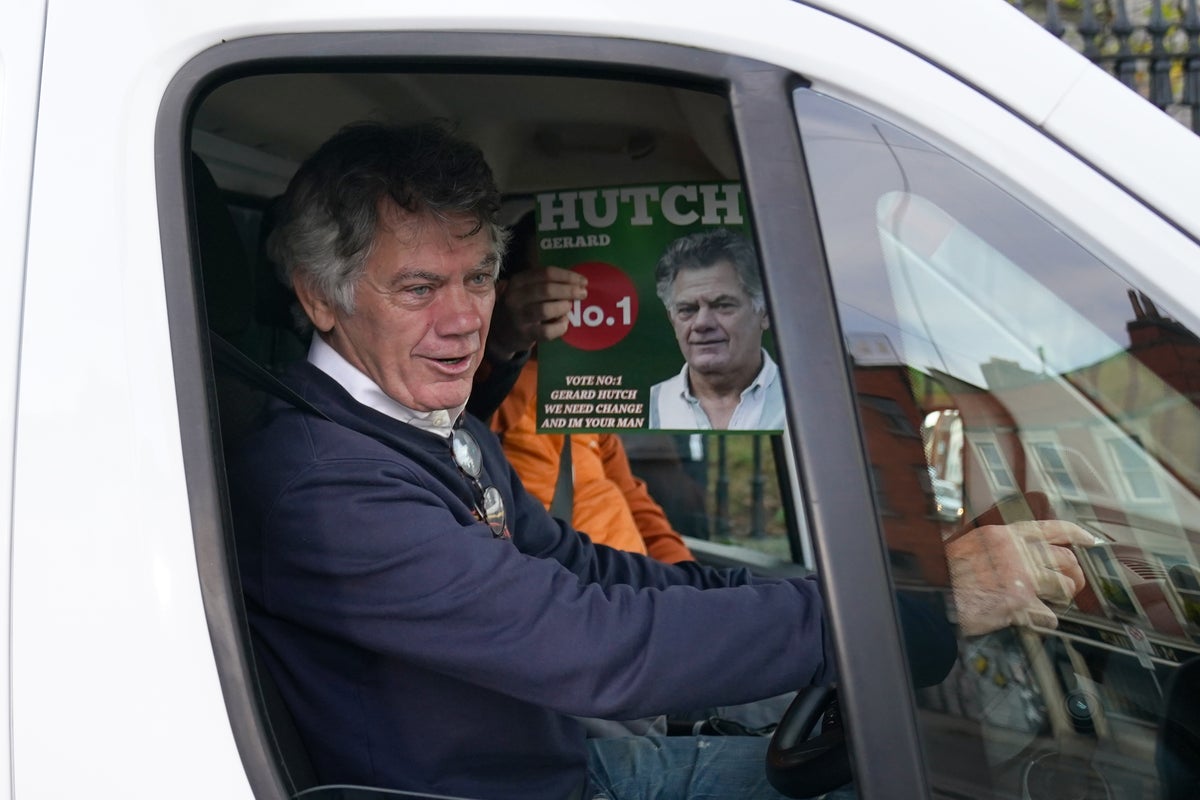
The candidacy of Gerard ‘The Monk’ Hutch for the Dublin Central by-election is not a mere eccentricity of local politics; it is a stress test for the Irish electoral system's tolerance for high-profile non-traditional candidates. By entering the race, Hutch disrupts the established equilibrium of one of the most competitive constituencies in Ireland. His presence forces a realignment of voter priorities, shifting the focus from standard service delivery to a referendum on institutional trust and the social capital of the marginalized. Understanding the impact of this candidacy requires a rigorous breakdown of the Dublin Central demographic profile, the mechanics of the Single Transferable Vote (STV) system, and the conversion rate of notoriety into political equity.
The Dublin Central Baseline and the Transfer Paradox
Dublin Central functions as a microcosm of Irish socioeconomic stratification. It contains some of the state's most affluent pockets alongside areas of extreme urban deprivation. Historically, this has created a fragmented political landscape where Sinn Féin, Fine Gael, and the Social Democrats compete for distinct but overlapping voter blocs.
The entry of an independent candidate with Hutch’s specific profile—defined by a decades-long history with the state’s legal apparatus and a subsequent acquittal in a high-profile Special Criminal Court trial—introduces a "Disruption Variable" into the STV model.
- The Primary Vote Capture: Hutch targets a specific demographic: the disillusioned voter who views the state as an adversarial force. In these pockets of Dublin Central, legal history is often viewed through a lens of state overreach or local loyalty rather than through the objective application of the law.
- The Transfer Exhaustion: Under STV, the ability to win a seat depends on "transfers"—votes passed down from eliminated candidates. Hutch faces a high "transfer toxicity" among middle-class voters in areas like Phibsborough or Stoneybatter. While he may secure a significant first-preference vote, his path to a seat is mathematically throttled if he cannot attract second and third preferences from mainstream party supporters.
The Three Pillars of the Hutch Campaign Logic
To move beyond the headlines, we must categorize the campaign’s viability through three structural pillars: Hyper-Locality, The Anti-Establishment Archetype, and Resource Asymmetry.
Hyper-Locality and the "One of Our Own" Narrative
In the North Inner City, political influence is often currency traded for local advocacy. Hutch leverages a legacy of community presence that predates his legal battles. This creates a localized trust economy that mainstream politicians, who divide their time between national legislation and local clinics, struggle to replicate. The campaign relies on the perception that a representative who has navigated the harshest levels of state scrutiny is uniquely qualified to fight for a community that feels ignored by the same institutions.
The Anti-Establishment Archetype as a Weapon
Hutch’s candidacy coincides with a broader European trend where traditional party structures are hemorrhaging support to outsiders. In the Irish context, Sinn Féin traditionally captured this "protest vote." However, as Sinn Féin professionalizes and moves toward the center to prepare for government, a vacuum has opened on the radical flank. Hutch occupies this space not through policy, but through his identity as a person who has survived the state's most concentrated efforts at prosecution.
Resource Asymmetry and Media Saturation
Most independent candidates fail due to a lack of name recognition and campaign funding. Hutch possesses 100% name recognition, a resource that candidates like the Social Democrats’ Gary Gannon or Fine Gael’s James Geoghegan had to build over years of public service. This saturation acts as a force multiplier. Every news cycle discussing his candidacy is effectively a free advertisement that reaches his target demographic without the need for a traditional canvassing infrastructure.
Quantifying the Electoral Risk for Incumbents
The risk to established parties is not necessarily that Hutch wins the seat, but that he alters the "elimination order." In a by-election, there is only one seat. This creates a winner-take-all environment that is far more volatile than a General Election.
- Sinn Féin’s Cannibalization Risk: Mary Lou McDonald holds a stronghold here, but the party’s base in the North Inner City overlaps significantly with Hutch’s potential voters. If Hutch siphons off 5–8% of the first-preference vote from the republican base, he could weaken Sinn Féin’s momentum, making it harder for them to claim a dominant mandate in the run-up to the General Election.
- The Government’s Defensive Posture: For Fine Gael and Fianna Fáil, a Hutch candidacy is a double-edged sword. It allows them to frame the election as a choice between "law and order" and "chaos," potentially galvanizing their own bases. However, it also highlights the failure of successive governments to address the root causes of urban decay that make a candidate like Hutch viable in the first place.
The Legal and Ethical Guardrails of the State
Ireland’s electoral laws are permissive by design. Under the Electoral Act 1992, as amended, there are few barriers to entry for a candidate who has not been convicted of a disqualifying offense that carries a sentence of more than six months without the option of a fine (and even then, specific conditions apply). Since Hutch’s 2023 acquittal, he remains a citizen in full standing regarding his right to seek office.
This creates a tension between Procedural Legitimacy and Moral Optics. The state cannot legally prevent his candidacy without fundamentally altering democratic protections. This leads to a situation where the political establishment must defeat him at the ballot box rather than through the courts—a task that requires engaging with the socioeconomic grievances he represents.
The Cost Function of Notoriety
While notoriety provides a high floor for a campaign, it also sets a low ceiling. In a constituency with 45,000 to 50,000 voters, winning a by-election usually requires a quota or a dominant lead at the final count.
The "Hutch Ceiling" is defined by the following constraints:
- The Vetting Gap: Unlike party candidates, Hutch lacks a policy platform. When the conversation shifts from his persona to the Dublin Central housing crisis, healthcare wait times, or public transport, the campaign’s lack of technical depth becomes a liability.
- The Civic Barrier: A significant portion of the electorate views the prospect of a Hutch victory as an international embarrassment for the Dáil. This "Civic Shame" factor acts as a psychological barrier that prevents his expansion into the undecided middle-class voter bloc.
Strategic Realignment and the Path to the Count
As the by-election approaches, the strategic play for the established parties is not to attack Hutch directly—which reinforces his "persecuted" narrative—but to starve his campaign of oxygen by focusing on hyper-technical local issues.
For the voter, the choice is between a representative who functions within the legislative machinery and an outsider whose primary utility is symbolic defiance. The actual impact of the Hutch candidacy will be measured in the "surplus transfers." If he is eliminated late in the count, his transfers will likely be highly "disorganized," meaning they will scatter across the board rather than following a party line. This unpredictability is the greatest threat to the status quo, as it could inadvertently hand the seat to a candidate who was not the frontrunner in early rounds.
The most effective strategy for an incumbent to counter this disruption is to isolate the Hutch vote to its geographic core while aggressively pursuing the secondary preferences of the "Quiet Middle." If the established parties fail to articulate a credible solution to the North Inner City's systemic neglect, they provide the fertile ground necessary for notoriety to transform into genuine political power. The count will ultimately reveal whether the Dublin Central electorate prioritizes institutional stability or a radical, albeit controversial, form of local representation.