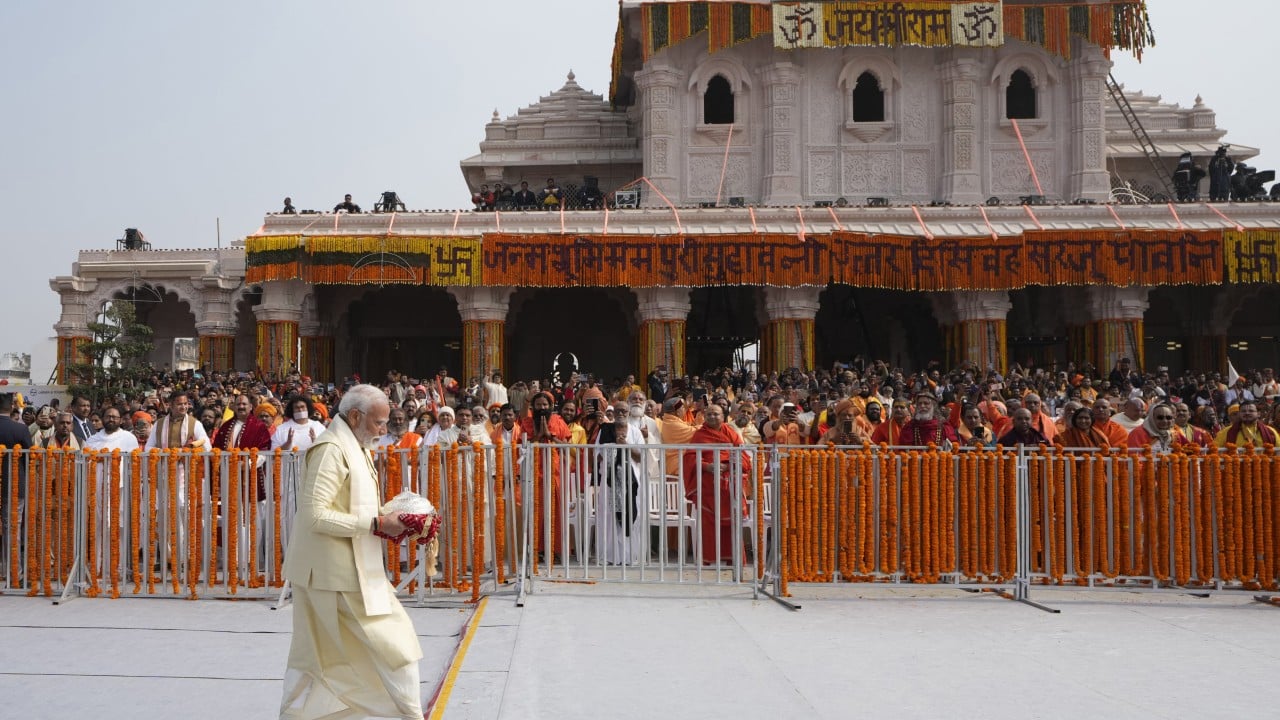
The collision of state power and religious finance generates a distinct class of liability: the integrity trap. When political entities align themselves with the administration of massive religious trusts, they assume fiduciary risks that transcend standard governance issues. The current scrutiny surrounding land acquisition and donation management in Uttar Pradesh is not merely an administrative hiccup; it is a fundamental stress test of the ruling party’s ability to manage the conversion of sacred belief into political equity.
Religious capital operates on a rigid trust model. Donors are not investors seeking a dividend; they are agents of faith seeking a spiritual return. This creates an imbalance where the standard market mechanism of "buyer beware" does not apply. Instead, the entity managing the trust is subject to a higher standard of scrutiny, where any financial discrepancy—perceived or real—functions as a direct erosion of the ruling party's moral narrative.
The Mechanics of Religious Capital
In Indian politics, the integration of temple development into the broader legislative agenda acts as a multiplier for political capital. The construction and management of prominent shrines provide a concrete, physical manifestation of ideological commitments. However, this creates a dependency chain. The legitimacy of the project rests entirely on the perceived purity of the financial execution.
The math of this capital is simple:
- Inputs: Voluntary donations, public land allocation, and legislative support.
- Outputs: Socio-political mobilization, symbolic victory, and local economic development.
- The Variable of Risk: Financial transparency.
If the financial execution (the middle step) is compromised by allegations of inflated land prices, non-transparent tendering, or internal conflict, the multiplier effect turns negative. The political entity becomes the primary target because the public views the Trust and the Party as a singular unit of governance. The separation of these entities exists on paper, but in the court of public opinion, they are fused.
The Principal-Agent Problem in Faith Trusts
The core of the current controversy lies in a classic principal-agent problem. The "Principal" is the donor base, whose contributions are driven by an expectation of service to the deity. The "Agent" is the trust board, tasked with managing these resources.
In a functioning corporate environment, the Board of Directors answers to shareholders. In a religious trust, the accountability loop is broken. There are no dividends to pay and no quarterly earnings reports to justify spending. When the Agent operates with opacity, the Principal cannot exercise oversight.
When the ruling party is perceived as the de facto supervisor of the Agent, the party inherits the Agent's failures. If the Trust fails to justify a land purchase price—specifically, when public record suggests a rapid appreciation in value without clear infrastructure investment—the donor base experiences cognitive dissonance. They feel their sacred contribution has been commodified.
This leads to a degradation of the party's core brand. The brand, in this context, is defined by "efficiency" and "anti-corruption." If the Trust displays the classic symptoms of cronyism, the ruling party loses the ability to claim the moral high ground on fiscal discipline. The scandal then shifts from a local administrative issue to a national reputational crisis.
Deconstructing the Land Deal Friction
The scrutiny surrounding land procurement reveals a lack of operational rigor in high-stakes environments. When a Trust acquires land for expansion, it operates under intense time pressure and public observation. Any delay in proper valuation protocols allows third-party actors to frame the process as exploitative.
The structural failure here is one of procurement optics. Purchasing land at a valuation that deviates significantly from the market rate—without rigorous, independent third-party audits made public before the transaction—creates a vacuum. In politics, a vacuum of information is invariably filled by an opposition narrative of corruption.
The specific risks in this procurement model include:
- The Valuation Gap: When purchase prices jump from baseline to extreme in short cycles, auditors and the public assume rent-seeking.
- Intermediate Party Involvement: The presence of intermediaries between the land seller and the Trust creates an unnecessary layer of vulnerability.
- Lack of Independent Auditing: The absence of a transparent, third-party certification process for every major asset acquisition is a structural weakness.
The party’s failure to enforce stringent, auditable standards on the Trust is not just a lack of administrative oversight; it is a failure of risk management. The inability to justify procurement costs creates a liability that the opposition will inevitably weaponize.
The Feedback Loop of Political Liability
The political fallout from financial opacity follows a predictable pattern. It begins with local dissent, escalates to institutional inquiry, and ends with a national narrative shift.
- Local Dissent: Internal stakeholders or disgruntled local leaders leak documents suggesting financial irregularities.
- Institutional Inquiry: The opposition party initiates legal challenges, demanding transparency. This forces the Trust into a defensive posture.
- Narrative Shift: The media cycle moves from focusing on the spiritual triumph of the temple to the fiscal impropriety of the Trust.
At this stage, the ruling party is forced into a reactionary cycle. If they defend the Trust unconditionally, they appear to be complicit in corruption. If they distance themselves, they appear weak and lose control of the narrative. This is the definition of a trap.
The party’s current strategy—relying on the sheer volume of public support to drown out individual scandals—is a short-term hedge that carries long-term toxicity. It relies on the assumption that the donor base is inelastic. However, in political science, belief systems are fragile. While initial support is fervent, a sustained barrage of evidence regarding mismanagement creates a slow, steady leak in political capital.
Operational Requirements for Risk Containment
To exit this trap, the ruling party must implement a strict operational decoupling. The objective is not to stop the project, but to insulate the party organization from the administrative machinery of the Trust.
1. Total Financial Disintermediation
The Trust must adopt an open-book policy. Every acquisition, contract, and vendor relationship must be public-facing. This is not about being "nice"; it is about self-preservation. By preemptively publishing every land deal with independent valuation reports, the Trust neutralizes the opposition’s ability to spin the numbers.
2. Institutional Firewalls
The leadership of the Trust must be demonstrably separated from the direct chain of command of the party organization. Appointing figures with non-partisan backgrounds—individuals whose reputations are built on technical, legal, or audit expertise—creates a buffer. When the Trust is managed by career bureaucrats rather than political operatives, the party has the capacity to intervene as an objective arbiter when accusations arise.
3. Proactive Audit Cycles
The Trust should invite third-party audits from top-tier, non-aligned firms. The results should be published with the same intensity that the party promotes the temple's construction. Treating an audit as a marketing tool—"We are so committed to transparency that we invited the world's strictest auditors"—shifts the narrative from "What are they hiding?" to "How efficiently are they running this?"
The Strategic Outlook
The current row is a symptom of a larger, systemic oversight. The ruling party has treated the Trust as a political instrument rather than a fiduciary entity. This is an operational error that risks the integrity of the entire temple project.
If the party continues to allow the Trust to operate with a "business as usual" approach to finance, the political costs will escalate. The opposition does not need to manufacture scandal; they only need to wait for the Trust to continue its current, opaque practices.
The strategic play is to force a pivot to radical transparency. The party must treat the Trust's finances with the same, or greater, scrutiny than they would apply to a state-run enterprise.
This requires the following immediate tactical changes:
- Immediate Suspension of Ambiguous Deals: Any pending land transaction that lacks independent, multi-source valuation should be halted.
- The Transparency Mandate: The Trust should release a comprehensive, itemized report of all donations and expenditures. This should be a digital, searchable database, not a static, redacted PDF.
- Professionalization of Management: Remove political appointees from day-to-day operational roles and replace them with a board of technical experts.
The party’s success depends on its ability to recognize that they are not just managing a religious project; they are managing a financial ecosystem. If they fail to secure that ecosystem, the project will cease to be a source of political capital and instead become a drain on their authority. The path forward is not to suppress the row, but to formalize the Trust's processes to a level that makes scrutiny irrelevant. The party must choose between being the protector of a flawed trust or the architect of an unimpeachable institution. The latter is the only path that preserves their capital.