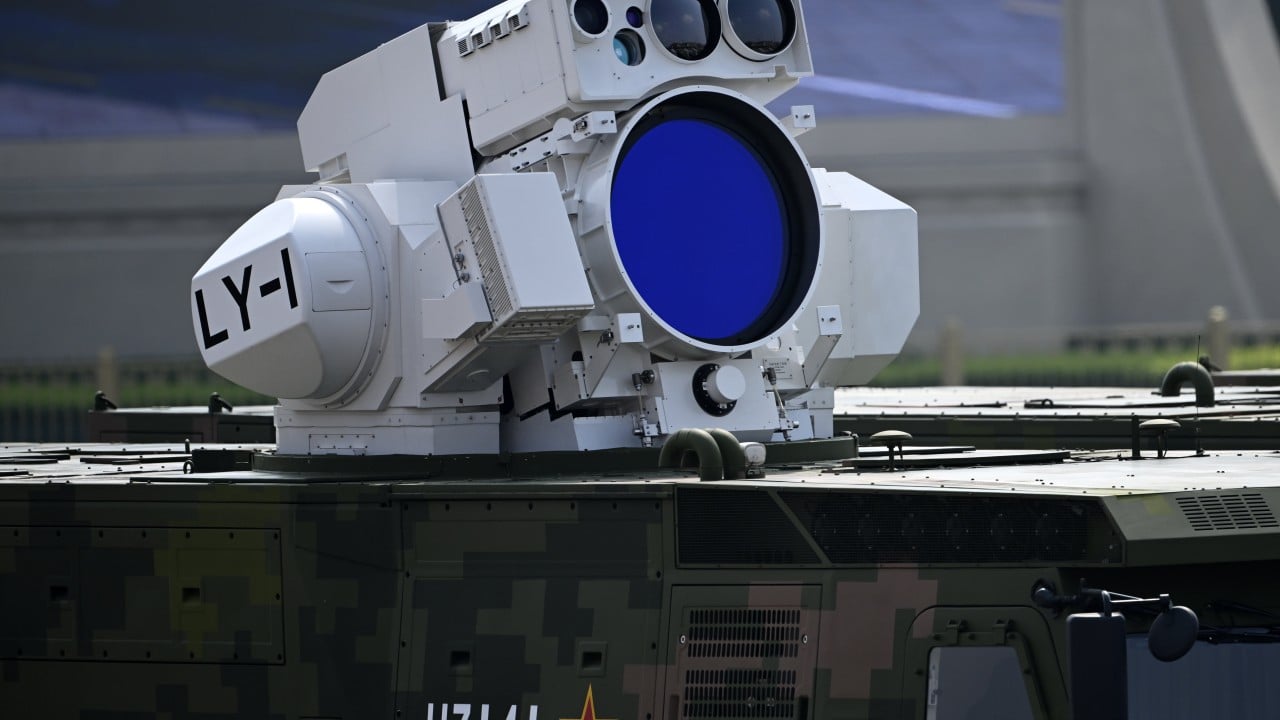
Every defense blogger on the internet is currently losing their minds over a grainy photo of a directed energy weapon strapped to the deck of a Type 071 amphibious transport dock in the South China Sea. The standard narrative runs on pure panic. Analysts call it a quantum leap in shipboard point defense. Commentators scream that soft-kill lasers have finally arrived to sweep low-cost quadcopters and loitering munitions off the modern maritime chessboard.
They are entirely wrong.
I have watched defense contractors burn billions of dollars chasing the directed energy mirage for two decades. I have evaluated power-scaling curves in anechoic chambers and watched thermal blooming tear apart high-power beams across maritime boundary layers. The frantic obsession with putting a laser on an amphibious hull exposes a fundamental misunderstanding of physics, salt-air thermodynamics, and the brutal mathematics of saturation warfare.
That weapon on the People Liberation Army Navy dock ship is not a revolution. It is a desperate band-aid slapped over an intractable naval vulnerability, and it will fail the exact second a peer adversary stops playing by its rules.
The Maritime Thermal Trap
Let us clear up the basic physics right now because the defense press refuses to do so. Directed energy weapons do not magically melt steel or incinerate composites from miles away. They rely on sustained optical dwell time to deliver enough joules per square centimeter to structurally compromise a target.
On land, high-energy lasers face atmospheric turbulence. At sea, the environment is magnitudes more hostile.
Marine boundary layers are choked with aerosolized salt, moisture, and thermal gradients. When you fire a high-energy beam across the surface of the South China Sea, beam scatter and thermal blooming do not just degrade your output; they actively destroy your focus. The air itself acts as a thermal lens, defocusing the energy before it ever touches a carbon-fiber rotor blade.
Worse yet, shipboard platforms are never static. They pitch, roll, and yaw with every swell. Keeping a multi-kilowatt beam pinned to a square-centimeter spot on a maneuvering drone's gimbal while your own platform is oscillating in heavy seas requires adaptive optics so complex and fragile that a single hard salt-spray crust on the emitter window will blind the system entirely.
I have seen lab-grade tracking rigs lose lock because of thermal distortion caused by the ship own exhaust plume. Now imagine trying to maintain sub-millimeter tracking accuracy from the heaving deck of an amphibious assault ship while taking evasive maneuvers. It is an engineering nightmare disguised as a tactical upgrade.
The Power Budget Fallacy
Let us talk about watts, because armchair tacticians love quoting kilowatt ratings without understanding where the juice comes from.
An amphibious transport dock is not a nuclear-powered aircraft carrier or a dedicated destroyer with integrated electric propulsion architectures designed for high-draw combat systems. Type 071 hulls rely on traditional diesel propulsion plants. Their electrical distribution grids are optimized for hotel loads, propulsion, and heavy hydraulic marine lifts for landing craft and vehicles.
To drive a solid-state laser capable of burning through a military-grade composite drone skin at militarily useful ranges, you need upwards of one hundred kilowatts of coherent output. Factor in wall-plug efficiency—which for standard commercial fiber lasers sits roughly around thirty to forty percent—and your generation requirement spikes past three hundred kilowatts of raw electrical draw.
Where is that power coming from on an amphibious dock ship during a high-tempo amphibious assault?
If you route that much current into a directed energy turret, you are starving critical shipboard systems. You are trading your electronic warfare suites, your active radar cooling loops, or your internal damage control pumps for a boutique weapon that can only engage one target at a time.
Which brings us to the core economic delusion of the anti-drone laser cult.
The Attrition Trap of Single Target Engagement
The entire selling point of directed energy is the supposed near-zero cost per shot. Proponents love to claim that firing a laser costs pennies in diesel fuel compared to a million-dollar surface-to-air missile.
That math works beautifully on a PowerPoint slide against a single hobbyist quadcopter. It falls apart completely in a modern saturation strike.
Imagine a scenario where a defended amphibious group runs headfirst into a swarm of fifty cheap, autonomous loitering munitions or fast attack boats equipped with low-cost electro-optical bypass guidance. A laser is a serial weapon. It must acquire, track, dwell, and destroy Target A before it can slew to Target B.
Even if a dwell time takes a blazing-fast two seconds, your thermal management system is soaking up massive amounts of waste heat that must be dumped into the surrounding seawater. Try cycling that weapon fifty times back-to-back without cooking your own internal cooling loops. The system will either thermal-throttle or experience catastrophic optical degradation.
Meanwhile, the swarm does not care about your per-shot cost. It overwhelms your queue. While your single beam is busy melting the plastic shell of drone number three, drones four through fifty are already slamming into your superstructure.
Directed energy is a sniper rifle in an era of artillery barrages.
The Electronic Warfare Shell Game
We need to talk about what these systems are actually replacing, or worse, what they are masking.
Navies desperate for close-in defense against asymmetric threats often bolt lasers onto decks because electronic warfare is hard to photograph and even harder to market to state media. A massive turret with tracking optics looks menacing in a press release. A phased-array antenna looks like a gray box.
Yet, any experienced operator knows that hard-kill kinetic or directed energy options are always a last resort. If your first line of defense against a drone is burning a hole in it with a laser, your electronic warfare posture has already failed.
Modern military drones are rarely operated via simple line-of-sight radio links that a medium-power laser can easily disrupt by dazzling a camera. They utilize frequency-hopping spread-spectrum waveforms, autonomous inertial navigation backups, and pre-programmed terminal attack profiles that do not rely on constant data feeds.
Blinding a camera with a low-power dazzler works against cheap commercial imports. It does nothing against a military-grade seeker head hardened against optical interference. And if you are relying on high-power thermal destruction, you are waiting until the threat is already uncomfortably close to your hull—close enough that any kinetic payload detonating upon impact will shred your exposed optical turret anyway.
The Counter-Intuitive Reality of Maritime Defense
The obsession with high-power lasers on amphibious ships misses the fundamental nature of naval survivability. Amphibious vessels are high-value, high-signature targets. They carry hundreds of marines, heavy armor, and aviation fuel. They are not designed to sit in the forward line of a contested anti-access/area-denial zone trading beam shots with autonomous swarms.
When you strap an experimental, power-hungry, environmentally fragile laser onto a Type 071, you are treating a symptom while ignoring the disease.
The real solution to maritime drone saturation is not a bigger magnifying glass powered by diesel generators. It is distributed, multi-layered electronic deception, networked kinetic interceptors with micro-calibers, and decentralized sensor grids that deny the enemy targeting data long before they ever cross the horizon.
The defense establishment loves a silver bullet because it avoids hard choices about ship design, doctrine, and fleet architecture. But nature does not care about marketing campaigns. Saltwater corrodes, thermal gradients scatter, and physics always wins.
Stop looking at the shiny toy on the deck. Look at the structural vulnerabilities it is trying to hide.