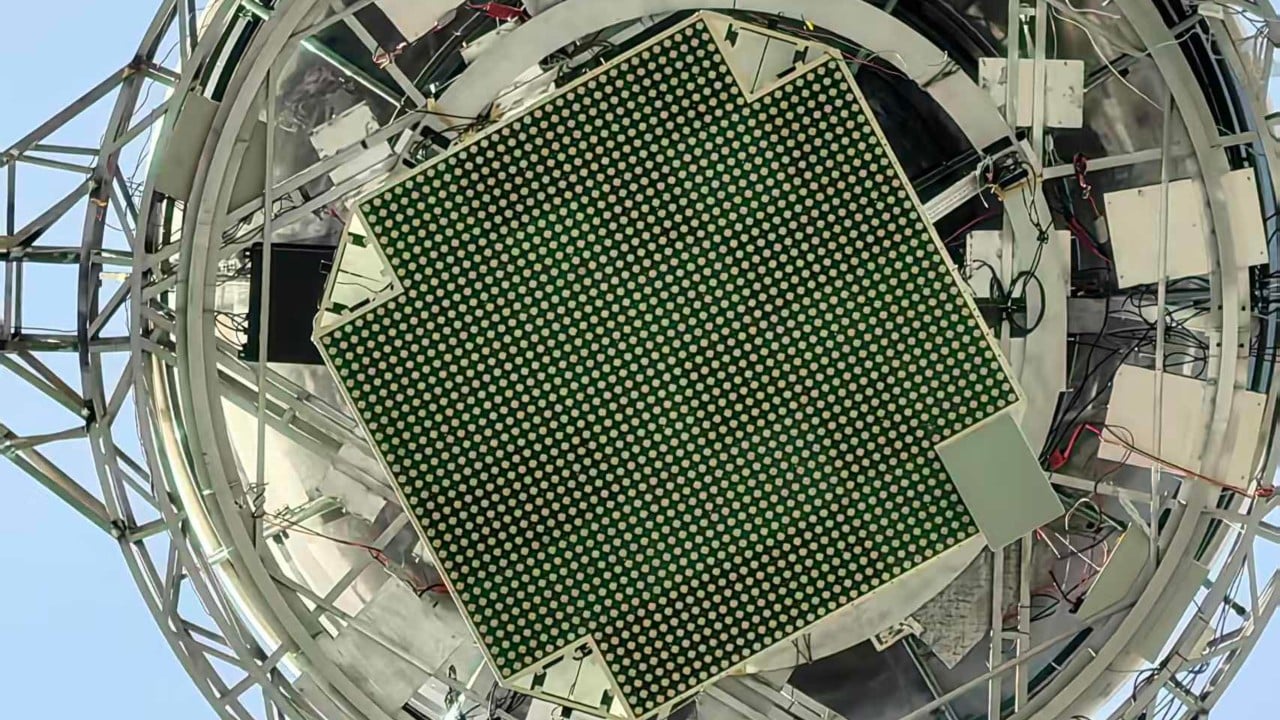
The ambition to capture baseload solar energy from geostationary orbit and beam it to Earth addresses a fundamental physical limitation of terrestrial renewables: the diurnal cycle and atmospheric attenuation. By placing photovoltaic arrays in geostationary earth orbit (GEO), an energy system receives up to eight times more solar irradiance per square meter than a typical terrestrial installation, completely uninterrupted by weather or nightfall. However, translating this raw physical advantage into a viable macro-utility requires overcoming a brutal series of engineering bottlenecks and thermodynamic penalties. The current initiatives led by Chinese research institutions, specifically the multi-phase projects utilizing the Bishan testing facility, serve as an ideal baseline to analyze the economic and mechanical viability of Space-Based Solar Power (SBSP).
The Three Pillars of Space Based Solar Power Architecture
To evaluate the feasibility of any SBSP system, the infrastructure must be decoupled into three discrete subsystems. Failure or sub-optimal efficiency in any single pillar invalidates the economic model of the entire enterprise. Meanwhile, you can explore related stories here: Why Indias Space Station Vision Matters More Than You Think.
[Primary Solar Collection (GEO)]
               │
               ▼  (DC-to-RF Conversion)
[Microwave Transmitting Antenna]
               │
               ▼  (Wireless Power Transfer through Atmosphere)
[Terrestrial Rectifying Antenna (Rectenna)]
1. The Orbital Collection Array
The primary subsystem requires deploying massive structures in GEO, roughly 35,786 kilometers above the equator. To match the output of a standard terrestrial nuclear or coal plant (approximately 1 gigawatt), the space-based collector requires a photovoltaic surface area spanning several square kilometers. The primary challenge is not the photovoltaic efficiency itself, but the structural mass-to-power ratio. Traditional silicon wafers are too heavy; the architecture depends on ultra-thin-film photovoltaics or concentrated solar power systems that focus light onto high-efficiency multi-junction cells.
2. The Wireless Power Transmission System
Once the orbital array generates direct current (DC), this energy must be converted into radio frequency (RF) energy—typically in the microwave spectrum at 2.45 GHz or 5.8 GHz. These frequencies are selected because they sit within atmospheric transmission windows, minimizing absorption by water vapor and clouds. The RF energy is then focused into a highly directional beam by a phased-array transmitting antenna. This transmitting structure itself must be up to a kilometer in diameter to maintain beam coherence over a 36,000-kilometer propagation path. To explore the complete picture, we recommend the recent article by Mashable.
3. The Terrestrial Rectenna
On the ground, the microwave beam is intercepted by a rectifying antenna, or rectenna, which converts the RF energy back into DC electricity for grid integration. Because of the diffraction limits of electromagnetic waves over geostationary distances, the beam spreads out as it travels. Even with a kilometer-wide transmitter, the ground-level footprint of the receiving rectenna array must span several kilometers in diameter. The power density at the center of the beam must be strictly controlled to meet safety standards for avian life and aviation corridors.
The Efficiency Cascade and the Thermodynamic Penalty
The primary argument for SBSP is the abundance of solar energy in space ($1,361 \text{ W/m}^2$ versus an average of $150\text{--}250 \text{ W/m}^2$ on Earth after atmospheric and day-night filtering). However, the system must survive a compounding sequence of energy conversions, each introducing a thermodynamic penalty.
The end-to-end efficiency chain can be mathematically modeled by tracking the energy losses at each stage:
$$\eta_{\text{system}} = \eta_{\text{pv}} \times \eta_{\text{dc-rf}} \times \eta_{\text{trans}} \times \eta_{\text{atmos}} \times \eta_{\text{rect}}$$
Where:
- $\eta_{\text{pv}}$ is the photovoltaic conversion efficiency (~30% for advanced multi-junction cells).
- $\eta_{\text{dc-rf}}$ is the conversion efficiency of DC to microwave energy via solid-state power amplifiers or magnetrons (~70%).
- $\eta_{\text{trans}}$ is the beam collection efficiency, governed by the aperture sizes of the transmitter and receiver (~80%).
- $\eta_{\text{atmos}}$ is the atmospheric transmission efficiency under clear or overcast conditions (~90%).
- $\eta_{\text{rect}}$ is the rectenna RF-to-DC conversion efficiency (~85%).
Compounding these conservative estimates yields an end-to-end efficiency of approximately 13% to 15% from the intercepted space sunlight to the terrestrial grid.
$$\eta_{\text{system}} = 0.30 \times 0.70 \times 0.80 \times 0.90 \times 0.85 \approx 0.128$$
To deliver 1 gigawatt of continuous power to the grid, the orbital array must capture roughly 7.8 gigawatts of solar power. At $1,361 \text{ W/m}^2$, this dictates a minimum collector area of 5.7 square kilometers. Any reduction in component efficiency exponentially scales the required size and mass of the space asset.
The Mass to Orbit Cost Function
The primary economic barrier to implementing an orbital solar program is the cost of launch logistics. A 1-gigawatt space solar satellite is estimated to weigh between 4,000 and 10,000 metric tons, depending on the lightweight nature of the structural composites and photovoltaics used.
To contextualize this, the International Space Station weighs roughly 420 metric tons and required more than 40 launches over a decade to assemble in Low Earth Orbit (LEO). Moving thousands of tons not just to LEO, but transferring it up to GEO, introduces an unprecedented logistical bottleneck.
The cost function of deploying the system depends heavily on two variables: the specific cost per kilogram to LEO and the efficiency of the orbital transfer vehicles moving mass from LEO to GEO.
[Terrestrial Manufacturing]
            │
            ▼ (Heavy-Lift Launch Vehicles: Long March 9 / Starship)
    [Low Earth Orbit (LEO)]
            │
            ▼ (High-Efficiency Electric Propulsion / Solar Tugs)
 [Geostationary Earth Orbit (GEO)]
            │
            ▼ (Autonomous Robotic In-Space Assembly)
  [Operational Solar Satellite]
The second limitation is the launch cadence. Current heavy-lift rockets cannot support this volume of mass without structural changes to manufacturing pipelines. Even assuming the maturation of reusable heavy-lift platforms like China's planned Long March 9 or SpaceX’s Starship, which target a LEO launch cost below $100 per kilogram, the total launch costs for a single solar plant would run into hundreds of millions of dollars.
Furthermore, lifting mass from LEO to GEO requires an immense budget of delta-v (velocity change). Using chemical propulsion for this transfer is self-defeating, as the propellant mass would dwarf the payload mass. The architecture must rely on solar-powered electric propulsion (ion thrusters) to slowly spiral the components from LEO to GEO over several months. This introduces extended exposure to the Van Allen radiation belts, risking premature degradation of the solar cells before operations even begin.
Thermal Dissipation and Material Degradation Challenges
A كثيرا ignored constraint in popular analysis is the thermal management of the orbital satellite. In the vacuum of space, convection is non-existent. All waste heat generated by the inefficiencies of the system must be rejected purely via thermal radiation.
The solid-state power amplifiers converting DC to RF operate at roughly 70% efficiency. In a system designed to transmit gigawatts of power, the remaining 30% is converted directly into waste heat within the transmitter array. For a 1-gigawatt system, this means hundreds of megawatts of thermal energy must be dissipated continuously.
The rate of radiative heat rejection is governed by the Stefan-Boltzmann law:
$$P_{\text{rad}} = \epsilon \sigma A T^4$$
To prevent the electronics from exceeding their maximum operating temperatures (typically around 350 Kelvin), massive, heavy radiator panels must be integrated into the design. If the transmitter cannot radiate this heat efficiently, the components will experience thermal runaway, destroying the phased-array calibration required to keep the microwave beam safely targeted at the terrestrial rectenna.
Furthermore, the space environment is actively hostile to long-term structural integrity. Satellites in GEO are subjected to continuous bombardment by high-energy cosmic rays, solar flares, and micrometeoroids. Over a twenty-year operational lifespan, thin-film photovoltaics suffer severe performance degradation from ionizing radiation. Terrestrial solar farms can be serviced easily; replacing broken modules on a multi-kilometer structure in geostationary orbit requires an autonomous robotic servicing fleet that does not yet exist.
Comparative Capital Efficiency: Space vs. Terrestrial
A strict economic evaluation requires comparing the capital expenditure (CapEx) and levelized cost of electricity (LCOE) of space-based solar against equivalent terrestrial alternatives paired with energy storage.
| Variable / Metric | Space-Based Solar Power (GEO) | Terrestrial Solar + Battery Storage |
|---|---|---|
| Capacity Factor | 99% (Interrupted only during equinoxes) | 20% – 30% (Weather and latitude dependent) |
| Primary Degradation Vectors | Ionizing radiation, atomic oxygen, meteoroids | Dust accumulation, moisture ingress, thermal cycling |
| Transmission Distance | 35,786 Kilometers (Wireless RF Link) | 100 – 500 Kilometers (High-Voltage AC/DC Lines) |
| Maintenance Profile | Autonomous orbital robotics (Unproven) | Manual ground crews (Highly optimized) |
| End-of-Life Liability | Orbit graveyard disposal / Space debris risk | Recycling of glass, silicon, and battery metals |
Terrestrial solar costs have fallen dramatically, with utility-scale installations sitting well below $1 per watt. While it is true that terrestrial solar requires massive battery storage systems to provide baseline power through the night, the cost curve of lithium-iron-phosphate (LFP) and sodium-ion batteries is declining faster than the cost of heavy-lift space logistics.
To compete effectively, an SBSP system must offer an LCOE that justifies the extreme up-front R&D and deployment risk. The advantage of SBSP is its near-100% capacity factor, bypassing the need for multi-day grid-scale storage. Yet, the initial capital required to build the launch infrastructure, the automated orbital assembly lines, and the massive ground-based rectennas means that the first operational system will produce electricity at a profound price premium over terrestrial options.
Strategic Trajectory and the Near Term Play
The development path for nations investing in SBSP, such as China through its Bishan base, is best understood not as an immediate commercial energy play, but as a dual-use technology incubator. The intermediate milestones required to realize space solar yield immediate, high-value capabilities in other sectors.
The primary near-term application of long-range wireless power transmission is not grid supply, but the targeted beaming of energy to remote military outposts, disaster zones, or moving assets like maritime vessels and unmanned aerial vehicles. A system capable of directing a tight microwave beam from orbit can re-energize sub-orbital or surface infrastructure without local fuel infrastructure.
The strategic play for the next decade is confined to low-earth orbit demonstrations. Developing high-precision beam pointing and tracking mechanisms—maintaining a steady beam within a fraction of a degree while both the source and target are in relative motion—is a prerequisite. The engineering data gathered from these micro-scale orbital tests will dictate whether the efficiency losses and thermal dissipation requirements can be tamed.
Until launch costs fall below the critical threshold of $50 per kilogram to LEO and in-space robotic manufacturing becomes fully autonomous, space-based solar plants will remain a theoretical benchmark for maximum potential energy collection rather than a viable alternative to terrestrial grid infrastructure. The timeline for true commercial baseload contribution sits well beyond the 2040 horizon, contingent entirely on the automation of orbital logistics.