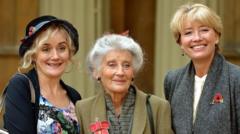
The death of Phyllida Law at ninety-four closes a distinct operational chapter in British stage and screen performance. Spanning nearly seven decades from her early training at the Bristol Old Vic to late-career cinematic appearances, Law maintained a high-output vocational model that resisted the volatility of the entertainment industry. Analyzing her trajectory requires moving past conventional biographical sentimentality to examine the structural mechanics of a career built on technical competence, institutional versatility, and intergenerational professional collaboration.
The Training Pipeline and Institutional Foundation
Law’s entry into professional acting followed a traditional mid-century institutional pathway. Born in Glasgow in 1932, her early exposure to theatrical arts transitioned into formal training at the Bristol Old Vic Theatre School. This foundation provided a vital variable for long-term career viability: repertoire stability.
In the mid-twentieth-century British theatre ecosystem, repertory companies functioned as intensive laboratories. Actors were required to cycle through diverse characters on weekly or bi-weekly turnarounds. This environment eliminated the luxury of specialized typecasting early on, forcing performers to develop a broad functional range. Law’s early work across regional stages and subsequent migration into television drama during the late 1950s—including recurring roles in procedural and anthology series like Dr Finlay's Casebook—demonstrated the direct utility of this training.
The primary economic driver of her early career was high-frequency, moderate-visibility work. Rather than waiting for marquee leading roles, Law sustained continuity through character acting. This approach insulated her against the structural unemployment that characteristically plagues freelance performers.
Intergenerational Creative Production
A defining characteristic of Law’s later career was the strategic integration of familial relationships into professional casting. As the mother of actresses Emma and Sophie Thompson, Law participated in a rare creative triumvirate that subverted traditional Hollywood separation of personal and professional spheres.
Collaborations with her daughters in projects such as Peter's Friends, Much Ado About Nothing, Emma, and Alan Rickman's directorial debut The Winter Guest served a dual operational purpose:
- Reduced Friction Casting: Directors casting ensemble period pieces or complex familial dynamics could leverage pre-existing psychological shorthand between Law and her daughters, minimizing rehearsal overhead for interpersonal scenes.
- Brand Resilience: The association with prominent family members reinforced Law's market visibility well into her later decades, converting personal bonds into a sustained commercial asset within British auteur cinema.
In The Winter Guest, where Law and Emma Thompson played mother and daughter, the dynamic allowed for an authentic friction that elevated the material. The production capitalized on the lived history of the performers, converting domestic reality into a reliable artistic output.
The Economics of Character Specialization
As the British television and film landscape shifted from live studio broadcasts to multi-camera serials and independent feature films, Law executed a pivot toward specialized character work. Her filmography reveals a calculated distribution of labor across three distinct tiers:
- High-Budget Feature Films: Serving as an institutional anchor in prestige adaptations and comedies directed by figures like Kenneth Branagh.
- Episodic Television Procedurals: Maintaining steady cash flow and public presence through guest-star arcs in long-running series such as Midsomer Murders, Foyle's War, and Doc Martin.
- Literary and Historical Adaptations: Providing immediate audience trust through authoritative supporting portrayals in period pieces.
This diversification strategy mitigated market shocks. When feature film casting slowed, television procedural commitments absorbed the downtime. The cost function of this strategy was the sacrifice of perennial headline-level celebrity status, traded instead for career longevity and an uninterrupted work span that stretched into her late eighties.
Cultural Impact and Institutional Recognition
Law’s receipt of an OBE in 2014 for services to drama and charitable causes codified her status within the British cultural establishment. Yet, her broader significance lies in how she navigated the systemic ageism inherent in visual media.
In an industry where career velocity typically decays rapidly for women past middle age, Law increased her cultural output density during her sixties, seventies, and eighties. This anomaly was managed through the conscious cultivation of an archetype: the sharp, unyielding, yet deeply observant matriarch. By embodying this archetype with technical precision, she filled a recurring structural gap in casting requirements for prestige British drama.
Furthermore, her venture into authorship with her 2013 memoir detailing her mother’s dementia demonstrated an ability to reallocate her verbal and narrative skills into literary formats. This diversification preserved her public profile through alternative channels when physical mobility on set naturally required scaling back.
The strategic takeaway from Phyllida Law’s career is the power of unglamorous vocational resilience. By prioritizing technical adaptability over fleeting stardom, leveraging familial networks without compromising professional standards, and diversifying across media tiers, she constructed a durable blueprint for long-term artistic survival.