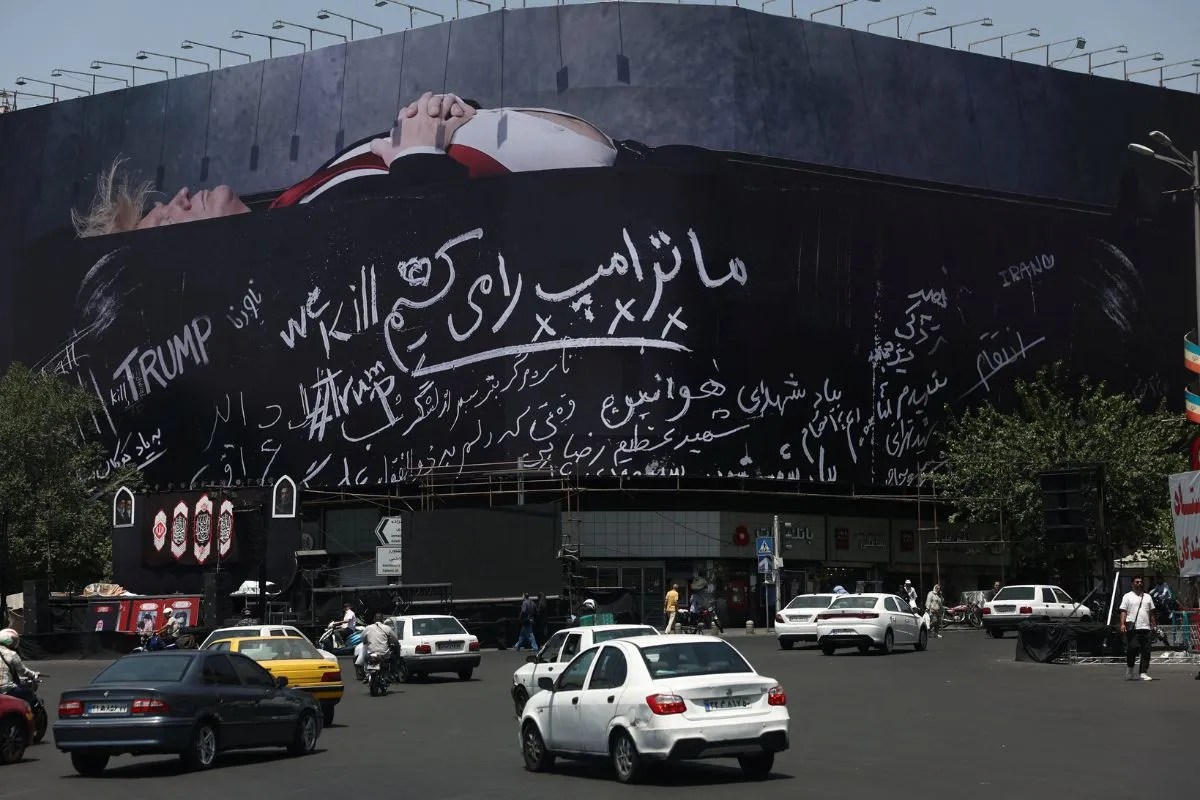
Tehran loves a giant billboard. If you drive through the major intersections of Iran's capital, you won't see ads for the latest smartphones or luxury cars. Instead, you'll see massive, state-sanctioned art. Recently, one of these billboards shocked the international community. It showed a chilling image of Donald Trump lying in a coffin, accompanied by a direct, ominous warning written in both Persian and Hebrew: "We will kill Trump."
Many Western observers brushed this off. They called it empty posturing. They thought it was just another theatrical display from a regime desperate to look tough.
They are wrong. This isn't just empty propaganda. It represents a highly coordinated, multi-year state campaign of psychological warfare and physical plots targeting a former and current U.S. President.
The Story Behind the Tehran Billboard Threat
The billboard erected in Tehran's Palestine Square isn't an isolated incident of vandalism. In Iran, public spaces are tightly controlled by the state, specifically the Islamic Revolutionary Guard Corps (IRGC). Nothing goes up on a major public billboard without direct government approval and funding.
The image itself is graphic. It shows Donald Trump inside a dark, polished wooden casket. The lighting is dramatic, designed to evoke a sense of inevitability. Below the coffin, the text makes no effort to hide its intentions. It promises death.
This isn't the first time the regime has used Trump's image in public death threats. We've seen animated videos of drone strikes on his Mar-a-Lago golf course. We've seen mock executions on state television. We've seen posters of him casting a long shadow in the shape of a target.
Why does Iran keep doing this?
It's a mix of domestic messaging and external psychological pressure. For the hardline base within Iran, these displays project strength. They signal that the regime hasn't forgotten its promises. For the outside world, it's a reminder that Iran is willing to cross traditional diplomatic boundaries to settle its scores.
Why Iran Vowed Eternal Revenge for Qasem Soleimani
To understand the sheer intensity of this hatred, you have to go back to January 3, 2020.
On that night, a U.S. MQ-9 Reaper drone fired missiles at a convoy leaving Baghdad International Airport. The target was Major General Qasem Soleimani, the commander of the IRGC's elite Quds Force. Soleimani wasn't just a military officer. He was a national icon in Iran, the architect of the country's regional influence, and the second most powerful man in the nation behind Supreme Leader Ali Khamenei.
Donald Trump personally ordered the strike.
The assassination sent shockwaves through the Middle East. Iran responded with a ballistic missile attack on U.S. bases in Iraq, but that was just the immediate military reaction. The long-term plan was much darker. Khamenei and senior Iranian officials vowed "harsh revenge." They explicitly stated that the revenge would only be complete with the elimination of those who ordered and carried out the hit.
Trump sits at the very top of that list.
Others on the list include former Secretary of State Mike Pompeo, former National Security Advisor John Bolton, and former CENTCOM Commander General Kenneth McKenzie. Iran isn't treating this as a political disagreement. They view it as a blood feud.
Tehran Billboard Diplomacy Explained
Public art in Iran serves as a direct mirror of the regime's current foreign policy. When negotiations are going well, the billboards might focus on regional unity. When tensions spike, the imagery turns violent.
The use of Hebrew on the recent billboard is a key detail. Iran is fighting a proxy war with Israel. By using Hebrew alongside Persian, Tehran is sending a message to both domestic audiences and its regional rivals. It's trying to show that it can target Israel's primary backer, the United States, at the highest level.
These billboards also serve to desensitize the Iranian public to the idea of extreme violence against foreign leaders. By normalizing the image of a U.S. president in a coffin, the state builds a cultural narrative where assassination is not just justified, but celebrated as a heroic act of justice.
The Secret Service and the Reality of the Threat
Here's what most people miss: the threat isn't confined to paint and vinyl on a Tehran street. The physical threat to Donald Trump is incredibly real, and U.S. intelligence agencies are taking it with absolute seriousness.
The U.S. government has tracked multiple active Iranian plots on American soil. The Department of Justice has unsealed indictments detailing complex murder-for-hire schemes orchestrated by IRGC operatives.
Consider these facts:
- Financial Bounties: U.S. intelligence reports indicate that Iranian entities have offered millions of dollars to anyone who can successfully assassinate Trump or his top aides.
- Local Recruits: The IRGC hasn't just tried to send agents across the border. They've actively tried to recruit criminal networks, cartel members, and private investigators inside the United States to conduct surveillance and carry out attacks.
- Massive Security Costs: The protection detail for individuals like Mike Pompeo and John Bolton costs millions of dollars annually, even years after they left office. This is a direct response to credible, ongoing threats detected by federal law enforcement.
This explains why Trump's security detail has looked different during public appearances. Bulletproof glass, heavily armed tactical teams, and strict airspace restrictions are now standard. It's not just about domestic political tensions. It's about a foreign adversary actively seeking an opportunity to strike.
How the US Deals With State Sponsored Threats
How do you deter a nation-state that openly advertises its desire to kill your current or former leader? It's a massive diplomatic and military headache.
The U.S. has used a combination of public warnings, sanctions, and quiet diplomatic warnings. Behind the scenes, Washington has communicated to Tehran that any attempt on the life of Donald Trump, or any former U.S. official, would be treated as an act of war.
This is a red line. If Iran were to succeed, the U.S. response would likely be devastating. The Iranian regime knows this, which is why they operate in the shadows, using proxies and criminal elements to maintain plausible deniability.
Yet, the public threats continue. The billboards stay up. The rhetoric remains red-hot. It shows a regime that is caught between its need to project ideological purity and the harsh realities of global geopolitics. They want revenge, but they don't want a war that could end their regime.
The Shadow War That Never Stops
This billboard is a symptom of a much larger, ongoing shadow war. While the world watches conventional conflicts, the intelligence agencies of the U.S. and Iran are constantly clashing.
This clash happens in the cyber world, where Iranian hackers target U.S. infrastructure and political campaigns. It happens in third-party countries, where intelligence officers foil assassination plots before they can make the news. And it happens on the streets of Tehran, where the regime uses visual media to keep its followers angry, focused, and loyal.
Don't look at the coffin billboard as a mere piece of dramatic art. It's a declaration of ongoing intent. The Soleimani file remains open in Tehran, and as long as the current regime holds power, they will keep looking for a way to close it.
Keep your eyes on the security measures surrounding high-profile U.S. targets. Watch the Justice Department's announcements regarding foreign interference and domestic plots. The next chapter of this conflict won't be fought on billboard vinyl. It will be fought in the shadows of international intelligence, where a single slip-up could trigger a major global crisis.