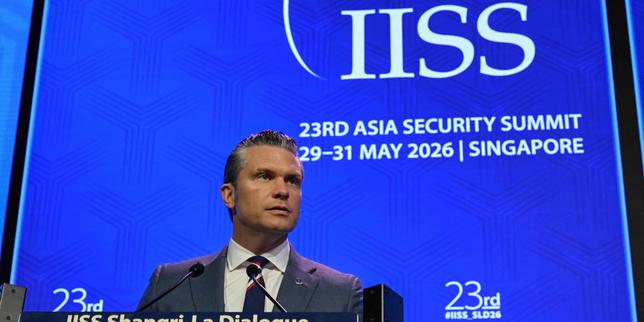
The defense establishment loves a predictable villain. For decades, Washington has run a reliable playbook: identify a rising state, count their warships, scream about a "window of vulnerability," and demand a bigger procurement budget. Pete Hegseth’s alarmist rhetoric regarding China’s military expansion in the Asia-Pacific is just the latest iteration of this tired script. The mainstream consensus rings the alarm over raw hull counts and hypersonic missile tests, viewing the Western Pacific through a rigid, mid-20th-century lens of total fleet dominance.
They are measuring the wrong metrics.
The panic over China’s regional buildup misses the fundamental shift in modern warfare. Beijing isn’t building a military to conquer the global commons; they are building a highly specialized, localized system designed to exploit the specific structural vulnerabilities of Western defense procurement. While Washington frets over losing its ability to project power anywhere on earth at a moment's notice, China is playing a game of asymmetric denial. The real threat isn’t that China can match the United States globally. The threat is that Western defense strategy remains shackled to legacy platforms that cost billions, take decades to build, and can be neutralized by a swarm of munitions costing a fraction of the price.
The Hull Count Fallacy
Step into any think-tank briefing in Washington, and you will hear the same terrifying statistic: the People’s Liberation Army Navy (PLAN) now possesses more battle force ships than the United States Navy.
This is a lazy, mathematically dishonest metric that equates a 1,500-ton Type 056A corvette with a 100,000-ton American Nimitz-class supercarrier. Tonnage matters. Firepower matters. Logistics matter. The United States maintains a massive lead in total displacement, structural survivability, and global reach.
But here is the contrarian reality that the Pentagon won't tell you: within the first island chain, global reach is a liability, not an asset.
China does not need a blue-water navy capable of patrolling the Atlantic or the Mediterranean. They enjoy the immense strategic advantage of geographic concentration. Every single one of their ships, land-based missile batteries, and fifth-generation fighters can be concentrated on a single theater. The United States, by virtue of its global commitments, must distribute its forces across the globe.
I have watched defense contractors spend decades defending bloated programs because they fit a traditional narrative of power projection. We build multi-billion-dollar destroyers designed to operate in permissive environments, then act shocked when an adversary develops a long-range anti-ship cruise missile that forces those destroyers to operate hundreds of miles outside their optimal striking range.
The PLAN's buildup isn't a mirror image of Western power. It is a tailor-made counter-punch.
The Tyranny of Distance and the Asymmetric Trap
To understand why the current panic is misplaced, we must look at the concept of Anti-Access/Area Denial (A2/AD). Defense analysts talk about A2/AD as if it is an invisible wall. It isn't. It is an economic calculation.
Consider the DF-21D or DF-26 "carrier killer" ballistic missiles. Estimates put the cost of a single DF-26 at roughly $5 million to $10 million. Now consider a U.S. Gerald R. Ford-class aircraft carrier, which costs roughly $13 billion to build, not including the thousands of personnel onboard and the priceless air wing parked on the deck.
The Grim Math of Modern Salvo Warfare
Imagine a scenario where China launches a coordinated saturation strike utilizing a mix of ballistic missiles, hypersonic glide vehicles, and low-cost loitering munitions against a Western carrier strike group.
- The Attack: 50 assorted missiles and drones targeting a single carrier. Total adversary cost: perhaps $200 million to $300 million.
- The Defense: The strike group relies on SM-2, SM-6, and ESSM interceptors. Each SM-6 costs over $4 million. The deep magazines of these escort ships are finite. Once they are empty, they cannot be reloaded at sea; the ships must sail back to a specialized port.
- The Outcome: Even with a 90% interception rate, five weapons get through. A single hit doesn't even need to sink the carrier; a "mission kill" that destroys the flight deck or disables the radar effectively removes a $13 billion asset from the fight.
This is the asymmetric trap. The competitor's article focuses on the scale of Chinese forces. The real issue is the efficiency of those forces against a Western military architecture that has optimized itself for exquisite, un-crewed-vulnerable, hyper-expensive platforms. We are trading pawns for queens, and we are running out of queens.
Dismantling the "People Also Ask" Consensus
When the public looks into this issue, they inevitably ask the wrong questions because the media feeds them a flawed premise. Let’s address those assumptions directly.
Is China’s military spending sustainable?
The common view is that China’s slowing economy will naturally curb its military ambitions. This is wishful thinking. China’s defense budget, while opaque, sits at roughly 1.3% to 1.7% of its GDP. The United States spends over 3%. Beijing has immense fiscal runway to sustain its current trajectory because its domestic military-industrial complex operates under a state-directed capitalist model. They do not suffer from the same multi-year contract disputes, cost overruns, and corporate lobbying that inflate Western defense budgets. They buy capability at cost; we buy it with a corporate premium.
Can the U.S. successfully defend Taiwan in a conventional conflict?
The honest, brutal answer is: not using the current operational concept. Congressional war games consistently show Western forces suffering catastrophic losses in the opening days of a Taiwan Strait conflict. The reason isn't a lack of bravery or technological inferiority. It is geography and logistics. Operating within the umbrella of China's land-based strike assets means our forward bases in Guam and Japan are highly vulnerable. If the conflict relies on traditional heavy assets, the tyranny of distance wins.
The Flaw in the Contrarian Approach
Any honest assessment must acknowledge the vulnerabilities of this counter-perspective. The primary weakness of China's localized, asymmetric strategy is its lack of operational combat experience.
The PLA has not fought a major war since 1979. Their command structure remains highly centralized, rigid, and prone to political interference. A strategy reliant on complex, synchronized missile salvos and cyber warfare looks flawless on a digital simulation. It often falls apart when exposed to the friction, chaos, and communication degradation of actual combat.
Furthermore, by over-indexing on localized denial, China lacks the ability to protect its own critical sea lines of communication. Their economy remains profoundly dependent on energy imports passing through the Malacca Strait. A localized military victory in the Taiwan Strait could still result in a catastrophic economic collapse if the broader global commons are closed to their merchant shipping.
The Actionable Pivot: Starve the Beast
If the current alarmist approach is broken, how do we fix it? We stop playing China's game.
The West must immediately pivot away from legacy procurement. We need to stop building a small number of exquisite, irreplaceable targets and start building a massive volume of low-cost, expendable, autonomous systems.
Instead of buying another multi-billion-dollar hull that takes a decade to deliver, that capital should be redirected into producing tens of thousands of long-range loitering munitions, autonomous underwater vehicles (AUVs), and mobile, land-based anti-ship batteries that can be distributed across the First Island Chain.
We must transform our own force posture into the ultimate A2/AD nightmare for Beijing. If they want to play the asymmetric game, we should force them to try and target thousands of small, dispersed, autonomous drone swarms rather than offering them a handful of massive, easily trackable surface ships.
The Pentagon's current panic is an admission of intellectual bankruptcy. They are terrified because the old way of buying power no longer guarantees dominance. The solution isn't to build more of what failed in the war games. The solution is to bankrupt the adversary's strategy by making their expensive localized buildup utterly irrelevant. Stop funding the museum pieces of tomorrow's war.