The air inside the East Room of the White House carries a distinct density. Heavy drapes muffle the hum of Washington traffic outside, while crystal chandeliers cast an unyielding gleam across polished hardwood floors. On a quiet afternoon, it feels like a museum. But when thirty professional athletes in tailored suits file through the doorway, fresh off a championship run, the room transforms into something else entirely: a stage where athletics and political theater cross paths.
The journey to that room never begins with politics. It begins in the dirt. It begins with raw leather popping against a catcher’s mitt at seven in the morning during spring training, with thousands of swing repetitions in dark indoor cages, and with the bone-deep fatigue of a 162-game season. For a baseball player, the championship ring is the singular North Star. Everything else is secondary.
Yet, for decades, winning the final game of October has carried an unspoken, second obligation. A flight to Washington D.C. A march down carpeted hallways beneath historical portraits. A photo opportunity alongside the President of the United States.
The Friction of the Photo Op
When championship teams step onto the White House podium, they carry more than their trophy. They carry the expectations, contradictions, and divisions of millions of fans watching at home.
Consider a hypothetical bullpen pitcher standing in the third row on the riser. Let us call him Marcus. Marcus spent nine years grinding through minor league stops in Iowa, Tennessee, and Texas before making a big-league roster. He did not spend those nine years contemplating constitutional law or trade policy; he spent them refining the spin rate on his slider. To Marcus, standing in the East Room represents the validation of every 5:00 AM workout his father drove him to as a kid. It is the apex of a career.
Yet, as the cameras flash, Marcus knows that half of his hometown will celebrate the ceremony, while the other half will view his presence as a tacit political endorsement.
That is the quiet strain beneath the smiles. The tradition of championship White House visits, initiated over a century ago when Ulysses S. Grant welcomed the Cincinnati Red Stockings, was conceived as a non-partisan nod to excellence. In those early decades, the gesture was simple: a leader honoring physical triumph.
Times shifted. The modern media environment turns every handshake into a statement and every absence into a headline. When a player chooses to attend, it is interpreted through a political lens. When a player declines to attend, citing personal schedule or principle, that decision is dissected across twenty-four-hour news cycles.
Beyond the Podium
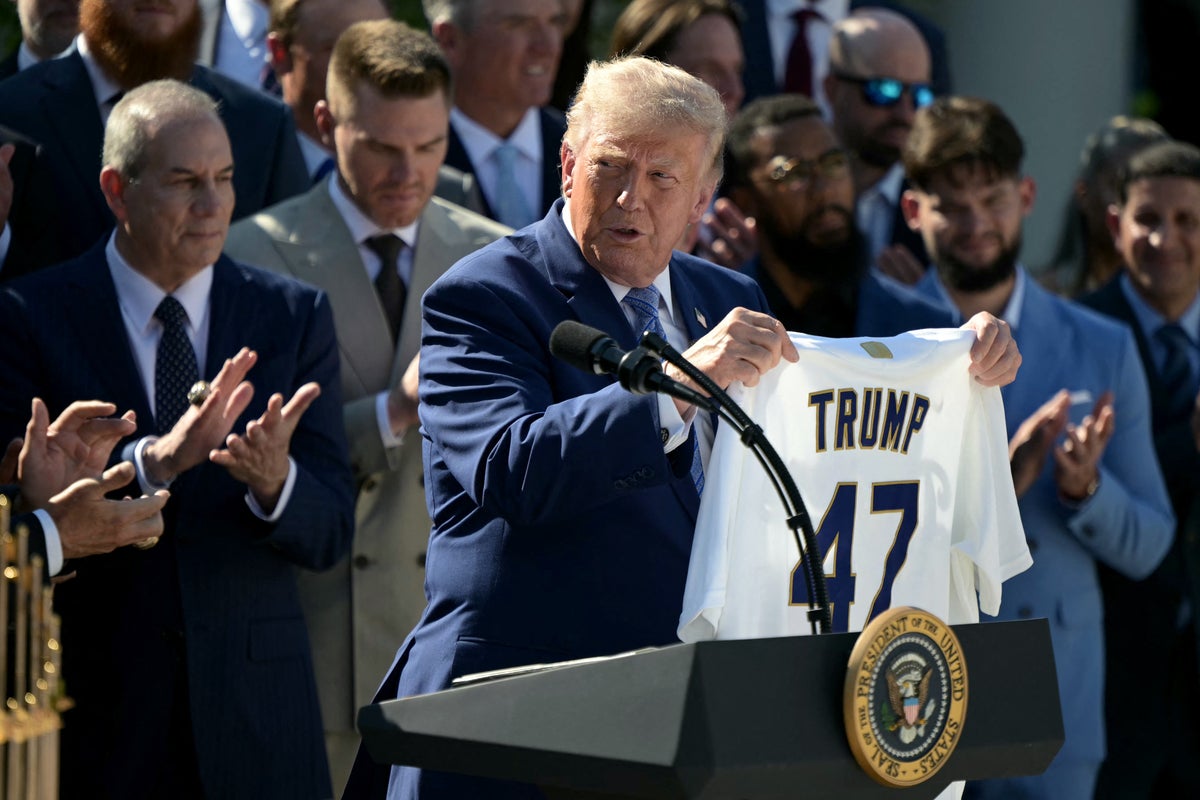
During the formal proceedings, the speech follows a familiar cadence. The President praises the team’s resilience, singles out key plays from the championship series, and cracked a lighthearted joke about an aging veteran or a dramatic late-inning comeback. The team owner and manager present the President with a custom jersey—bold lettering, number one, stamped across the back.
From the front row, the Commissioner of Baseball nods along. Flashing cameras capture the precise second the jersey changes hands.
Behind that polished surface, however, lies the complex reality of a modern sports locker room. Professional clubrooms are among the most diverse workplaces on the planet. You have kids straight out of rural high schools sitting next to ivy league graduates, international stars from the Dominican Republic, Japan, and Venezuela sharing meals with players from southern California and suburban Texas.
They do not agree on everything. They do not vote the same way. But across nine months of travel, shared injuries, and intense pressure, they form an internal treaty: the game comes first.
Standing in the White House tests that treaty. For some players, walking through the West Wing evokes genuine awe—a profound appreciation for American institutions regardless of who sits behind the Resolute Desk. For others, the setting brings discomfort, highlighting sharp disagreements with administration policies or rhetoric.
When the ceremony concludes and the team files out toward the South Lawn for a quick round of press questions, the applause fades fast. The players board buses back to the airport, swap their suits for comfortable travel gear, and head toward the next series, leaving behind a news cycle already moving on to the next debate.
The trophy will reside in a glass display case inside the stadium lobby, clean and unquestioned. But the memory of that afternoon in Washington lingers as a reminder of an unavoidable truth in modern life: no matter how high you jump or how fast you run, the wider world always finds a way inside the lines.