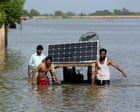
You don't need a government degree to understand why Pakistanis are frantically bolting silicon panels to their roofs. Walk through any middle-class neighborhood in Lahore or Karachi right now, and you'll see it: a shimmering, blue-black sea of solar glass. This isn't a government-led green initiative or a sudden collective desire to save the planet. It's a desperate, high-speed escape from a national power grid that's effectively broken.
While the Middle East teeters on the edge of a massive energy crisis—driven by the 2026 tensions in the Strait of Hormuz—Pakistan has accidentally built a massive shield. By importing over 50 GW of solar panels from China since 2024, the country has insulated itself from the kind of oil and gas price shocks that used to cripple its economy. Meanwhile, you can explore related stories here: The Calculated Silence Behind the June Strikes on Iran.
The Grid is Pricing Itself Out of Existence
For years, the Pakistani government has hiked electricity tariffs to cover the "circular debt"—a polite term for a financial black hole. Between 2023 and 2025, residential tariffs jumped by over 155%. If you're a shopkeeper in Multan or a factory owner in Faisalabad, your bill didn't just go up; it became your biggest business risk.
At the same time, the global price of solar panels crashed. China, facing its own overproduction, started selling modules at historic lows—around $0.08 to $0.10 per watt. The math became undeniable. If the grid charges you $0.15 per unit and you can generate your own for $0.04 over the life of a system, you'd be a fool not to switch. To see the bigger picture, check out the excellent article by Al Jazeera.
This isn't just "growth." It’s a "demand shock" that the state-owned utilities never saw coming. As the most affluent and industrial customers leave the grid, the remaining costs are spread across a smaller group of poorer people. It’s a death spiral for the old way of doing things.
Solar as a Hedge Against Middle East Turmoil
Pakistan usually lives and dies by the price of Brent crude and LNG. In 2024, the country ranked as one of the world's most vulnerable nations to shipping disruptions in the Persian Gulf. Almost all its fuel transits the Strait of Hormuz. When tensions spiked and LNG prices jumped 40% recently, the usual script called for massive blackouts and economic paralysis in Islamabad.
But the script changed. Because so many homes and factories now run on "behind-the-meter" solar, the national demand for gas-fired power dropped.
- Import Savings: Estimates suggest Pakistan avoided over $12 billion in fuel imports because of the solar surge.
- Daytime Resilience: During peak sunlight hours, solar now accounts for nearly 25% of the country's total utility-scale electricity generation.
- The Duck Curve: The grid now has more power than it knows what to do with at noon, but still struggles at 8:00 PM when the sun goes down and everyone turns on their AC.
The Empire Strikes Back with New Taxes
The government's reaction to this "people-led boom" hasn't exactly been a round of applause. Instead, they’re panicking about lost revenue. In early 2026, the National Electric Power Regulatory Authority (NEPRA) dropped a hammer on solar owners by overhauling net metering rules.
Previously, if you sent excess power back to the grid, the government paid you roughly RS 27 per unit. Under the new "Net Billing" framework, they’ve slashed that to about RS 10-13. They’ve also shortened contract lengths from seven years to five and started imposing "fixed charges" on anyone with a three-phase meter.
It's a classic move: the state is trying to tax its way out of an efficiency problem. They claim solar users are "freeloaders" who don't pay for the wires and poles. Solar owners, naturally, feel like they're being punished for solving a problem the government couldn't.
Batteries are the Next Frontier
If the government thought slashing buyback rates would stop the solar boom, they haven't been paying attention to battery prices. As the ROI for selling power back to the grid drops, Pakistanis are simply stopping the exports. They’re buying Lithium Iron Phosphate (LFP) batteries to store their own power for use at night.
This is the ultimate "grid defection." When a household adds a 10kWh battery to their 10kW solar system, they effectively vanish from the utility's ledger. This shift is happening right now across the agricultural sector too. Thousands of farmers have ditched expensive diesel for solar-powered tubewells. They aren't waiting for a subsidy; they're just looking at their bank accounts.
Don't Wait for the Next Policy Shift
If you’re still sitting on the fence, here’s the reality of the 2026 market. The "golden era" of lucrative net metering is ending, but the era of total energy independence is just starting.
- Size for Consumption, Not Export: Stop trying to build a "power plant" to sell energy back to the government. They will keep changing the rates. Build a system that covers your own 24-hour load.
- Invest in LFP Storage Now: With the new net billing rates, the "payback period" for batteries has dropped significantly. Keeping your own electrons is now more profitable than selling them.
- Check Your Load Category: The government is specifically targeting "unprotected" consumer categories for higher taxes. If you can stay under the 200-unit threshold for grid use, you save significantly more.
The boom isn't over. It's just moving from the roof into the battery closet. The grid is becoming a backup, not the primary source. If you want to insulate your family from the next Middle East flare-up, stop asking the government for help and start looking at your own roof.
If you're planning an installation this year, your first step should be an independent energy audit to see exactly how much storage you need to go 90% off-grid.