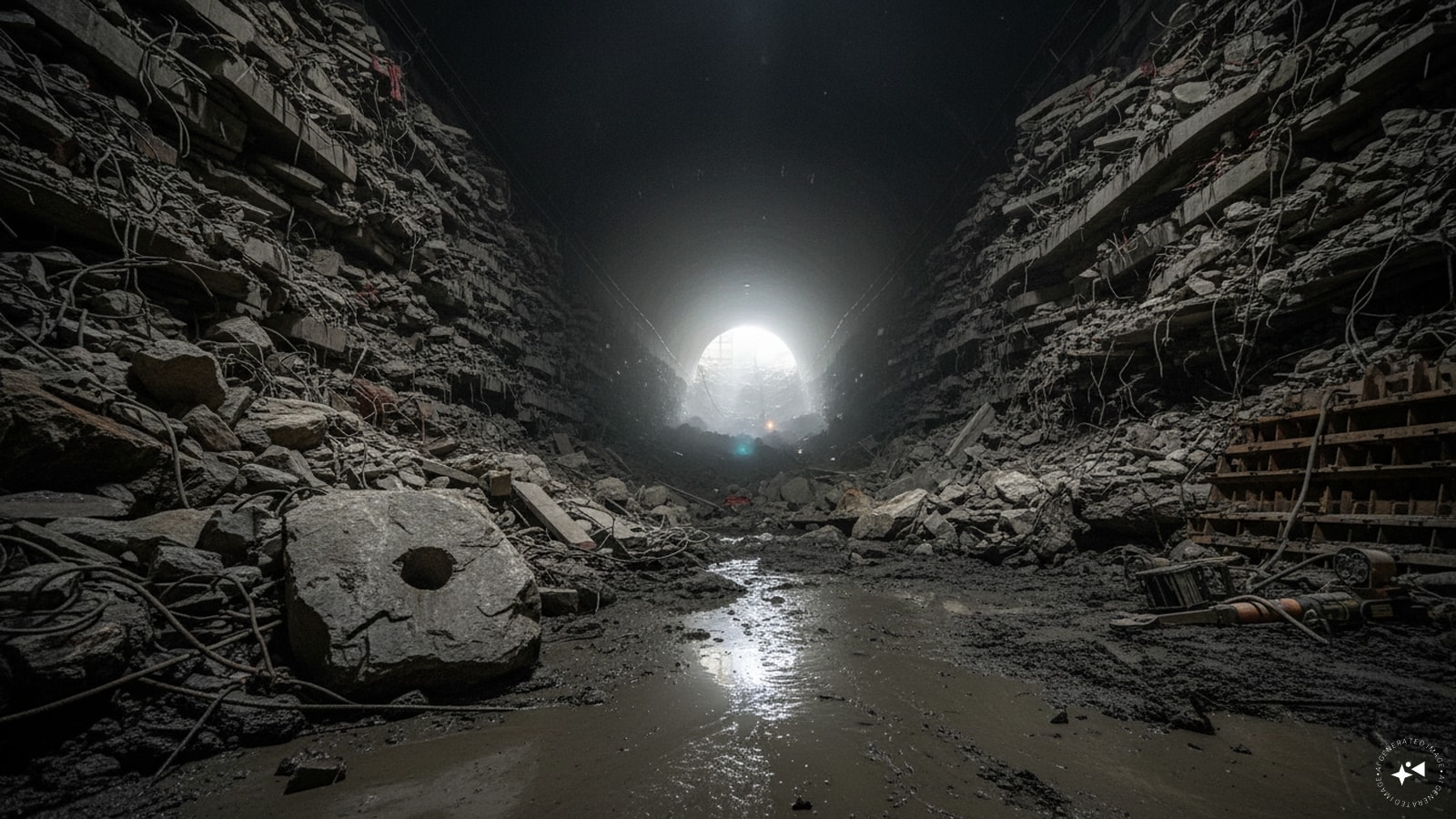
The physical destruction of a territory leaves behind more than dust. It leaves a catastrophic vacuum of ownership. When entire neighborhoods are reduced to powder, the fundamental question of who owns the land beneath the debris becomes the most dangerous battleground of all. Real estate records vanish. Municipal archives burn. Legal title deeds turn to ash or sit trapped inside government offices that no longer exist.
At the center of this vacuum is a brutal contest over property rights, title deeds, and the future of urban reconstruction in Gaza. This is not merely a logistical problem for future urban planners. It is a high-stakes political and economic war. Whoever controls the deeds controls the land. And whoever controls the land dictates whether displaced families return, corporate developers move in, or foreign powers dictate terms from afar.
The Disappearing Paper Trail
Property ownership in the Gaza Strip operates on a complex historical layering of land laws. Systems date back to the Ottoman Empire, through the British Mandate, Egyptian administration, Jordanian influence, Israeli military orders, and decades of Palestinian Authority jurisdiction. Many families hold handwritten deeds passed down across generations, never formally updated in a centralized registry. Others possess modern electronic records maintained by municipal authorities, records now vulnerable to complete data destruction or server annihilation.
When digital databases and physical archives are destroyed simultaneously, the baseline of proof shatters.
- Customary ownership relies on community consensus and neighborhood memory, which fractures when populations are violently displaced across different regions.
- Formal legal titles require verification through courts and registries that currently lack electricity, staff, security, and physical infrastructure.
- Absentees property claims introduce massive legal vulnerabilities, creating opportunities for speculative land grabs by external actors.
Without a functioning judiciary, possession becomes nine-tenths of the law. Powerful local clans, armed factions, and opportunistic commercial syndicates are already positioning themselves to stake claims over flattened commercial districts and strategic coastal zones. The absence of state authority invites a predatory free-for-all where might makes right, leaving ordinary citizens with little recourse to reclaim their ancestral homes.
The Reconstruction Cartel
Rebuilding a flattened metropolis requires billions of dollars, heavy machinery, and international capital. It also requires legal certainty. Global financial institutions and institutional investors will not pour capital into a territory with contested land titles. The risk of future litigation is simply too high.
This creates a perverse financial incentive for external actors to wipe the slate clean. If individual ownership cannot be proven, large swaths of urban territory risk being reclassified as state land or abandoned property. Governments and corporate consortia can then bypass the original inhabitants entirely, transforming ancient residential neighborhoods into master-planned commercial zones, luxury developments, or strategic security corridors.
The blueprint for this approach is visible in historical post-conflict zones across the globe. When property rights are sufficiently pulverized, the rebuilding process is outsourced to corporate entities that prioritize high-return commercial viability over restitution for displaced residents.
- Eminent domain maneuvers can be rushed through emergency decrees, overriding civil property protections under the guise of public safety and modernization.
- Consortium funding ties reconstruction dollars to structural zoning overhauls, effectively locking original landowners out of their own geography through prohibitive development fees.
The battle for Gaza's ruins is therefore a class war disguised as an engineering challenge. The wealthy and well-connected possess the resources to duplicate lost paperwork, hire high-priced legal counsel, and lobby emerging administrative bodies. The average laborer whose home was leveled by an airstrike possesses only a memory and perhaps a scorched fragment of paper.
The Geopolitical Land Grab
Beyond local commerce and private wealth, the ownership of Gaza's ruins carries immense geopolitical weight. Land is sovereignty. If the demographic composition of specific districts is permanently altered through protracted displacement and legal disenfranchisement, the map of the region changes forever.
Foreign governments eyeing post-conflict contracts understand this dynamic intimately. Architectural firms, engineering conglomerates, and private security contractors are already drafting conceptual master plans for Mediterranean waterfronts that feature marinas, high-rise towers, and tourist hubs. These blueprints rarely account for the pre-existing property rights of the hundreds of thousands of people currently living in tents nearby.
To make these visions a reality, the legal architecture of ownership must be managed carefully. If local titles are honored, developers must negotiate property by property with millions of stubborn stakeholders. If local titles are nullified or ignored, developers deal with a single centralized authority. The financial difference is astronomical.
The Human Cost of Legal Erasure
Legal technicalities sound dry until they determine whether a family can sleep under a roof or sleep on the street.
Consider a hypothetical family whose three-story home in central Gaza was leveled during the conflict. The father inherited the land from his grandfather. The official registration paper was stored in a municipal building that was bombed during the opening weeks of the war. The father now lives with his wife and children in a makeshift tent fifty miles away. When the fighting eventually stops, he attempts to return to his plot, only to find a commercial clearing crew backed by local security forces clearing the rubble to build a logistics depot. He has no deed. He has no lawyer. He has no government office to visit.
This scenario is not an aberration. It is the anticipated reality for hundreds of thousands of residents whose entire net worth was tied up in brick, mortar, and land.
The international community often speaks of reconstruction in terms of concrete, steel, and electrical grids. Those are physical necessities. But the invisible infrastructure of property law is equally vital. Without a transparent, independent, and protective mechanism to adjudicate land ownership and restore titles to their rightful owners, any physical rebuilding will simply cement a massive, violent dispossession.
The rubble will eventually be cleared. The real question is who will be standing on the freshly paved streets when the dust finally settles.
The Emerging Resistance of the Dispossessed
Despite overwhelming odds, civil society networks and grassroots legal collectives are attempting to counter this systematic erasure. Using decentralized digital storage methods, refugee-led documentation projects, and oral history archives, citizens are actively crowdsourcing property proofs. Neighbors are signing affidavits for one another, corroborating boundaries, inheritance lines, and historical occupancies before memories fade and witnesses scatter further.
These civilian efforts face fierce resistance from those who benefit from the chaos. Yet, they represent the only barrier standing between complete legal disenfranchisement and the preservation of indigenous property rights.
The struggle for the ruins of Gaza is ultimately a race against time. If formal restitution mechanisms are not established swiftly under international oversight, the legal vacuum will be filled permanently by force and finance. The maps will be redrawn by the victors of a bureaucratic war, leaving the actual inhabitants of the land as permanent strangers in their own neighborhoods.
The bulldozers are warming up their engines. The lawyers are drafting the new decrees. And the paperwork continues to burn.