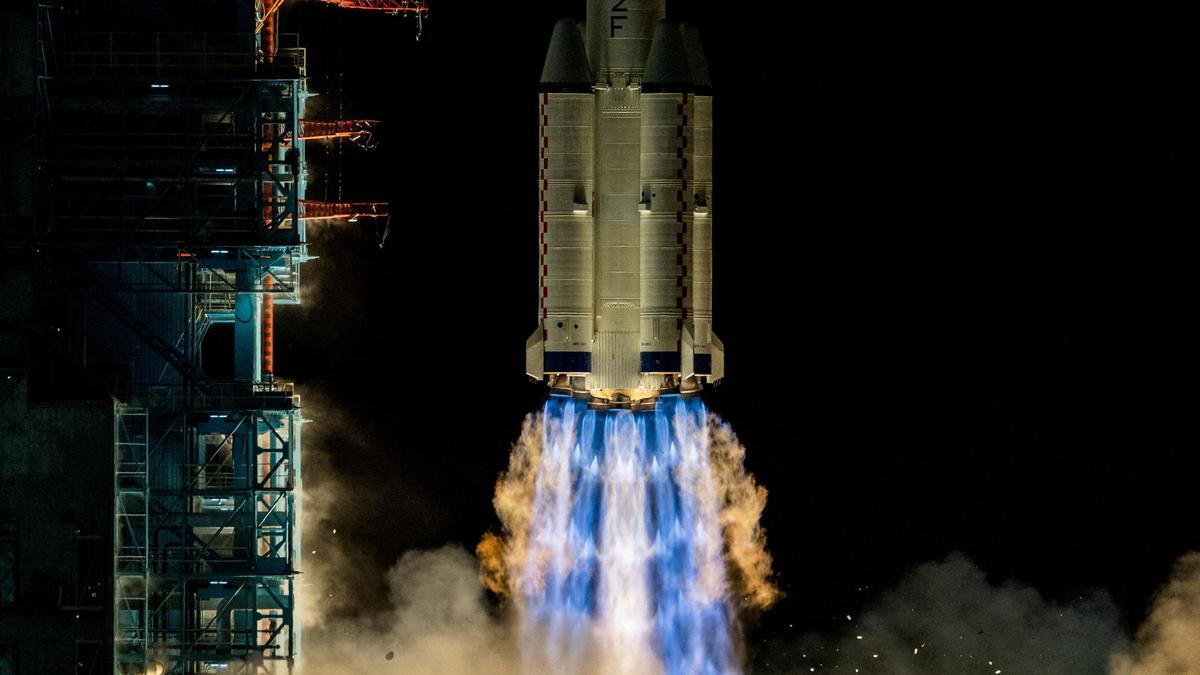
The recent launch of Pakistan's PRSC-EO3 satellite from China’s Taiyuan facility is not merely an achievement of scientific ambition. It is a calculated escalation in regional surveillance architecture. As Islamabad accelerates its transition toward sovereign Earth observation, the partnership with Beijing has evolved from simple hardware procurement into a deep, synchronized integration of space-based assets. This alignment, cemented by the imminent arrival of Pakistani payload specialists aboard the Tiangong space station, signals that the final frontier has officially become a core component of the all-weather strategic relationship between these two nations.
Space is no longer a peripheral domain for developing economies. It is the high ground where geopolitical influence is now measured in orbital resolution and data autonomy.
From Hardware Sales to Orbital Integration
For years, analysts viewed the Sino-Pakistani space connection through a transactional lens. Beijing provided the rockets; Islamabad paid for the launch. That phase concluded somewhere around the middle of this decade. Today, the relationship is defined by a shared operational framework.
Consider the PRSC-EO constellation. With the EO-3 satellite now in a sun-synchronous orbit, Pakistan possesses a persistent, indigenous monitoring capability that covers its own territory and beyond. This is not just about disaster management or agricultural planning. It is about intelligence, surveillance, and reconnaissance (ISR). By maintaining a three-satellite electro-optical architecture, Pakistan is effectively reducing its historical reliance on third-party satellite data providers, many of whom are subject to western political pressures or operational restrictions.
China, in turn, secures a willing partner for its broader vision of a multipolar space order. By training Pakistani astronauts and integrating their scientific payloads into the Tiangong mission, Beijing demonstrates the credibility and accessibility of its space infrastructure. This is a deliberate counter-narrative to the limitations imposed by the aging International Space Station program. If a nation is locked out of one system, Beijing is offering a viable, fully functioning alternative.
The Human Factor in Space Diplomacy
The selection of Pakistani candidates for training under the China Manned Space Agency is a masterstroke of soft power. It transforms the relationship from abstract agreements into tangible, human-centric success stories.
When these individuals eventually reach orbit as payload specialists, they will carry more than just scientific instruments. They will embody the success of a partnership that has defied conventional expectations. For Islamabad, this provides immense diplomatic capital. It signals to domestic and regional audiences that the country is not merely a bystander in global technological shifts.
The training regime is rigorous. It involves mastering the internal systems of the Shenzhou spacecraft and the operational protocols of the Tiangong station. This knowledge transfer is not unilateral. By embedding foreign specialists, China gains valuable data on how to integrate diverse mission requirements into its own station workflows. They are field-testing their capacity to lead an international coalition, using Pakistan as the primary proof of concept.
The Security Implications of Persistent Monitoring
We must acknowledge the friction point here. The transition to sovereign, high-resolution Earth observation changes the local security calculus. Real-time data availability allows for unprecedented tracking of assets, border movements, and regional infrastructure development.
Hypothetically, imagine a scenario where a nation can track the deployment of heavy artillery or the construction of sensitive defensive positions with daily, high-resolution imagery. This creates a state of perpetual observation. Secrecy becomes significantly more difficult to maintain. When this observational power is backed by the technical support and launch infrastructure of a global superpower, the strategic weight shifts.
The integration of the Beidou navigation system into Pakistan’s domestic infrastructure serves as the connective tissue for this intelligence network. Beidou offers the geographic precision necessary to weaponize space-based data accurately. It is a complete, closed-loop ecosystem—from observation satellites to navigation signals—that operates independently of legacy western systems.
The Reality of Technological Sovereignty
Despite the outward appearance of progress, the drive for autonomy contains inherent limitations. Building and maintaining an indigenous space program requires continuous capital infusion and a permanent cadre of highly specialized engineers.
Pakistan’s Space and Upper Atmosphere Research Commission (SUPARCO) is currently executing an ambitious roadmap. However, the reliance on Chinese launch facilities remains a bottleneck. Sovereign control is only fully realized when a nation possesses its own launch sites and carrier vehicle production. Until that day, the partnership remains a form of strategic interdependence rather than absolute independence.
Beijing is well aware of this reality. By acting as the primary enabler, they ensure that Islamabad’s orbital aspirations remain tethered to Chinese technology. This is not inherently negative, but it is a constraint that policymakers in both capitals understand. The cooperation is built on mutual utility. Beijing needs a stable, capable partner to validate its space ambitions in the Global South, and Islamabad needs the technological velocity that only a superpower can provide.
The future of this alignment will likely move toward more complex space-based communications and deep-space tracking capabilities. As 2026 progresses, watch for the integration of data-sharing protocols that extend beyond basic imaging. The goal is to create a seamless network where space-based intelligence informs military command structures in real time.
We are witnessing the construction of a new regional security architecture. The ground beneath our feet is being mapped, tracked, and observed from above by a partnership that is tightening its orbit. Every launch from Taiyuan is a signal. The message is clear: the high ground is occupied.