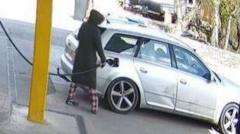
Retail fuel loss, traditionally categorized under "shrinkage," has evolved from opportunistic pilferage into a predictable failure of automated point-of-sale (POS) systems and physical surveillance protocols. The recent series of drive-away thefts involving a suspect characterized by distinctive casual attire—pyjamas—highlights a systemic breakdown in the Verification-Authorization-Enforcement triad. This analysis deconstructs the mechanics of fuel theft, the psychological exploitation of low-friction retail environments, and the hard economic ceiling of current mitigation strategies.
The Triad of Systematic Fuel Loss
To understand why a repeat offender can successfully execute multiple thefts in a high-surveillance environment, one must analyze the three specific vectors that allow these incidents to occur.
1. The Friction Paradox in Customer UX
Modern fuel stations are designed to minimize "friction"—the time between a customer arriving and departing. By allowing fuel to flow before payment is secured (a post-pay model), the retailer creates a high-trust environment that is structurally incompatible with high-risk urban or highway locations. The "pyjama-clad" suspect exploits this by blending the visual cues of a "short-distance/local" customer with the high-velocity exit strategy of a professional thief.
2. Failure of the Surveillance-to-Action Pipeline
Surveillance in retail fuel environments is largely forensic rather than preventative. High-definition CCTV captures the event (the theft) and the identifier (the pyjamas), but it fails to trigger a real-time intervention. This delay exists because:
- Cognitive Load: Attendants are often managing multi-tasking environments (convenience store sales, inventory, cleaning) while monitoring up to 16 pumps.
- False Positive Costs: Stopping a legitimate customer because they are dressed casually or appear "suspicious" carries a high reputational and legal risk.
3. The Anonymity of Mobile Assets
The vehicle serves as the primary tool of the crime, providing both the storage capacity for the stolen asset and the means of rapid extraction. When license plates are obscured, stolen, or cloned, the primary link between the physical act and the legal identity of the actor is severed. The suspect’s choice of attire—loose, non-descript pyjamas—further serves to obscure body geometry and identifiable markers, complicating post-event biometric or manual identification.
The Economic Mechanics of Fuel Theft
Theft is rarely a random act; it is governed by a Cost-Benefit Function ($CBF$) where the actor calculates the probability of apprehension against the immediate utility of the fuel.
$$CBF = U(f) - (P_a \times C_p)$$
Where:
- $U(f)$: The utility of the fuel (resale value or personal use).
- $P_a$: The perceived probability of apprehension.
- $C_p$: The cost of punishment (legal fees, incarceration, social stigma).
In the case of the "pyjama-clad" suspect, the probability of apprehension ($P_a$) at the point of the act is near zero. Retailers have a "no-confrontation" policy to protect staff from physical harm, effectively subsidizing the thief’s escape. Furthermore, the cost of punishment for "petty" fuel theft is often insufficient to deter recidivism.
Structural Vulnerabilities in License Plate Recognition (LPR)
While many modern stations utilize Automatic Number Plate Recognition (ANPR), the system is plagued by two primary bottlenecks that serial thieves exploit.
The Database Latency Gap
ANPR systems are only as effective as the "hotlist" they reference. If a vehicle is used in a theft at 09:00, there is a significant lag before that vehicle's identifiers are synced across regional or national databases. A "blitz" strategy—hitting multiple stations in a 120-minute window—allows a suspect to stay ahead of the digital update cycle.
Physical Obfuscation and Environmental Factors
LPR systems require specific angles and light conditions to achieve 99% accuracy. Suspects often use:
- Temporary Mud/Debris: Strategically placed to obscure a single digit.
- Reflective Sprays: Designed to overexpose the plate under infrared flash.
- Strategic Positioning: Parking the vehicle at an angle that creates a "blind spot" for fixed-angle cameras.
The Psychographic Profile of Casual-Wear Offenders
The choice of pyjamas is not merely a lack of grooming; it is a tactical choice in the "Dark Nudge" of social engineering.
Low-Threat Signaling
In a retail environment, high-visibility threats usually present as individuals wearing hoodies, masks, or heavy jackets. Pyjamas signal "domesticity" and "non-preparedness." An attendant looking at a monitor sees someone who looks like they just stepped out of their living room. This lowers the attendant’s guard, delaying the "threat assessment" phase of their observation until the fuel has already been dispensed.
Visual Displacement
The human brain prioritizes vivid, unusual details over structural ones. A witness is more likely to remember "blue pyjamas" than the make, model, or year of the getaway vehicle. This creates a "vividness bias" in police reports that can actually hinder technical investigations which rely on more boring, consistent data points like tire tread patterns or specific vehicle dents.
Resource Allocation and the Law of Diminishing Returns
Fuel retailers face a brutal calculation: the cost of preventing 100% of thefts is higher than the cost of the thefts themselves.
- Pre-Pay Mandates: Forcing all customers to pay before the pump activates eliminates drive-aways but reduces convenience store "footfall" by an estimated 20-30%. Many customers who pay at the pump do not enter the store, where the high-margin sales (coffee, snacks) occur.
- Physical Barriers: Installing bollards or "tiger teeth" that rise after a car enters the bay is capital-intensive and creates significant liability risks regarding fire safety and emergency egress.
- Third-Party Debt Recovery: Many retailers now outsource the "chase" to private agencies. These agencies use the "pyjama" footage not to arrest the suspect, but to identify the registered keeper and demand payment plus "administration fees."
Technological Intervention: The Shift Toward Behavioral AI
The next evolution in stopping the "woman in pyjamas" and similar serial offenders is not better cameras, but better Behavioral Analytics.
Current R&D is focusing on Human Activity Recognition (HAR). Rather than looking for a specific face or plate, the system analyzes the cadence of the movement. A legitimate customer typically follows a routine:
- Exit vehicle $\rightarrow$ Open fuel door $\rightarrow$ Select grade $\rightarrow$ Insert nozzle.
A high-risk actor often exhibits "pre-flight" behaviors:
- Leaving the engine running or the driver-side door ajar.
- Scanning the perimeter (the "hawk" gaze) instead of looking at the pump interface.
- An irregular "pacing" distance from the vehicle.
When these behavioral markers are detected, the system can automatically lock the pump and require "Attendant Authorization," shifting the burden of friction onto the suspect rather than the general public.
Strategic Recommendation for Retail Operators
To mitigate the impact of serial fuel theft without alienating the core customer base, retailers must move from a Reactive-Forensic model to an Active-Predictive model.
Phase I: Hardening the POS Interface
Immediate implementation of "Day-Part Pre-pay." This involves switching to mandatory pre-pay during high-risk hours (typically 22:00 to 06:00) while maintaining post-pay during peak hours. This targets the temporal window where most serial thefts occur.
Phase II: Integrating Cross-Station Telemetry
Individual franchises must break the "silo" model of data. A "theft-in-progress" alert should be broadcast via a localized mesh network to all stations within a 10-mile radius. If a "woman in pyjamas" hits Station A, Station B’s pumps should automatically transition to pre-pay mode for any vehicle matching that description before she arrives.
Phase III: The "Grey-List" Protocol
Retailers should maintain a local "Grey-List" of vehicles that have previously "failed to pay" (even if excused as an accident). Upon ANPR detection of a Grey-List plate, the pump should require the customer to enter the store to "verify the pump" before fuel is dispensed. This creates a psychological barrier; a thief is unlikely to enter the store and face an attendant directly before committing the act.
The failure to apprehend the pyjama-clad suspect is not a failure of the police; it is an indictment of a retail model that prioritizes speed over security to a degree that makes theft statistically inevitable. The solution lies in the strategic reintroduction of friction for high-risk profiles while maintaining a "fast lane" for verified, low-risk consumers.