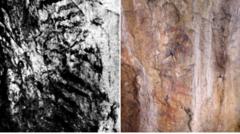
Mainstream archaeology is addicted to a very specific kind of romanticism. The pattern is entirely predictable. A mainstream news outlet publishes an article breathlessly announcing that "Britain's earliest prehistoric art" has been discovered in a "beauty spot cave." The media rushes to paint a picture of Ice Age visionaries huddling by flickering firelight, driven by an innate human desire to create fine art on the limestone walls of South Wales.
They are talking about Bacon Hole in the Gower Peninsula. They are talking about red pigment bands recently dated via uranium-thorium testing to 17,100 years ago. The academic community is patting itself on the back because a discovery originally dismissed in 1928 as mere "mineral seepage" has been vindicated.
But the entire premise of this celebration is fundamentally flawed.
By hyper-focusing on cave walls as the birthplace of human expression, the public and the archaeological establishment are falling for a massive preservation bias. We are celebrating a few finger-painted lines not because they represent a pinnacle of ancient human behavior, but because they happened to be trapped in a geological refrigerator.
It is time to stop romanticizing the caveman gallery. The obsession with deep-cave art ignores the brutal reality of how prehistoric humans actually lived, worked, and expressed themselves across the wider landscape.
The Preservation Illusion
To understand why this discovery is being misread, look at the science of preservation. Caves are unique geological anomalies. They offer stable temperatures, protection from the elements, and a chemically specific environment that can shield organic pigments or delicate deposits from destruction.
When Dr. George Nash and his international team applied uranium-thorium dating to the red oxide bands at Bacon Hole, they did not uncover a unique cultural epicenter. They uncovered a statistical survivor.
Imagine a scenario where a modern city is completely leveled by a natural disaster, and the only surviving artifact is a plastic billboard in an underground subway tunnel. If future archaeologists concluded that 21st-century humans only expressed themselves on subterranean plastic, they would be laughed out of the room. Yet, we commit this exact logical fallacy with the Upper Palaeolithic era.
The Upper Palaeolithic people were not subterranean dwellers who only felt the urge to create when they crawled into dark, damp holes. They were mobile hunter-gatherers. They lived under the sky. They carved wood, decorated animal skins, tattooed their bodies, and painted open-air rock faces.
The problem? Wood rots. Skins decay. Skin cells shed. Rain, wind, and frost scrub open-air rock faces clean within a few centuries.
By treating Bacon Hole as a monumental breakthrough in the history of "British art," we mistake a lack of data elsewhere for a lack of human activity. The mainstream consensus treats the cave as the canvas, when in reality, the cave was simply the ziplock bag that kept the garbage from decomposing.
The Myth of the Prehistoric Artist
The second lazy consensus that needs to be dismantled is the projection of modern artistic intent onto ancient survival mechanisms. The competitor pieces love to use terms that imply a structured, high-art aesthetic. They point out that the lines at Bacon Hole are "equidistant from one another, indicating a deliberate and structured pattern."
This is a classic case of over-interpreting basic human motor skills. A series of parallel finger wipes does not require an artistic philosophy. It requires a hand.
I have spent years looking at how heritage sites monetize and mythologize these finds to drive tourism. The National Trust of Wales and various regional bodies want a British Lascaux. They want a story that connects modern Welsh culture to an ancient lineage of master painters.
But look at the actual context of the Gower Peninsula 17,100 years ago. The region was emerging from the brutal chill of the Devensian glaciation. The Bristol Channel was a dry, treeless periglacial valley. The groups migrating through this area were chasing megafauna during brief summer windows. They were fighting freezing temperatures, navigating perilous terrain, and trying not to starve.
To suggest that these people entered Bacon Hole to create "art" in the modern, aesthetic sense is a Eurocentric projection. The red ochre used in these bands was not just a paint pigment; it was a highly functional tool. Ochre was used as an adhesive for hafting tools, a hide-tanning agent, an insect repellent, and a sunblock.
The marks on the wall at Bacon Hole are just as likely to be a hunter cleaning excess grease and mineral paste off their fingers after preparing a tool as they are to be a deliberate symbolic message. By elevating a functional smear to the status of prehistoric masterwork, we cheapen the actual, complex survival strategies of Palaeolithic humans.
Dismantling the Archaeological Double Standard
The public often asks: Why does it take so long to confirm these discoveries? Why did we have to wait from 1912 until now to validate the Bacon Hole paintings?
The brutal truth is that the archaeological establishment is paralyzed by a fear of being conned. After the Piltdown Man hoax and countless fraudulent rock art claims across Europe, academia swung hard in the opposite direction. In 1928, the establishment looked at Bacon Hole, saw a local fisherman's graffiti from 1894 on an adjacent wall, and opted for the safest, most dismissive explanation: natural mineral seepage.
Now, thanks to mass spectrometry and advanced radiometric dating, the pendulum has swung back. But notice what gets funded and what gets protected.
The team behind the Bacon Hole analysis is already calling for the site to be designated a "scheduled monument." Why? Because it fits the neat, photogenic narrative of cave art.
Meanwhile, open-air sites across the UK that contain actual tools, camp remnants, and slaughter sites—the real data points of daily Palaeolithic life—are routinely paved over for housing developments and highway expansions. We are willing to spend massive resources protecting a few red lines in a cliffside cave while allowing the actual landscapes these people inhabited to be systematically destroyed.
The True Value of Bacon Hole
The real value of the Bacon Hole data has nothing to do with art history. The real value is environmental and chronological.
The mix of calcite and clay residues within the pigment recipe tells us exactly what materials were accessible in the post-glacial environment. The uranium-thorium date provides a definitive marker for human presence in northwestern Europe during a transitional climate phase. It proves that despite the retreating glaciers, human groups were highly resilient, moving deep into periglacial zones far earlier than some conservative models suggested.
That is the story we should be telling. Not a fairy tale about ancient gallery openings, but a gritty, data-driven account of climate survival.
Stop looking at the walls of beauty spot caves expecting to find the origins of human creativity. The creativity of the Upper Palaeolithic was not locked away in the dark. It was happening out in the open, across thousands of miles of lost tundra, carved into materials that time refused to save.