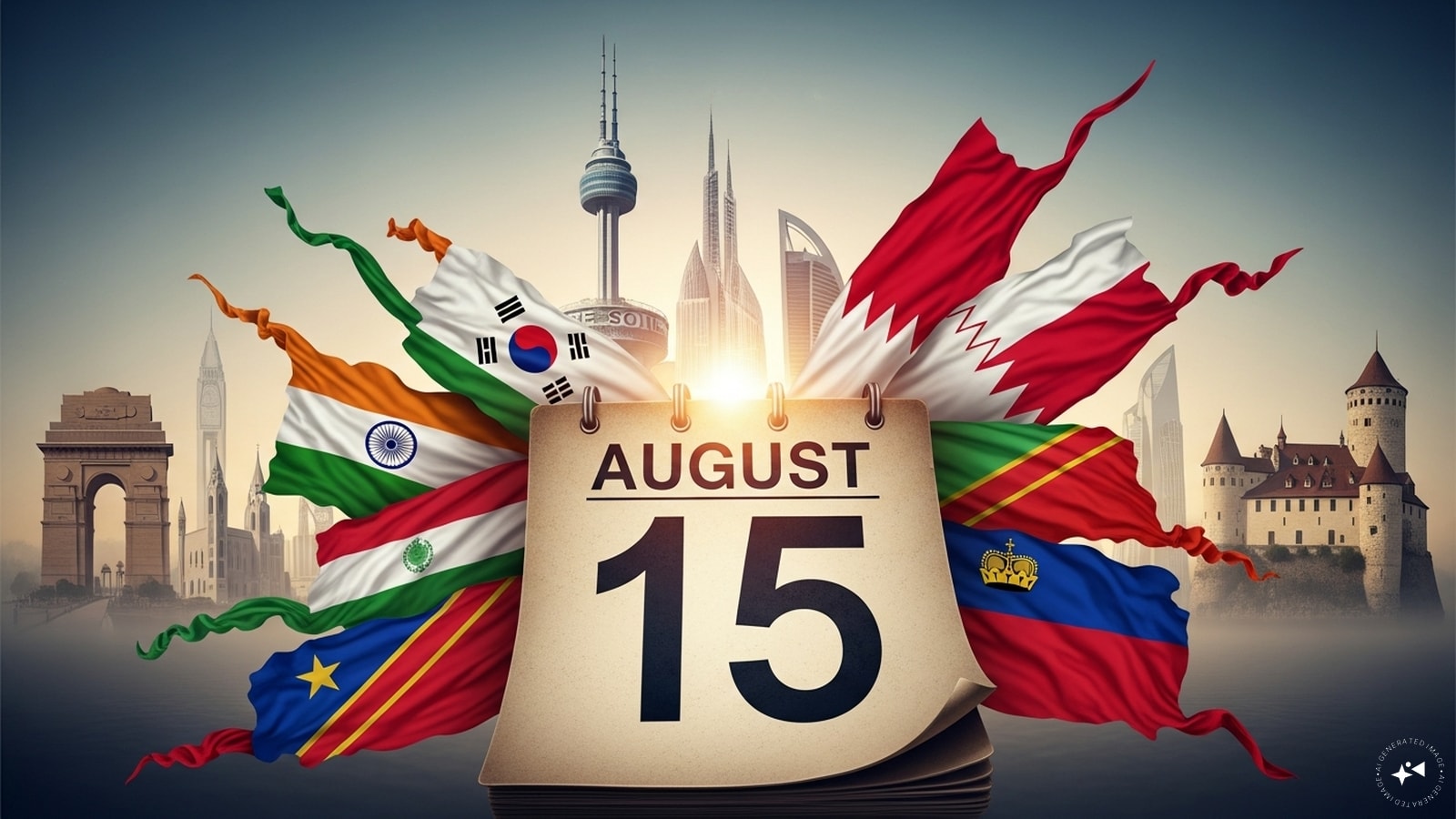
Every single year around mid-August, internet listicles crawl out of the digital woodwork to drop the exact same trivia fact. They tell you that India is not alone in celebrating its independence on August 15. They point out that South Korea, Bahrain, the Republic of Congo, and Liechtenstein also mark national milestones on this exact date.
It is presented as a mind-bending coincidence. A geographic parlor trick.
It is also an intellectual lazy Susan.
Listing countries that share a calendar square because of a shared date is not history. It is a trivia night question designed to farm clicks from people who mistake dates for context. Dates are arbitrary markers invented by humans to stop crops from rotting in the winter. History is about power, blood, logistics, and institutional collapse.
When you look at August 15 through the lens of institutional design rather than sentimental calendar-watching, the lazy consensus falls apart completely. Grouping India, South Korea, and Liechtenstein together based on a shared month and day tells you precisely nothing about why nations succeed, why empires shatter, or how sovereignty actually functions in the modern world.
Let us dismantle the shallow narrative.
The Chronology Trap
The lazy article assumes that sharing a calendar date implies a shared historical gravity. It creates a false equivalence that insults the scale of what happened in 1947.
Look at the mechanics.
India's freedom on August 15, 1947, was the violent, chaotic surgical removal of the British Raj from a subcontinent containing nearly four hundred million people. It was accompanied by Partition, a demographic trauma that displaced fifteen million individuals and left up to two million dead in a matter of weeks. The sheer administrative horror of drawing borders with a ruler while trains packed with refugees crossed in opposite directions has zero parallel in modern statecraft.
Now look at Liechtenstein. The tiny Alpine principality celebrates its national holiday on August 15 because the ruling prince’s birthday happened to fall on the Feast of the Assumption, and the government simply merged the church holiday with national pride in 1940.
Comparing the violent birth pangs of the world's largest democracy to a royal birthday party in a tax haven with a population smaller than a suburban high school is absurd. Yet, the internet treats them as peers because they occupy the same row in a date picker.
This is the fundamental error of calendar-based journalism. It treats time as an active agent. Time does nothing. Power does everything.
Sovereignty Is Not a Synchronized Swimming Event
When people read these lists, they fall victim to what psychologists call synchronicity bias—the irrational belief that events occurring at the same time share a deeper causal connection.
South Korea marks National Liberation Day on August 15, commemorating the end of Japanese colonial rule in 1945. Bahrain declared its formal independence from British protection on August 15, 1971. The Republic of Congo gained independence from France on August 15, 1960.
Four completely distinct imperial collapses. Four entirely different geopolitical fallout zones.
Treating them as a collective phenomenon is intellectually lazy. It suggests that August 15 holds some mystical power over the dismantling of colonialism. In reality, the date for India was chosen by Lord Mountbatten because it marked the second anniversary of the Japanese surrender in World War II, a personal vanity project to highlight his own military command. Mountbatten picked the date on a whim during a press conference in New Delhi.
Think about that for a second.
The birth date of a nation of hundreds of millions of people was dictated by a British viceroy's arbitrary scheduling preference. If Mountbatten had a stomachache on August 14, 1947, the largest democracy on earth might celebrate its independence on a completely different Tuesday.
When you realize how random these foundational dates are, the entire premise of celebrating "August 15 twins" collapses under its own weight.
The Myth of the Clean Break
Another persistent delusion peddled by these anniversary roundups is that independence happens on a day.
It does not. Independence is a process, not a ribbon-cutting ceremony.
When South Korea marked August 15, 1945, foreign troops did not vanish. The peninsula was immediately carved up along the 38th parallel by two rival superpowers, setting the stage for a horrific proxy war that killed millions and continues to divide families today. Liberation day was merely the opening bell of a much more brutal chapter.
When India woke to freedom on August 15, 1947, the British administrative machinery stayed in place for months. Judges, civil servants, and military officers remained at their desks using colonial penal codes that took decades to reform. The physical act of lowering one flag and raising another is theater. The hard work is dismantling the institutional architecture left behind by the occupier.
Most nations fail not because they lack a flashy independence day, but because they never finish the unglamorous work of building domestic institutional capacity once the foreign masters pack their bags.
What the Listicles Miss About Liechtenstein
Let us look closer at Liechtenstein, because it exposes the intellectual bankruptcy of the shared-date comparison.
Liechtenstein was never colonized. It did not have to fight a war of liberation. It did not have to negotiate debt transfers with a bankrupt European crown. It survived two world wars by virtue of neutrality, banking secrecy, and geographic insignificance.
Comparing Liechtenstein's August 15 to India's August 15 is like comparing a person who won the lottery to someone who spent thirty years digging themselves out of a financial crater while dragging three wounded relatives behind them. Both have money in their bank accounts on the same day, but their stories have nothing to do with each other.
By pretending these nations share a historical bond based solely on a Gregorian calendar quirk, we flatten history into a series of trivia cards. We rob these countries of their unique struggles and replace them with manufactured symmetry.
Stop Asking the Wrong Questions
People search for these anniversaries because they are looking for neat patterns in a messy world. They want reassurance that history follows a script.
It does not.
If you want to understand why India punches above its weight on the global stage, do not look at August 15. Look at the dogged resilience of its judicial system, the audacity of its 1950 constitution, and the grueling economic liberalization of 1991 that saved the nation from bankruptcy.
If you want to understand South Korea, look at the brutal state-directed capitalism of the mid-20th century, the bloody student uprisings of the democratization movement, and the terrifying proximity of the demilitarized zone.
The date is a footnote. The struggle is the text.
Stop collecting calendar coincidences. Start studying the mechanics of how nations actually survive when the empire leaves and nobody is left to blame for the wreckage.
History does not care what day it is. Neither should you.