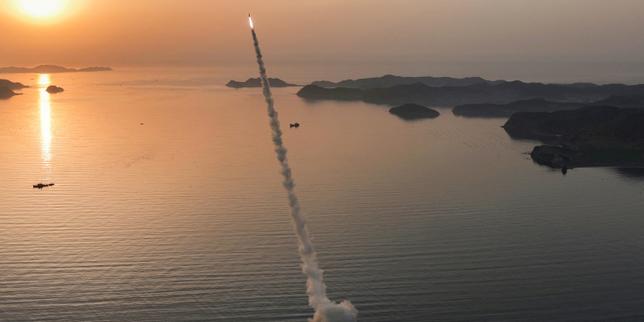
North Korea isn't interested in diplomatic handshakes right now. They want attention. That’s exactly what they got this past Saturday when state media confirmed the launch of five ballistic missiles. It wasn't a warning shot. It was a calculated display of hardware designed to remind the world that Pyongyang’s arsenal is growing faster than international sanctions can stop it.
If you’ve been watching the Korean Peninsula, you know this pattern. It happens every time they feel pressured or ignored. You’re looking at a state that views its nuclear and missile program as its only real insurance policy. When they launch, they aren't just testing distance. They’re signaling to Washington, Seoul, and Tokyo that the costs of any potential conflict are rising every single day.
Understanding the Message Behind the Noise
Most news outlets report these launches as isolated incidents. They focus on the number of missiles or the trajectory. That misses the point. These aren't just technical tests. They are political communications.
When the KCNA (Korean Central News Agency) confirms a launch, it’s a deliberate act of transparency meant to demonstrate operational readiness. They want you to know they have the tech. They want you to see that their command-and-control systems are working. By firing multiple missiles in a single window, they’re showing they can overwhelm defenses. It’s a classic strategy of coercion. They’re trying to force the regional powers back to the table on their own terms.
The Technical Reality of Recent Tests
We have to look at the hardware. It’s easy to dismiss these as crude attempts, but that’s a mistake. Recent reports indicate progress in solid-fuel technology. This is massive. Liquid-fuel missiles take time to prep for launch. That prep time gives satellites and intelligence agencies enough warning to spot the activity and prepare a response.
Solid-fuel missiles, on the other hand, can be stored fueled and ready to go. They can be moved around on transporter erector launchers (TELs) and fired with almost zero warning. This makes detection incredibly difficult. If you’re a military planner in Seoul, this keeps you up at night. The window to preempt a launch shrinks from hours to minutes. That fundamentally alters the strategic balance in the region.
Why Sanctions Keep Failing
You’ll often hear experts talk about tightening the screws. They suggest more economic pressure. They push for harsher UN resolutions. I’ve seen this movie before, and the ending never changes. North Korea has spent decades building a sanctions-proof economy. They use illicit ship-to-ship transfers, cyber theft, and shadow banking networks to fund their weapons programs.
Honestly, at this point, the international community is running out of leverage. You can’t sanction a country that has already effectively cut itself off from the global financial system. The reality is that as long as China and Russia remain reluctant to fully enforce meaningful pressure, Pyongyang has the breathing room it needs to keep testing.
The Regional Security Dynamic
The situation is getting more complex because the responses are changing. South Korea and Japan have been forced to deepen their own defense cooperation. This is the last thing Pyongyang wanted. Their provocations are actually driving their adversaries to integrate their missile defense systems and increase joint exercises with the United States.
It’s an ironic twist. North Korea tries to use force to fracture the alliance, but instead, they’re welding it together. We’re seeing more Aegis-equipped destroyers in the region. We’re seeing more long-range surveillance assets being deployed.
What Actually Comes Next
Don't expect the testing to stop. It’s part of their national identity now. They have a five-year plan for military modernization that includes everything from tactical nuclear weapons to reconnaissance satellites. They aren't going to scrap that progress for a promise of food aid or a minor easing of trade restrictions.
If you’re trying to track this situation, watch for the shift in rhetoric rather than the individual launches. Pay attention to how they talk about their nuclear doctrine. When they start lowering the threshold for use—when they talk about "preemptive" strikes as a standard policy—that’s when the danger levels spike.
For the general observer, the most important thing to grasp is that this is the new normal. We’re in an era of long-term containment. There’s no magic button to turn off the missile program. Keeping tabs on the intelligence reports from the Japanese Ministry of Defense or the South Korean Joint Chiefs of Staff is your best way to understand the immediate tactical shifts. Stay focused on the movement of their mobile launchers and the frequency of these tests. That’s where the real story is playing out.