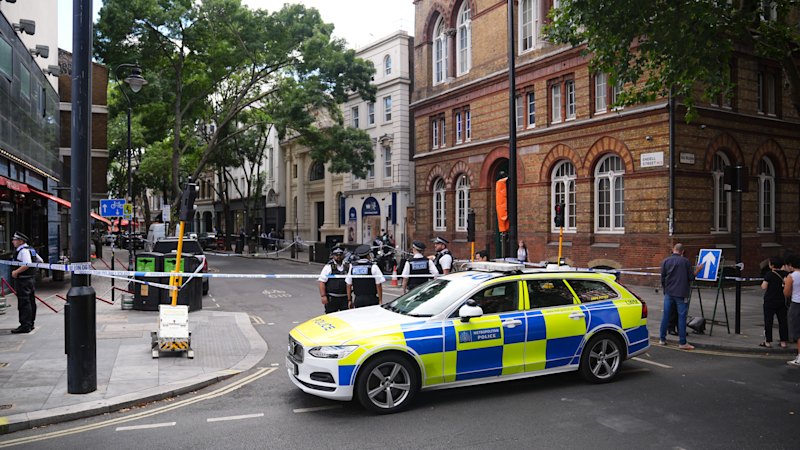
The coffee cups were still warm. Lunch hour on Endell Street hummed with the ordinary, unhurried rhythm of central London, where tourists trace old maps and locals rush past brick facades without looking up. It was twenty-seven minutes past twelve on a Wednesday. The air smelled of fried fish, espresso, and wet pavement.
Then came the sharp break in reality.
Consider what happens next: a quiet, frantic sprint inside a local grooming room, a man tearing off his shirt to reveal a sudden, blooming gash, and the immediate, terrifying realization that the urban social contract had just evaporated.
Four men—aged thirty-four, thirty-nine, forty-two, and fifty-two—were suddenly bleeding on the concrete.
The weapon was not a polished blade forged for malice, but something far more ordinary and domestic. Scissors. Improvised, jarring, and violently out of place. Witnesses near the Shaftesbury Theatre watched in stunned silence as a 47-year-old woman moved through the lunchtime crowd, her voice disjointed, her actions erratic. To local shopkeepers, she was not an unfamiliar ghost; she was a person of the street, frequently seen, chronically unstable, drifting along the margins of a city that looks right through the vulnerable until they shatter.
Chaos arrived with sirens. The Metropolitan Police swarmed the cordoned-off blocks within minutes, backed by fast-response paramedic cars and the heavy rotor wash of London's Air Ambulance descending unpredictably onto nearby public spaces. Paramedics dropped to their knees on the pavement, chest-compressing fear into clinical efficiency, rushing all four victims to a major trauma centre. Two would later be discharged back into the light of day, while others remained under medical watch with injuries mercifully deemed non-life-threatening.
But the statistics miss the psychological shrapnel.
When police announced that the incident was believed to be mental health-related, it recast the narrative from a simple crime report into a glaring institutional mirror. We build cities that bustle with millions of souls, yet leave individuals to drown silently in plain sight. Untreated crises do not simply vanish; they fester in doorways, wander down theatre districts, and occasionally erupt into sudden, blinding violence that leaves ordinary bystanders asking how the warning signs were missed by everyone and no one at all.
By mid-afternoon, the police tape came down. Restaurant workers swept away the debris, and tourists trickled back to order tiramisu feet from where a man had bled. The pavement was washed clean. The city resumed its stride, erasing the bloodstains with astonishing speed.
Yet the silence left behind remains heavy, humming quietly beneath the traffic.