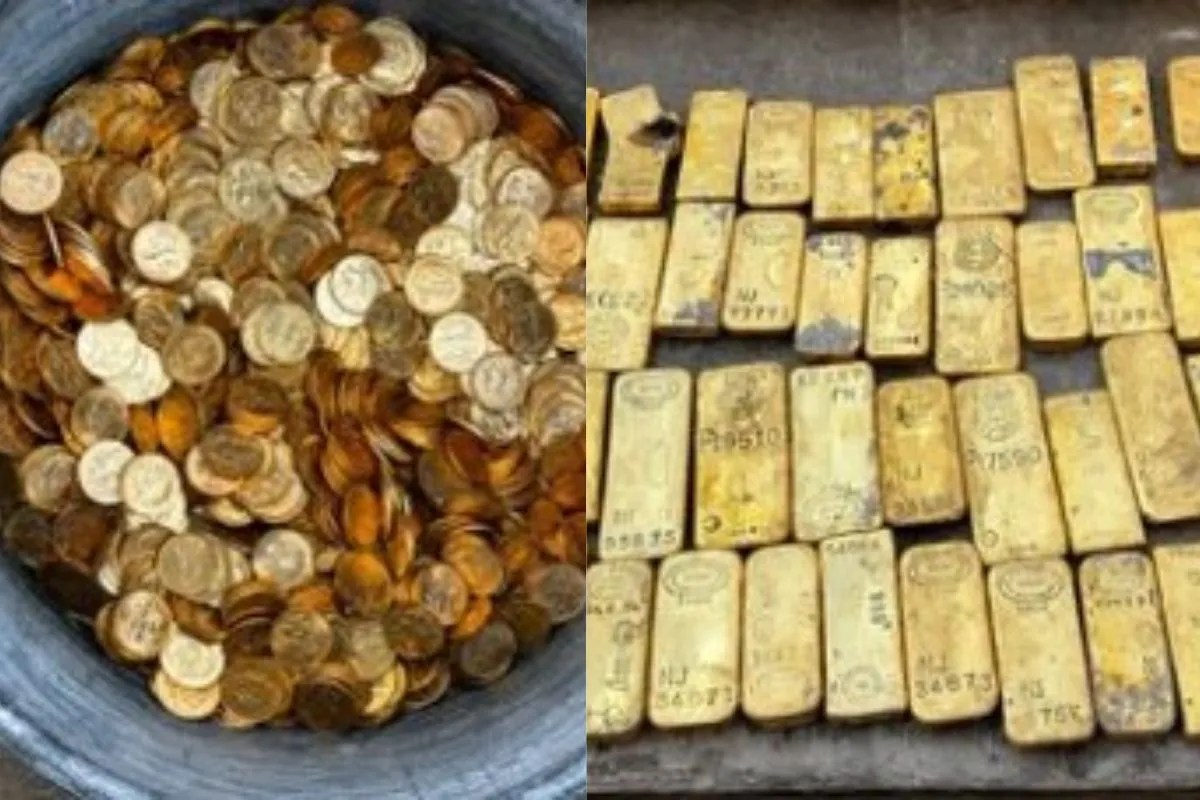
In the quiet Flemish town of Dendermonde, a routine renovation project recently transformed into a historical puzzle that has seized international attention. Construction workers, tasked with the mundane labor of installing sewage pipes in a cellar, unearthed a hoard of gold bars and coins valued at approximately nine million euros. This was not a modest cache; it was a substantial fortune, estimated at over ten million dollars, sealed deep within the stone and mortar of a building now owned by a local welfare charity.
The find occurred earlier this week when the renovation team, which included an eighteen-year-old student working a summer shift, breached the cellar walls. What initially appeared to be simple currency quickly revealed itself as something far more significant. The workers, recognizing the magnitude of the discovery, contacted local authorities immediately. This quick action effectively moved the treasure from a construction site to a high-security government vault, ending the possibility of any illicit distribution before it could even be whispered among the crew.
The burning question for those involved is simple, yet legally treacherous: Who rightfully owns nine million euros worth of bullion found inside a wall?
Belgian law provides a structured, if lengthy, path for resolving such questions. The authorities have launched a formal investigation to determine the origins of the gold. This is not merely a matter of bookkeeping; investigators must verify whether the hoard is connected to past criminal activity. If it is linked to a crime, the state may seize the assets. If it is deemed "clean," the clock begins on a five-year waiting period. Under current statutes, the original owner has precisely 1,823 days to come forward with a legitimate claim. If no such person appears, the treasure will likely be divided between the individuals who discovered it and the charitable organization that owns the property.
The logistics of the find itself provide a glimpse into why such things remain hidden for decades. The gold was stashed in a chest, a deliberate attempt to keep the wealth out of sight. Why someone would go to the trouble of bricking a fortune into a cellar wall remains a matter of speculation. Was it a casualty of war? A desperate attempt to protect assets during a period of economic upheaval? Or perhaps the ill-gotten gains of a long-dead enterprise? The lack of documentation or markings that have been publicly acknowledged suggests a clandestine origin, one that may never be fully clarified by the passage of time.
For the workers involved, the find represents a surreal interruption to their working lives. Kobe, the teenage worker who first questioned the nature of the coins, described his initial reaction as disbelief. He expected to find simple household detritus or common building materials; instead, he held the weight of a fortune. Despite the temptation that such a discovery might pose in a different context, the group understood that retaining the gold was impossible. The sheer volume of material, combined with the legal realities of such a find, made the idea of a secret split entirely impractical.
The local charity that owns the site, CAW Oost-Vlaanderen, now finds itself at the center of an unexpected financial windfall. Its director, Geert Hillaert, has expressed both surprise and a measured optimism, noting that the resources could, in theory, significantly bolster the organization's mission to address daily welfare needs. However, that optimism is tempered by the reality of the legal wait. The charity, like the workers, must now sit on the sidelines while the investigation proceeds.
Police in Dendermonde have been proactive in managing the inevitable aftermath of the news. They have cordoned off the area and issued warnings to amateur treasure hunters, noting that the site has been thoroughly scoured. The police even updated their social media imagery to feature a gold coin, a nod to the spectacle while reinforcing the seriousness of their current investigation. They have made it clear that the site is a dangerous, fenced-off construction zone and that no further fortune is tucked away in the shadows of the basement.
The rarity of such an event often leads to public fantasy, yet the reality is governed by the cold, slow grind of bureaucracy. Finding a fortune does not equate to owning it. The story of the Dendermonde gold is a reminder that the physical structures we inhabit often act as time capsules, holding onto the secrets of those who came before us. While the world waits to see if a claimant emerges, the gold remains in the dark, silent and secured, its true history still waiting to be excavated by a legal system that moves at a pace far slower than the construction that unearthed it.
Whether this discovery ends in a windfall for a local charity and a group of laborers or remains a mystery stored in a government warehouse, the event serves as a sharp contrast to the digital, ephemeral nature of modern wealth. There is something primal about the discovery of physical gold, a tangible link to the past that ignores our contemporary obsession with data and finance. For now, the wall has been breached, the secret is out, and the law has the final say.