The grease on the wrench felt colder than usual. Reid Wiseman, Victor Glover, Christina Koch, and Jeremy Hansen aren't just names on a flight manifest; they are the living, breathing heart of a machine that weighs millions of pounds and aims for a target 238,900 miles away. When the Artemis II crew finally climbs into the Orion capsule, they won't be thinking about "inspiring a generation." They will be thinking about the seals, the oxygen scrubbers, and the terrifying silence of the lunar far side.
We have spent fifty years treating the moon like a dusty relic of the Cold War. It became a museum piece, a grainy video of men in bulky suits hopping across a gray desert. But the museum doors just blew off.
The Weight of Four People
In a nondescript building in Houston, the air smells of ozone and recycled breath. This is where the abstract becomes visceral. For the four astronauts of Artemis II, the mission isn't a press release. It is a series of brutal, repetitive simulations designed to break their spirits before the vacuum of space gets a chance to break their bodies.
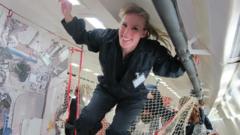
Consider Christina Koch. She already holds the record for the longest single spaceflight by a woman. She knows the physical toll: the way your spine stretches, the way fluids shift to your head, the strange metallic taste of recycled air. When she looks at the moon from the window of Orion, she won't just see a celestial body. She will see the edge of a cliff. Artemis II is the first time humans will leave Earth’s orbit since 1972. They aren't going to land—not yet. They are going to slingshot around the lunar far side, staring into a darkness that no human eye has seen in person for half a century.
This isn't just a flight. It is a stress test for the soul.
The mission profile is deceptively simple. Launch. Orbit Earth to check systems. Fire the engines to head for the moon. Loop around. Come home. But the stakes are invisible and absolute. If the heat shield fails upon re-entry, they hit the atmosphere at 25,000 miles per hour, turning the capsule into a streak of fire that never reaches the ground. This isn't a "pivotal" moment—it is a life-or-death gamble on the math of orbital mechanics.
The Silence in the Classroom
Go into any third-grade classroom and ask a kid what they want to be. For decades, the answer was "a YouTuber" or "an influencer." Space had become boring. It was something private companies did to put satellites in orbit so we could refresh our feeds faster.
But something shifted when the SLS rocket first roared to life during the Artemis I uncrewed test. People felt the vibration in their chests even if they were watching through a screen. Suddenly, the moon wasn't just a light in the sky; it was a destination again.
The true impact of Artemis II isn't found in the engineering bays or the halls of Congress. It’s found in the quiet intensity of a girl in rural Ohio who stayed up until 3:00 AM to watch a splashdown. She doesn't care about "leveraging synergies" or "robust frameworks." She cares that someone who looks like her is going to see the Earth rise over a lunar crater.
The human element is the only thing that justifies the cost. We could send robots forever. They are cheaper. They don't need sandwiches or oxygen or a way to use the bathroom in zero-G. But a robot cannot feel the awe. A robot cannot come back and tell us what it feels like to see everyone you’ve ever loved reduced to a tiny, fragile marble hanging in a void.
The Machinery of Hope
The Orion spacecraft is a masterpiece of claustrophobia. It’s roughly the size of a small SUV, packed with four adults and enough electronics to run a small city. Every cubic inch is contested. There is no privacy. There is only the mission.
The heat shield is perhaps the most critical piece of hardware ever built. It’s made of Avcoat, a material that intentionally burns away to carry heat away from the capsule. During re-entry, temperatures will soar to 5,000 degrees Fahrenheit. That is half as hot as the surface of the sun. Inside, the crew will be strapped in, feeling the crushing weight of several Gs, trusting that a layer of treated resin will keep them from vaporizing.
Why do we do this?
It isn't for the rocks. We have lunar rocks. It isn't for the "landscape." We have high-resolution maps. We do it because humanity is a species of explorers that has spent too long sitting on the porch. Artemis II is the first step back onto the trail. It is the proof of concept for Artemis III, which will actually put boots on the lunar south pole—a place of eternal shadow and frozen water.
The Invisible Stakes
There is a myth that space travel is a solved problem. It isn't. Every launch is an act of defiance against gravity, a force that spent billions of years trying to keep us pinned to the mud.
If Artemis II succeeds, it validates a decade of work and billions of dollars in investment. It proves that the Orion and the SLS aren't just expensive toys, but a bridge to Mars. But if it fails? If a valve sticks or a computer glitches in the deep dark of the lunar shadow? The dream of being a multi-planetary species could go dark for another fifty years.
The pressure on these four individuals is immense. Victor Glover, the pilot, isn't just flying a ship; he’s carrying the expectations of a world that is increasingly divided and cynical. For a few days in 2025, the world will stop arguing about politics and look up. They will wait for the signal to return from behind the moon. They will hold their collective breath.
Beyond the Horizon
We often talk about the "Apollo effect," the surge in science and engineering interest that followed the 1960s missions. But Apollo was born of war. It was a race to prove who had the better missiles. Artemis is different. It is a slow, methodical return to our natural state: curiosity.
The crew of Artemis II won't see the stars like we see them. Out there, away from the atmospheric haze, the stars don't twinkle. They are steady, piercing points of light in an ocean of black. And in that blackness, the four of them will be the only life for hundreds of thousands of miles.
Think about that for a second. The loneliness. The absolute, terrifying isolation.
They are doing this so we don't have to. They are the scouts. They are going out into the dark to find the path, so that one day, going to the moon is as mundane as a cross-country flight. We aren't just watching a mission; we are watching the expansion of our neighborhood.
The real story isn't the rocket. It isn't the fuel or the budget or the timeline. The story is the look on a child's face when they realize that the moon is no longer a ceiling, but a floor.
The night we stop looking down at our phones and start looking back at the sky is the night we remember who we are. We are the people who build ships to sail into the sun. We are the people who refuse to stay in the cave. Artemis II is the hand reaching for the doorknob.
The hatch is closing. The countdown is a heartbeat. And the moon is waiting, indifferent and ancient, for the sound of human voices to return to its silence.

 (1).webp)
