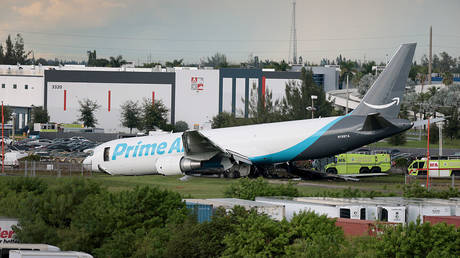
The asphalt of the Dolphin Expressway usually knows only the steady, humming pulse of midnight commuters, the casual drift of semi-trucks hauling cargo toward the port, and the low-slung headlights of sedans making their quiet way home. It is a place of transit. It is a place of motion. It is not a place for the sky to fall.
Yet, on that evening, gravity changed its mind.
Imagine standing on the perimeter road near Miami International Airport, the humid Florida air heavy with the scent of jet fuel and sea salt. You are waiting for someone. Flight 305 is late—just ten minutes, the kind of minor delay that breeds irritation rather than dread. You check your watch. You look up at the blinking green lights of the approach corridor, tracing the familiar geometry of descent. Planes come down here every three minutes. They are silver needles threading a needle-eye of radar and radio waves, guided by invisible threads of procedure and habit.
Then, the world tears open.
There is no elegant descent. There is only a sudden, violent deceleration that vibrates through the soles of your shoes before the sound even reaches you. A sickening metallic shriek, like steel screaming against stone. Sparks cascade into the dark like an inverted firework display, blinding and chaotic. And then, the fireball. It blooms with terrifying speed, a massive, orange-and-black fist punching into the subtropical night, swallowing the tail section and instantly turning the quiet highway into an inferno.
Plane crashes in the modern imagination are sterile things. We visualize them through the lens of dry National Transportation Safety Board briefs, monochrome wreckage diagrams, and polite statistical graphs showing that flying remains safer than crossing the street. We distance ourselves. We treat aviation disasters as anomalies of physics, aberrations so rare they feel almost fictional.
But physics does not care about our comfort.
When a multi-ton aluminum tube skids off a rain-slicked runway and breaches the perimeter fence, statistics evaporate. In their place stands the raw, pulsing reality of human fragility.
Consider what happens in the cockpit during those final, frantic seconds. For the pilots, the routine is broken in a heartbeat. The checklist, practiced a thousand times in simulators under the artificial twilight of training facilities, dissolves into pure instinct. Hydroplaning is an invisible enemy. It is the moment the tire treads lose their grip on a water-logged runway, lifting the aircraft on a microscopic cushion of fluid until the pilot is no longer steering a machine, but riding a runaway sled.
As a former first responder who spent decades pulling twisted metal apart on Florida highways, I recognize the particular violence of high-speed deceleration. You do not hear the impact first; you feel it in your teeth. It is a concussive thump that rattles the sternum. In aviation accidents of this scale, the margin between a hard landing and catastrophe is often measured not in miles, but in wet inches. A few degrees of yaw, a sudden crosswind shear off the Everglades, a fraction of a second's delay in deploying spoilers—and the mundane becomes catastrophic.
The initial news alerts flash across millions of glowing screens miles away with chilling detachment. Miami Airport crash LIVE: Plane erupts into fireball after skidding onto motorway.
Those eight words reduce a symphony of terror, courage, and loss into a headline designed for clicks. They strip away the trembling hands of the flight attendants yelling commands that have saved countless lives. They erase the truck driver who slammed on his brakes fifty yards away, watching in disbelief as a commercial airliner skidded across his path like a dying meteor. They mute the frantic radio traffic of dispatchers calling code reds, sending sirens wailing through the Palm-lined avenues of Dade County.
We consume these disasters from the safety of our living rooms, scrolling past the carnage while our morning coffee grows cold. We want to know the body count. We want to know whose fault it was. Was it pilot error? Mechanical failure? A freak meteorological event that defied the radar screens?
We demand simple answers to complex tragedies because certainty is comforting. We want to believe that if we can just point to a broken valve or a misread dial, the skies remain safe for the rest of us.
Yet the truth is far more humbling. Aviation is an uneasy truce between human ambition and the unforgiving laws of aerodynamics. Every time we step into a metal tube and climb thirty thousand feet into the troposphere, we are participating in a grand, fragile collective trust. We trust the engineers who poured titanium into turbine blades. We trust the air traffic controllers staring at green phosphorescent blips through tired eyes at three in the morning. We trust the weather gods to keep their tempers.
When that trust breaks—when a plane breaches the fence and ignites the motorway—the illusion of invulnerability shatters with it.
The flames on the Dolphin Expressway eventually died down, choked by thousands of gallons of purple-tinted chemical foam poured by firefighters in heavy bunker gear. The smoke cleared, leaving behind a jagged scar of scorched pavement, melted guardrails, and the ghostly skeleton of a fuselage. Investigators in high-visibility vests moved in with tape measures and sifted through the ash, looking for the orange boxes that would tell the story in numbers and data streams.
Back inside the terminal, arrivals boards continued to flip. Flight 305 was marked canceled. Families waiting behind the glass slowly realized their loved ones were not coming home, their ordinary Tuesday transformed into a before-and-after dividing line that nothing will ever bridge.
The highway has since been repaved. The traffic flows again, bumper-to-bumper, oblivious to the ghosts beneath the tires. But the sky above Miami still hums with the weight of our relentless desire to fly, carrying us forward through the dark, suspended over the abyss.