The sirens in Jerusalem do not sound like a warning. They sound like a lament. It is a rising and falling wail that cuts through the cool night air, vibrating in the soles of your feet before it even registers in your ears. When that sound begins, the normal world vanishes. The mundane reality of a Saturday night—unwashed dishes in the sink, an unfinished television show, a text message left on read—is instantly replaced by a cold, primal calculus. How many seconds to the stairwell? Who is holding the flashlight?
For months, the Middle East had been trapped in a exhausting cycle of anticipation. It was a region waiting for a match to fall into a powder keg. On that specific night, the match was lit. Hundreds of drones and missiles were fired from Iranian soil, charting a course across the dark expanses of Iraq and Jordan, aimed directly at the Israeli heartland. It was an unprecedented escalation, a direct state-on-state confrontation that shattered decades of shadow warfare.
But beneath the geopolitical chess pieces and the sweeping headlines, the real story was unfolding in crowded basement shelters, in the tense silence of military bunkers, and in the white-knuckle grip of parents holding their children in the dark.
The Geometry of Fear
To understand the weight of that night, you have to understand the geography of the airspace. Air power is usually abstract. We think of it in terms of statistics, ranges, and payload capacities. But when those weapons are heading toward your home, the math becomes intensely personal.
Imagine standing on a coastline, watching a massive tidal wave form on the horizon. You know it is coming. You can track its speed. You have hours to wait, hours to think, hours to terrify yourself before the water actually hits the shore. That is what the drone launch felt like on the ground. Unlike the sudden, blinding shock of localized rocket fire, this was a threat with a timetable.
Reports began filtering through smartphones and television screens. Drones detected over Iraq. Estimated arrival time: three hours.
Think about what you can do in three hours. You can cook a meal. You can watch a movie. Or, if you are caught in the crosshairs of a regional conflict, you can pace the floor of a concrete safe room, watching the battery percentage on your phone tick down, wondering if the roof above your head will hold.
The threat came in layers. First were the slow-moving suicide drones, humming like angry lawnmowers across the night sky, designed to confuse and saturate radar systems. Behind them came the cruise missiles, faster and more lethal. And finally, the ballistic missiles, fired later but traveling at hypersonic speeds, soaring into the upper atmosphere before plunging back down toward earth like falling stars.
It was a synchronized orchestra of destruction, orchestrated from hundreds of miles away. The invisible stakes were not just about military targets or strategic deterrence. They were about the survival of families huddled under blankets, listening to the distant, muffled thuds of air defense interceptions echoing through the concrete walls.
The Iron Roof
There is a specific sound that accompanies the defense of a nation. It is not the roar of a jet engine or the boom of an explosion. It is a sharp, metallic crack that tears through the sky, followed by a brilliant flash of light that turns midnight into a fleeting, artificial noon.
This is the Arrow system, the Patriot batteries, and the Iron Dome at work. Together, they form an invisible, multi-tiered roof over the country.
During the height of the attack, the sky became a canvas of kinetic energy. Red streaks climbed upward from the ground, racing to meet the incoming threats. To watch it was to witness a terrifyingly complex physics problem played out with human lives on the line. Every successful interception was a quiet victory; every miss carried the potential for catastrophe.
International coalitions materialized in the darkness. American, British, and Jordanian forces joined the defense, forming a makeshift shield across the region's airspace. It was a rare moment of overt synchronization in a part of the world defined by its fractures. Fighter jets soared through the night, hunting down low-flying drones before they could even reach the border.
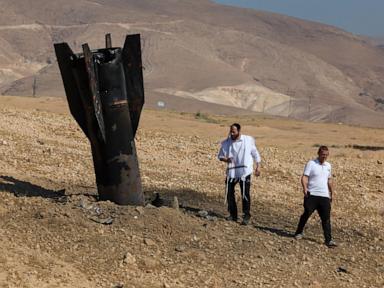
Yet, despite the high-tech marvel of a 99 percent interception rate, the statistics offer cold comfort when you are part of the remaining one percent. In a Bedouin village in the southern desert, a young girl was severely injured by shrapnel from an intercepted ballistic missile. Her injury served as a stark reminder that in warfare, there is no such thing as a perfect shield. The debris of a neutralized threat still has to fall somewhere. The gravity of the situation remained absolute.
The Sudden Silence
Then, just as the tension reached a breaking point, the tone shifted.
The Iranian military, via its diplomatic channels and state media, issued a statement. The objective had been met. The retaliatory strike, launched in response to an attack on their diplomatic compound in Damascus, was officially over. The message was clear: We have settled the score. We do not intend to push further, provided there is no counter-response.
The announcement arrived with a strange, jarring abruptness.
Wars do not usually operate like a theatrical performance with a clear curtain call. Yet, this encounter felt precisely like that—a highly choreographed, immensely dangerous demonstration of capability designed to send a message without triggering a total, apocalyptic regional collapse. It was a high-stakes gamble played with live ammunition and millions of human collateral.
In the early hours of the morning, the home front command gave the all-clear. People began to trickle out of their shelters. They blinked against the sudden brightness of hallway lights, looking at each other with a mixture of profound relief and lingering disbelief. The immediate danger had passed, but the world they stepped back into felt fundamentally altered.
The shadow war had walked out into the open light of day. A line had been crossed, a new precedent established.
The Morning After
Morning in Jerusalem always brings a specific quality of light. It washes over the ancient limestone walls, turning them a pale, warm gold. On Sunday morning, the city looked exactly as it had twenty-four hours earlier. The buses ran on time. The aroma of fresh coffee and baked goods drifted from neighborhood cafes. Children looked out of car windows on their way to school.
But the normalcy was an illusion. It was a thin veneer stretched over a deep, collective exhaustion.
Everyone you passed on the street shared the same secret knowledge. They knew what the sky looked like when it was filled with fire. They knew the exact weight of the silence that falls between the sound of a siren and the shockwave of an explosion.
We often talk about geopolitics as if it were a game played by leaders in wood-paneled rooms. We analyze treaties, weapons capabilities, and diplomatic communiqués. But the true cost of these conflicts is measured in the quiet accumulation of collective trauma. It is measured in the heartbeat of a child who flinches at the sound of a motorcycle backfiring, or a parent who cannot sleep without checking the lock on the shelter door one last time.
The attack had ended, the missiles had been stopped, and the military briefings were concluded. Yet, as the sun climbed higher into the cloudless blue sky, the silence left behind was not peaceful. It was heavy, fragile, and fraught with the uneasy knowledge that the sky could open up again at any moment.