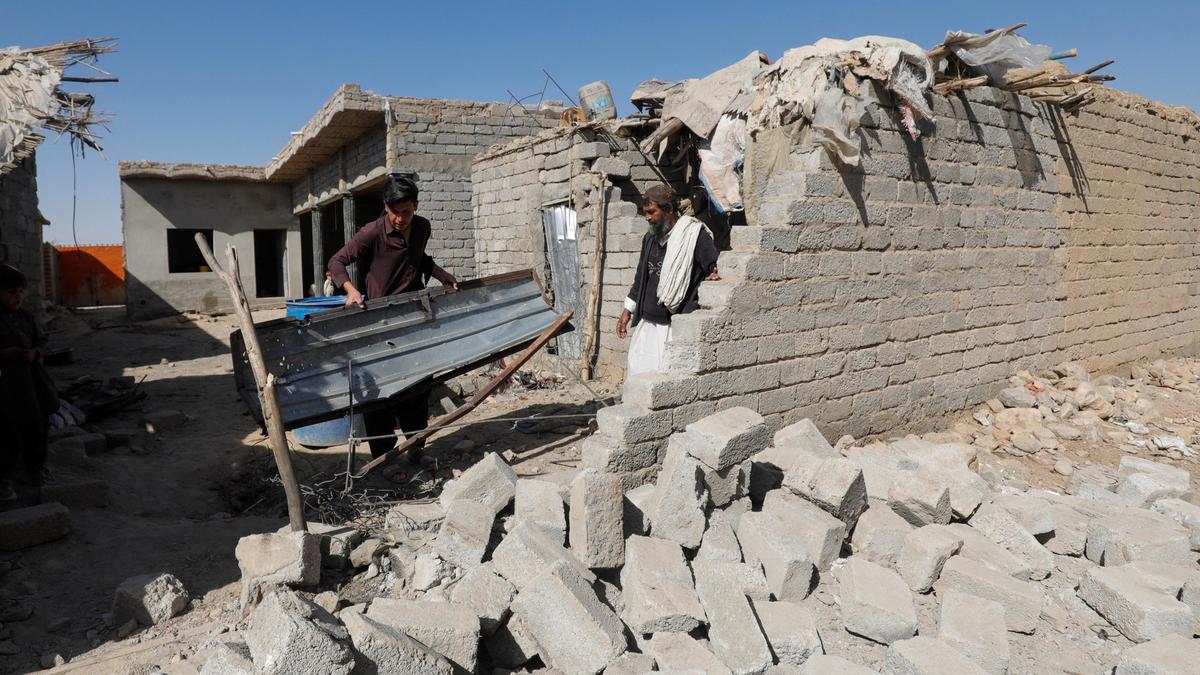
The border between Pakistan and Afghanistan is not a line on a map. It is a jagged, unforgiving spine of rock and dust where the wind carries the scent of juniper and the weight of centuries-old grievances. For those living in the shadow of the Khyber Pass, the sounds of the night are familiar: the distant bark of a dog, the low rumble of a transport truck, the whistle of the gale through the crags. But recently, a new sound has begun to haunt the silence. It is a high-pitched, mechanical whine. The sound of a lawnmower engine suspended in the void.
When the Pakistani military recently announced they had intercepted a series of "drone attacks" launched by the Afghan Taliban, the news broke in the dry, sterile language of a press briefing. Coordinates were mentioned. Weapon types were categorized. Official "deep concerns" were expressed. Yet, to understand what is actually happening on this frontier, you have to look past the ink on the page and into the dark expanse of the night sky where the rules of war are being rewritten by hobbyist electronics and lethal intent.
The Toy That Became a Terror
Consider a young soldier stationed at a remote outpost in the North Waziristan district. Let's call him Tariq. He is twenty-two years old, nursing a cup of lukewarm tea, watching a thermal monitor that flickers with the ghosts of heat signatures—goats, rocks, the occasional fox. In the old days, a threat meant a silhouette on a ridge or the muzzle flash of a long-range rifle. You could see your enemy. You could hear them coming.
Now, the threat is a silhouette against the stars, no larger than a shoebox.
The technology involved isn't the billion-dollar "Reaper" drones seen in Hollywood movies. We are talking about commercial quadcopters—the kind you might buy for a teenager at Christmas—strapped with improvised explosive devices. They are cheap. They are replaceable. And they are terrifyingly effective at sowing paranoia. When Pakistan’s security forces thwarted this latest wave of aerial incursions, they weren't just stopping a physical bomb; they were trying to plug a hole in a border that has suddenly become three-dimensional.
A Breach of Trust and Airspace
The tension between Islamabad and the Taliban government in Kabul has been simmering since the fall of 2021, but it has reached a boiling point. The accusations are heavy: Pakistan claims the Afghan Taliban is providing a safe haven for the Tehreek-e-Taliban Pakistan (TTP), a group that has unleashed a wave of violence across the country. The Taliban denies it. But the drones tell a different story.
Navigating this diplomatic minefield is like walking on broken glass in the dark. On one side, you have a Pakistani state that historically sought "strategic depth" in Afghanistan, only to find that the fire they hoped would stay in the neighbor’s hearth has spread to their own curtains. On the other, you have a Taliban administration that is struggling to transition from a decentralized insurgency to a functional government, yet seemingly unable—or unwilling—to restrain the militants operating from their soil.
When a drone crosses that border, it isn't just a violation of airspace. It is a signal. It says that the rugged terrain—the mountains that have protected these tribes for millennia—is no longer a barrier.
The Mechanics of the Interception
How do you stop a ghost?
The Pakistani military has had to rapidly evolve. Traditional radar often struggles to pick up small, plastic-bodied drones that fly low and slow, hugging the contours of the valleys to stay beneath the "sight" of long-range sensors. Thwarting these attacks requires a mix of electronic warfare—jamming the radio frequencies that tell the drone where to go—and good old-fashioned vigilance.
Imagine the tension in a command center when a signal is detected. It is a frantic race against a countdown. If the drone loses its GPS link, it might hover aimlessly until its battery dies, or it might trigger a fail-safe and fall like a stone. In this most recent incident, the Pakistani forces managed to "neutralize" the threats before they reached their targets. But "neutralized" is a cold word for a high-stakes game of electronic cat-and-mouse where a single missed signal could mean dozens of casualties in a crowded marketplace or a remote barracks.
The Invisible Stakes
We often talk about border security in terms of fences and checkpoints. Pakistan has spent years and millions of dollars fencing the Durand Line, a massive engineering project designed to stop the flow of militants and smugglers.
But a fence is a two-dimensional solution to a three-dimensional problem. The "drone attacks" represent a technological leapfrog. The fence is still there, sturdy and silver in the sun, but it is becoming a relic. The militants have realized that they don't need to cut the wire if they can simply fly over it.
This shift has profound psychological consequences. For the people living in the border regions, the threat is no longer localized to a specific road or a known flashpoint. It is everywhere. It is above. The psychological toll of "drone loitering"—the knowledge that a silent, unblinking eye could be watching from the clouds—is a weight that is hard to measure but impossible to ignore.
The Fracturing of a Fragile Peace
Why now? The timing of these thwarted attacks isn't accidental. It comes at a moment when Pakistan is grappling with an economic crisis and internal political upheaval. The state is vulnerable, and the TTP knows it. By utilizing Afghan soil to launch these low-cost, high-impact sorties, they are forcing the Pakistani military to spread its resources thin.
It also puts Kabul in a corner. Every drone that is shot down with "Made in Afghanistan" fingerprints (metaphorically speaking) erodes the Taliban’s remaining shreds of international's credibility. They claim they want trade, recognition, and an end to sanctions. Yet, if they cannot control their own borders—or if they are actively complicit in these provocations—those goals move further out of reach.
The tragedy of the frontier is that the people who suffer most are rarely the ones making the decisions. The shopkeeper in Peshawar, the student in Quetta, the soldier in the trench—they are the ones who live with the anxiety of the "whirr."
The Evolution of the Shadow War
The use of drones by non-state actors in this region marks a dark milestone. It is the democratization of airpower. Ten years ago, the ability to strike from the sky was a luxury reserved for superpowers. Today, it requires a smartphone, a steady hand, and a few hundred dollars.
We are seeing a version of the conflict that looks less like a traditional war and more like a grim science fiction novel. In this landscape, the winner isn't necessarily the one with the biggest tanks, but the one who can best manipulate the invisible waves of the electromagnetic spectrum.
The Pakistani government’s announcement that they "thwarted" the attacks is a temporary relief. It is a victory of a single night. But as the sun rises over the jagged peaks of the Hindu Kush, the underlying problem remains. The drones are just the symptoms of a much deeper infection—a breakdown in diplomacy, a resurgence of extremist ambition, and a border that has become a sieve.
The sky is clear for now. The soldiers at the outposts go back to their tea. The thermal monitors return to their steady, green glow. But everyone knows the silence is fragile. Somewhere across the ridge, in a hidden valley where the law does not reach, someone is plugging a battery into a charger, waiting for the cover of the next moonless night.
The wind continues to howl through the passes, but it no longer travels alone. It carries the faint, persistent ghost of a machine, reminding everyone below that the mountains are no longer high enough to keep the world away.