The air in Manhattan usually smells of exhaust and expensive espresso, but by six o’clock on Tuesday, it smelled like damp cardboard and adrenaline. It started as a low hum, the kind of vibration you feel in your molars before you actually hear the sound. Then came the rhythm. It wasn't the polished beat of a parade or the chaotic honking of gridlock. It was the sound of thousands of boots hitting the asphalt in unison, a percussion of pure, unadulterated discontent.
Elena stood on the corner of 5th Avenue, clutching a thermos that had long since gone cold. She isn't a professional activist. She’s a pediatric nurse who spent ten hours today explaining to a terrified six-year-old why needles don't actually hurt that much. She was tired. Her lower back throbbed. But when she saw the first wave of "No Kings" banners cresting the hill, she didn't head for the subway. She stepped off the curb.
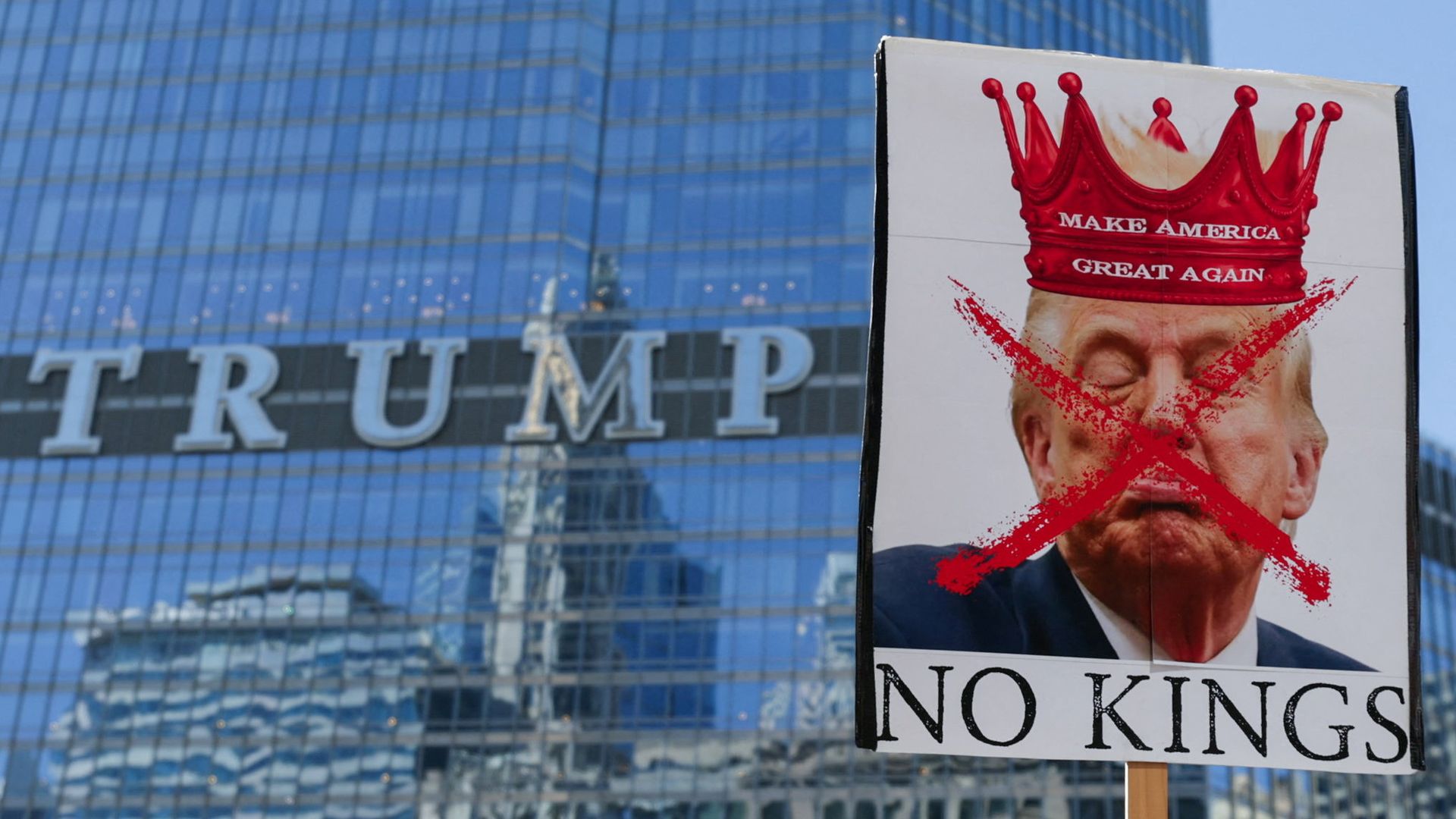
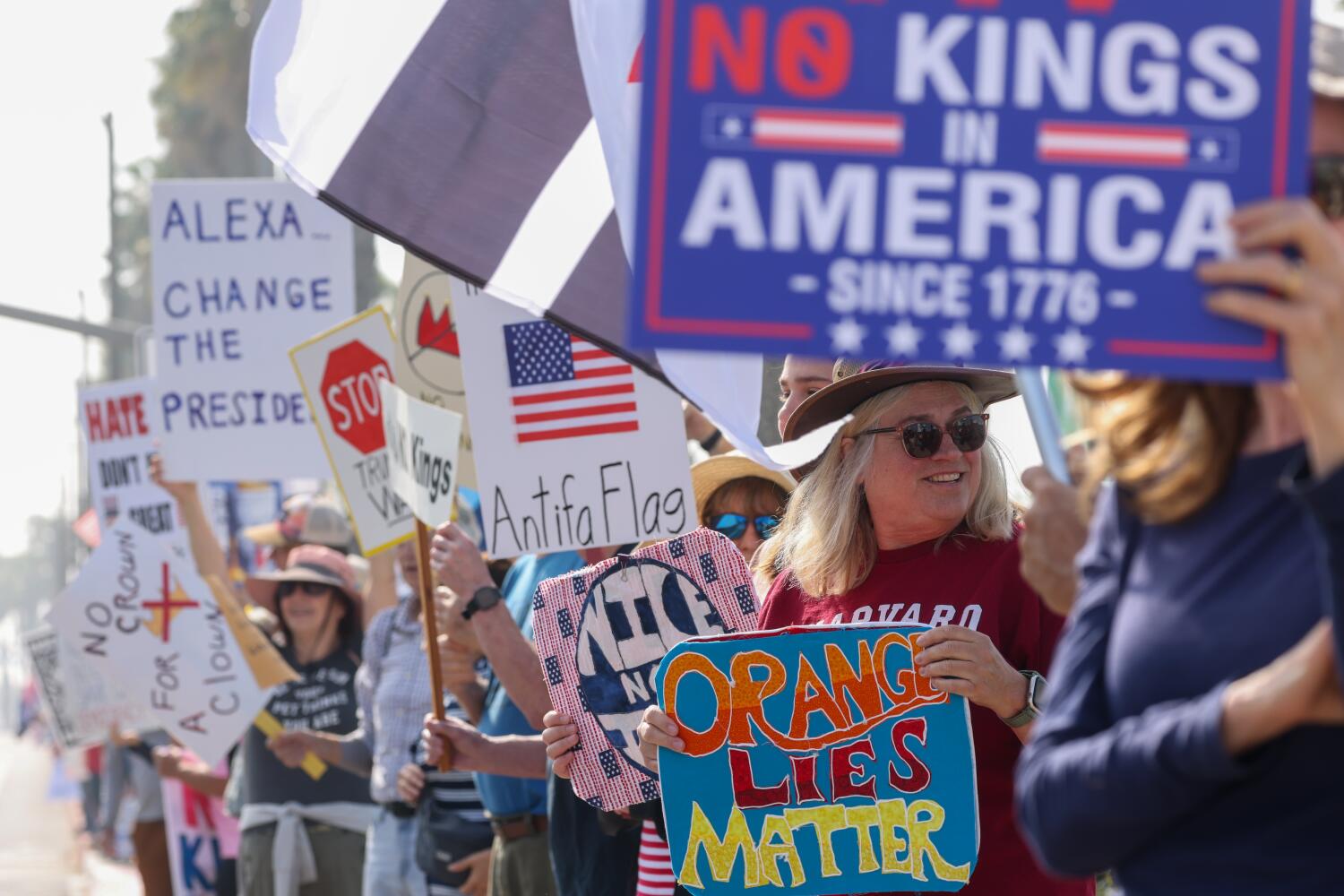
This wasn't just a crowd. It was a physical manifestation of a nation’s frayed nerves. Across the country, from the rain-slicked streets of Seattle to the humid plazas of Miami, the scene was being mirrored. The headlines will tell you about the "protest against Trump" or the "clash of ideologies." They will give you the headcount—estimates ranging from tens of thousands to nearly a million nationwide. They will quote the slogans. But they miss the texture of the moment. They miss the way a grandmother in a wool coat shared her hand-warmers with a college student in a thin hoodie because, for tonight, they were part of the same breathing machine.
The "No Kings" movement didn't spring from a single policy memo or a specific legislative gaffe. It grew from a deep-seated, ancestral fear that the guardrails of the American experiment were turning into wet noodles. The name itself is a visceral rejection of the idea that any one person—regardless of the office they hold—should be beyond the reach of the law. It is a demand for the return of the mundane, predictable accountability that keeps a republic from curdling into something else.
Consider the weight of that word: King. In the American psyche, it is the ultimate ghost. It’s the thing we thought we’d buried in 1776. To see it splashed across neon signs and chanted by schoolteachers in 2026 feels like a glitch in the simulation. But for those on the street, the glitch isn't the protest. The glitch is the feeling that the rules only apply to people who don't have a private jet.
The statistics back up the scale of the unrest, even if they can’t capture the mood. Public trust in the judiciary has hit a forty-year low. Polling data suggests that nearly 60% of the population feels the current political trajectory is "unrecognizable." This isn't a fringe element or a localized riot. It is a systemic shivering.
In Chicago, the wind off the lake was brutal. A hypothetical observer—let’s call him Marcus—watches from his apartment window. Marcus is a Republican. He voted for the man everyone is shouting about because he wanted lower taxes and a stronger border. But tonight, he isn't cheering for the "other side" to go home. He’s watching the police lines and the flickering torches with a sense of profound unease. He sees his neighbor, a man he’s shared beer and lawnmower advice with for a decade, holding a sign that says Accountability is not an Option.
Marcus realizes that the anger isn't just about a personality. It’s about the erosion of the shared reality they both used to inhabit. He wonders if the person he voted for realizes that the fire they lit to stay warm is now licking at the rafters of the whole house.
The movement is fueled by a specific type of exhaustion. It is the exhaustion of being told that what you are seeing with your own eyes isn't happening. When the crowds shout "No Kings," they are responding to a series of legal maneuvers and executive assertions that feel less like governance and more like an endgame. They are reacting to the idea that "absolute immunity" is a concept compatible with a democracy. It’s a logical paradox that the human brain struggles to process without screaming.
Think of it like a bridge. We all drive across the bridge every day, assuming the bolts are tight and the concrete is solid. We don't think about the engineers. We don't think about the maintenance crews. But if you see a crack form—a real, jagged, widening gap—you don't just keep driving and hope for the best. You stop the car. You get out. You point at the crack and you yell until someone brings a wrench.
Tonight, the nation is out of its cars.
The logistical scale of these gatherings is a feat of modern coordination, yet it feels strangely organic. In Denver, the crowd moved like a river around the Capitol, silent for long stretches, then erupting into a roar that could be heard miles away. There were no speakers on stages, no centralized leaders barking orders through megaphones. It was a leaderless swarm, a decentralized nervous system reacting to a perceived threat.
Critics argue that these protests are merely "theatrical" or "disruptive to the economy." They point to the blocked intersections and the shuttered storefronts as evidence of a mob mentality. But that perspective ignores the fundamental math of a protest. People do not stand in the freezing rain for six hours because they want to be theatrical. They do it because they feel that the cost of staying home has finally exceeded the cost of standing up.
History shows us that when the perceived gap between "the people" and "the law" becomes too wide, the vacuum is always filled by the street. We saw it in the 1960s. We saw it in the suffrage movements. The common thread is a sense of betrayal—the feeling that the social contract has been rewritten in the middle of the night by a pen you didn't authorize.
Back on 5th Avenue, the police presence was massive. Officers in riot gear stood like statues, their faces unreadable behind plexiglass visors. But even there, the human element leaked through. A young officer, likely no older than twenty-two, caught Elena’s eye as she walked past. For a split second, the barrier dropped. He looked tired. He looked like he wanted to be anywhere else. She saw him shift his weight, his eyes scanning the crowd not for enemies, but for a sign that things wouldn't turn violent.
The tension was a physical thing, a stretched wire vibrating at a frequency that made your skin crawl. Every time a firecracker went off or a trash can lid hit the pavement, the air turned electric. It wouldn't take much to tip the scale. A single shove, a misunderstood gesture, and the "peaceful assembly" would dissolve into something the evening news would be talking about for a decade.
Yet, for the most part, the wire held.
The protesters are trying to communicate something that doesn't fit into a three-minute news segment. They are trying to say that the American identity is not tied to a person, but to a process. When that process is mocked or bypassed, the identity itself begins to dissolve. That is the "invisible stake." It isn't just about who sits in the Oval Office in 2027. It’s about whether the chair itself still means anything.
As the night wore on, the crowds didn't thin; they consolidated. In San Francisco, the Golden Gate Bridge became a necklace of lights as thousands marched across, their voices carried away by the Pacific wind. In Philadelphia, they gathered in the shadow of the hall where the whole messy, beautiful, fragile experiment began.
There is a specific kind of silence that happens when a crowd of fifty thousand people all stop talking at once. It happened at 9:00 PM EST, a coordinated moment of reflection that swept across the time zones. For sixty seconds, the only sound in the heart of our busiest cities was the wind and the distant hum of the world continuing to turn. In that minute, the "protesters" weren't Democrats or Republicans, activists or agitators. They were just people standing in the dark, wondering if the ground beneath them was still solid.
The reality of 2026 is that we are living in a house with a shifting foundation. We can argue about the color of the curtains or the layout of the kitchen, but none of it matters if the floorboards are rotting. The "No Kings" movement is a desperate, loud, beautiful, and terrifying attempt to point at the rot.
Elena finally started her walk home around midnight. Her feet were numb, and her voice was a raspy shadow of its former self. She passed a discarded sign lying in a puddle. It was hand-painted, the ink running into a grey blur. It didn't have a clever slogan or a biting insult. It just had four words, written in a shaky, careful hand: I live here too.
The streets will be cleaned by morning. The trash will be hauled away, the barriers will be folded up, and the headlines will pivot to the next scandal or the next stock market dip. But the vibration in the asphalt doesn't just disappear. You can still feel it if you stand still long enough. It’s the sound of a million people realizing that the only thing standing between a citizen and a subject is the willingness to show up when the sun goes down.
The lights in the skyscrapers flickered as the last of the marchers disappeared into the subway entrances. For a moment, the city felt impossibly small, like a toy set resting on a shelf. Then a siren wailed in the distance, a taxi honked, and the silence broke. But as Elena turned the key in her door, she looked back at the empty street. The cracks were still there, but at least now, everyone was looking at them.