The rain in Copenhagen doesn't just fall; it leans against you. On this particular Sunday evening, as the sun dipped behind the jagged silhouette of the Bourse, the air felt unusually heavy, thick with the scent of damp wool and the electric hum of a country holding its breath. In a small, dimly lit cafe tucked away in a side street of Vesterbro, an elderly man named Jens sat alone. He stared at a flickering television screen, his hand trembling slightly as he held a porcelain cup of black coffee.
Jens has voted for the Social Democrats since the year the Beatles broke up. For him, the party wasn't just a political choice; it was the floor beneath his feet. It was the promise that no matter how hard the wind blew from the North Sea, the state would keep him warm. But as the first exit polls flashed across the screen in jagged bars of red and blue, the floor didn't just creak. It vanished.
The numbers were brutal. Cold. Final.
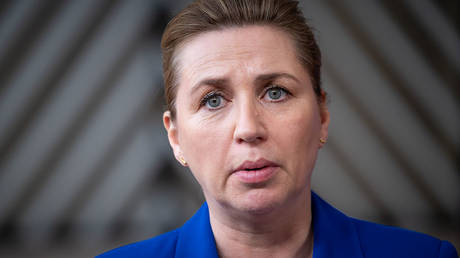
Mette Frederiksen’s Social Democrats, the architects of the modern Danish soul, had just suffered their worst election result in over a century. To find a defeat this staggering, you would have to travel back to a time before the world had seen a Great Depression or a second World War.
The Weight of a Century
Politics is often described in terms of "swings" and "mandates," but those are bloodless words. What happened in Denmark was an earthquake in slow motion. When a party that has defined the national identity for 100 years loses its grip, it isn't just a change in leadership. It is a crisis of belonging.
Consider the math. For decades, the Social Democrats hovered like a protective canopy over the Danish middle class. They built the "flexicurity" model—that delicate, almost magical balance where it is easy to fire someone but impossible for them to fall through the cracks. It was a system built on high taxes and higher trust.
But trust is a finite resource.
The exit polls suggested the party had plummeted to around 15 percent of the vote. In the context of Danish history, that is a ghost number. It is the sound of a foundation cracking. For Mette Frederiksen, a leader who had navigated the choppy waters of a global pandemic and the shivering uncertainty of a war on Europe’s doorstep, the result was a visceral rejection.
The Invisible Divide
What changed? To understand the collapse, you have to look away from the Parliament buildings at Christiansborg and toward the kitchen tables in towns like Esbjerg and Randers.
There is a quiet, simmering tension in the Danish countryside. While the "latte-socialists" in Copenhagen talk about green transitions and European integration, the people who actually drive the trucks and harvest the rye feel like the world is being redesigned without their input.
Imagine a young woman named Clara. She works at a regional hospital. She believes in the welfare state, but she watches as her local clinic loses funding while the government spends billions on ambitious, far-off climate goals. She sees her grocery bill climbing. She feels the pinch of energy prices. When she looks at the Social Democrats, she no longer sees the party of the worker. She sees a party of the elite, dressed in the costume of the working class.
This isn't a uniquely Danish problem, but the Danes have a word for the cozy, communal well-being they prize: hygge. On election night, the hygge evaporated.
The voters didn't just move to the right; they shattered. They scattered toward the fringes, toward new parties with names that sound like promises—the Denmark Democrats, the Moderates. They sought out anyone who didn't sound like the establishment.
The Paradox of Power
Frederiksen had attempted something radical: a "grand coalition" across the center. She tried to marry the left and the right to provide stability in an unstable world. It was a move of pragmatism, but in politics, pragmatism often looks like a betrayal of principle.
By reaching across the aisle, she left the flanks exposed. The traditional left felt she had sold her soul to the markets. The traditional right felt she was a wolf in sheep’s clothing. In trying to be everything to everyone, she became nothing to enough people to lose the room.
The exit polls weren't just a tally of votes; they were a collective scream of exhaustion.
Denmark is a small country. It relies on the idea that everyone is in the same boat, rowing in the same direction. But on this night, it became clear that the boat had developed a dozen different leaks, and everyone was trying to row toward a different shore.
A Ghost at the Feast
As the night deepened, the atmosphere at the Social Democratic headquarters was described by witnesses as "funereal." There were no cheers when the projections appeared. Only the hollow sound of footsteps on parquet floors and the frantic whispering of aides.
For the party of Thorvald Stauning—the man who led them through the 1930s with the slogan "Stauning or Chaos"—this was the chaos they had always feared. It was the realization that the old stories no longer worked. You cannot tell a person that the system is working when they feel the cold air coming through the gaps in the window frame.
The irony is that Denmark remains, by almost every global metric, one of the most successful societies on Earth. It is wealthy, safe, and functional. Yet, beneath the surface, there is a profound sense of loss. A loss of certainty. A loss of the feeling that tomorrow will inevitably be better than today.
The Morning After
When the sun finally rose over Copenhagen the next morning, the rain had stopped, leaving the cobblestones slick and shining like obsidian. The newspapers were already being printed with headlines that read like obituaries.
Jens, the man in the cafe, walked home in the gray light. He passed a campaign poster of Frederiksen, its corners peeling back in the wind. He didn't feel angry. He just felt tired.
The Social Democrats will remain in the building. They will still have a seat at the table. But the mandate that once allowed them to speak for the very soul of the nation has been revoked.
The century-long reign of the "Red Heart" hasn't ended with a bang, but with the quiet, devastating click of thousands of digital voting machines, each one a tiny act of divorce from a past that no longer feels like home. The red paint is still there, but the wood beneath it is rotting, and for the first time in a hundred years, nobody is quite sure how to fix the house.
Somewhere in the halls of power, a light stays on late into the night, casting a long, lonely shadow over a map of a country that looks the same as it did yesterday, but feels entirely different.