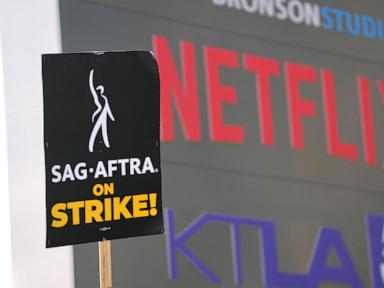
The fluorescent lights of a 24-hour diner in Burbank don’t usually feel like a sanctuary. But for Sarah, a mid-level screenwriter who spent the last six months pacing her cramped apartment and checking a dwindling bank balance, that harsh glow felt like a sunrise. She wasn't alone. Thousands of others were staring at their phones, waiting for the notification that would determine if they could keep their health insurance or if they’d have to start looking for desk jobs in industries they didn't love.
The notification came. The deal was done.
A four-year contract had been ratified with an overwhelming majority—over 90% of the union membership saying "yes" to a future that, only weeks prior, looked like a black hole. This wasn't just a win on paper. It was a pulse check for a dying dream. To understand why a group of writers would walk away from their livelihoods for nearly half a year, you have to look past the spreadsheets and the corporate jargon of "residuals" and "minimums." You have to look at the desk where the stories actually happen.
The Ghost in the Machine
For years, the people who write the lines your favorite actors say were being treated like gig workers in a digital sweatshop. The shift to streaming changed the math of Hollywood, but it also changed the soul of the work. Writers found themselves in "mini-rooms," where they were hired for a few weeks, paid the bare minimum, and then tossed aside before the show even started filming. They were being severed from the very stories they created.
Imagine building a house from the foundation up, picking every brick and choosing the color of every shutter, only to be locked out of the front door the moment the roof is finished.
That was the reality. Writers weren't allowed on set. They weren't involved in the edit. They were becoming ghosts in their own industry. This new contract doesn't just put money in pockets; it puts writers back in the room. It mandates staffing levels that ensure a show isn't just a product squeezed out by two exhausted people in a basement, but a collaborative effort that trains the next generation of showrunners.
The Math of Human Worth
The numbers are public, but the weight of them is felt in the grocery store aisle. The contract includes a significant bump in general compensation—roughly 5% in the first year, followed by 4% and 3.5% in the subsequent years. On a corporate balance sheet, those are rounding errors. For a writer who hasn't seen a paycheck since the previous autumn, that's the difference between staying in Los Angeles and moving back into their parents' basement in Ohio.
But the real victory—the one that had people weeping in that Burbank diner—was the streaming residual.
Under the old system, a writer could have a hit show watched by ten million people on a global platform and receive a residual check for six cents. It’s an insult wrapped in an envelope. The new deal introduces a viewership-based bonus. If a show hits a certain threshold of popularity on a streaming service, the people who dreamt it up actually share in that success. It's a fundamental acknowledgment: if you make the company billions, you shouldn't be struggling to pay for a dental cleaning.
The Silicon Shadow
Then there was the existential threat. The one that kept veteran writers awake at night, wondering if they were the last of a dying breed.
Artificial Intelligence.
The studios wanted the right to use "material" generated by machines. The writers saw the writing on the wall. They knew that if they didn't draw a hard line now, the future of storytelling would be a human "polishing" the fever dreams of a software program.
The new contract creates a fortress. It explicitly states that AI cannot write or rewrite literary material. It ensures that a writer’s work cannot be used to train these models without consent and compensation. It preserves the human spark. It says, quite clearly, that while a machine can string sentences together based on a probability matrix, it cannot understand the heartbreak of a breakup, the terror of a parent, or the specific, jagged joy of a hard-won victory.
Only a person knows what it feels like to bleed, and only a person can write about it.
The Long Road Home
The strike wasn't just about the writers. It was a cold winter for the entire ecosystem of film and television. For every writer on a picket line, there was a camera op, a makeup artist, and a caterer whose life had been put on hold. The tension in the air during those months was thick enough to choke on.
When the news of the four-year deal broke, the relief didn't just belong to the Guild. It belonged to the drivers who deliver the trailers and the assistants who schedule the auditions.
The "yes" vote was a signal that the industry was ready to move forward, but it wasn't a return to the status quo. The status quo was broken. This contract is a new blueprint. It acknowledges that the era of "disruption" cannot come at the cost of the people being disrupted.
Sarah finished her coffee and walked out into the cool California night. For the first time in months, she wasn't thinking about her bank account or the cold indifference of a studio executive. She was thinking about a character she’d been carrying in her head—a woman standing at a crossroads, finally seeing a path through the woods.
She went home, opened her laptop, and started to type.
The cursor blinked, steady and rhythmic, like a heartbeat returning to a body that had been cold for far too long.


