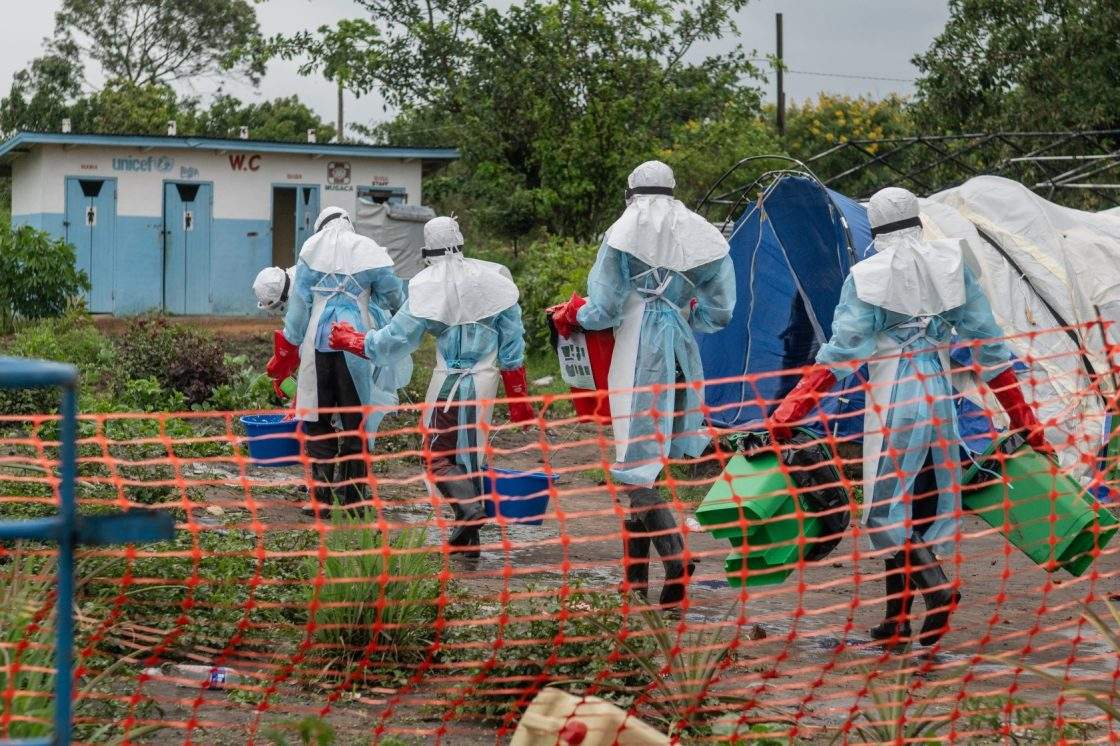
The air inside the isolation ward carries a specific, metallic weight. It smells of chlorine, sweat, and the sharp, chemical tang of heavy-duty disinfectants. Beneath that layer sits something older and more primal: the scent of a body shutting down under the assault of a virus that liquefies tissue from the inside out.
To the doctors and nurses wrapped in suffocating layers of personal protective equipment, this room is a frontline. It is a sterile, calculated fortress built to trap a monster. But to the family standing outside the plastic sheeting, peering through a fogged visor, this room is something else entirely. It is a prison. A place where their loved ones go to vanish into zippered rubber bags.
When Ebola strikes a community in the Democratic Republic of Congo, it does not just attack human T-cells. It fractures the unspoken contract between the living and the dead.
Then come the guns.
The Sound of Breaking Glass
Imagine a young man—let us call him Mathieu, a composite of the desperate sons who have stood outside these clinics. Mathieu’s father died two hours ago. To Mathieu, his father is not a biohazard. He is an elder, a protector, a man whose spirit cannot rest until his body is washed by his family, dressed in his finest clothes, and laid into the earth by the hands that loved him.
Instead, strangers in white space suits have sprayed the body with bleach. They have sealed it away. They say the body is hot. They say to touch it is to invite death into the entire village.
To a grieving mind, this does not sound like medicine. It sounds like a theft. It sounds like state-sponsored desecration.
When the gunfire shattered the windows of the clinic in the eastern Congo, it was not an act of random terrorism. It was the terrifying, inevitable explosion of grief turned inside out by a profound lack of trust. The men who stormed the facility with automatic weapons were not there to steal drugs or demand ransoms. They came for the corpses.
The bullets tore through plastic partitioning, sending nurses diving under metal gurneys. Sirens wailed, mixing with the shouting of men who believed, with every fiber of their being, that they were rescuing their kin from a desecration worse than death itself. By the time the smoke cleared, the attackers had taken what they came for, leaving behind a ruined sanctuary and a terrifyingly high probability that the virus would now multiply exponentially in the shadows.
The Hidden Engine of an Epidemic
Public health officials often talk about epidemics in numbers. They track transmission rates, incubation periods, and mortality statistics. But on the ground, an epidemic is governed entirely by human emotion. Fear, grief, and deep-seated suspicion are the true vectors of Ebola.
When an outbreak hits a region scarred by decades of civil war, political instability, and exploitation, the arrival of international medical teams is rarely met with uncritical relief. For years, the government or external forces brought violence. Suddenly, when a deadly virus appears, foreigners arrive with millions of dollars, high-tech gear, and a sudden, intense interest in the local population.
Consider how this looks from the outside. The sick go into the tents, and they rarely come out alive. When they die, their families are barred from touching them. Rumors spread like wildfire through the market stalls. The foreigners are harvesting organs. The virus is a hoax to bring in aid money. The doctors are killing the patients.
It is easy for an observer sitting in a comfortable living room thousands of miles away to dismiss these rumors as ignorance. It is an easy, arrogant trap to fall into. But these beliefs are born from a history of broken promises and systemic neglect. When people have been abandoned by the world for decades, they do not trust the world when it suddenly arrives offering help wrapped in biohazard suits.
The clash at the hospital is a manifestation of this deep cognitive disconnect. The medical teams view a deceased Ebola patient as a ticking biological bomb; the body’s viral load is at its absolute peak immediately after death. The family views that same body as an ancestral obligation.
When those two worldview collide, violence becomes the tragic, desperate language of the dispossessed.
The Tragedy of the Safe Burial
To understand why a family would risk a shootout to reclaim a body, you have to understand the ritual of the safe and dignified burial.
In many traditional Congolese cultures, the transition from life to death is a journey that requires community participation. The body must be prepared with reverence. Mourners kiss the forehead of the deceased. They wash the limbs. They sit with the body for days, sharing meals and stories.
When the World Health Organization implemented "safe and dignified burial" protocols during previous outbreaks, the emphasis was heavily on the "safe" and barely on the "dignified." Teams would arrive in communities like military units, seize bodies, spray them down, and bury them in unmarked graves without the family's presence.
The result? Communities stopped reporting cases. They hid their sick in the forest. They buried their dead at night, in secret, touching the highly infectious bodies in the dark, away from the eyes of the authorities. The very measures designed to stop the virus drove it deeper underground, allowing it to burn through families unseen until it was too late.
The attack on the hospital was not an isolated incident of lawlessness. It was the breaking point of a community pushed past its emotional threshold. The gunmen who breached the clinic doors were looking to assert control over the one thing they felt they had left: their right to honor their dead.
Shifting the Frontline
The solution to these violent standoffs does not lie in deploying more armed guards to protect the clinics. Adding more guns to a medical crisis only reinforces the narrative that the health response is an occupying army.
The real work—the agonizingly slow, unglamorous work—happens through dialogue. It requires medical teams to strip off the terrifying suits for an hour, sit under a mango tree with village elders, and listen. Not lecture. Listen.
Change only happens when the community is brought into the tent. In recent years, progressive anthropologists and local health workers have begun rewriting the protocol. If a family cannot touch the body, how can they still honor it?
The answers are deeply human. Can the family stand at a safe distance and watch through a clear plastic viewing window while a local religious leader performs the final rites? Can the body be wrapped in a traditional, beautiful shroud inside the body bag, rather than just being zipped into bleak black rubber? Can the family choose the burial site, and can they be the ones to shovel the earth onto the coffin using long-handled tools that keep them safe from contagion?
When these concessions are made, the tension dissipates. The hospital stops looking like a slaughterhouse and starts looking like a place of care.
But these shifts take time, and a virus does not wait for cultural negotiations to conclude. It moves with terrifying speed, capitalizing on every mistake, every misunderstanding, and every burst of violence.
The tragedy of the raid on the hospital is that every person involved believed they were doing the right thing. The doctors were trying to save the living by containing the dead. The gunmen were trying to save the dead from being abandoned in the dark.
As the sun rose over the fractured clinic the next morning, the broken glass glinted in the dirt, a quiet testament to a war fought on the wrong battlefield. The stolen bodies were gone, carried back into the hills to be buried according to tradition. Somewhere in those hills, in a candlelit room filled with weeping relatives, the invisible monster was already finding its next host.